Mirbolouk Mohammadhassan, Boakye Ellen, Obisesan Olufunmilayo, Osei Albert D, Dzaye Omar, Osuji Ngozi, Erhabor John, Stokes Andrew C, El-Shahawy Omar, Rodriguez Carlos J, Hirsch Glenn A, Benjamin Emelia J, DeFilippis Andrew P, Marie Robertson Rose, Bhatnagar Aruni, Blaha Michael J
Department of Internal Medicine, Yale School of Medicine, New Haven, CT, USA.
Johns Hopkins Ciccarone Center for the Prevention of Cardiovascular Disease, Baltimore, MD, USA.
Prev Med Rep. 2022 Jul 22;29:101925. doi: 10.1016/j.pmedr.2022.101925. eCollection 2022 Oct.
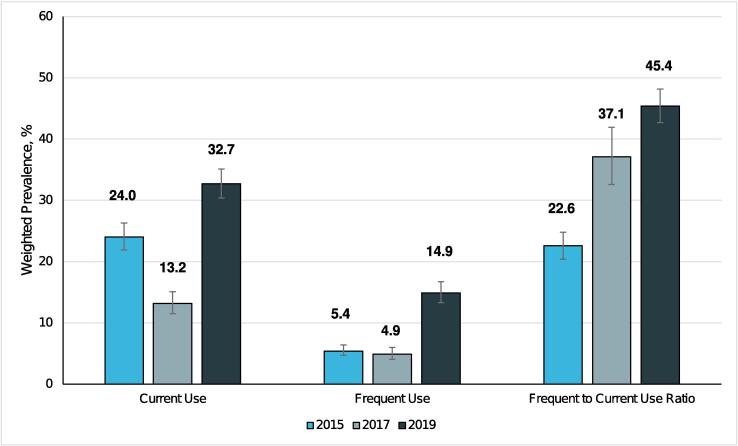
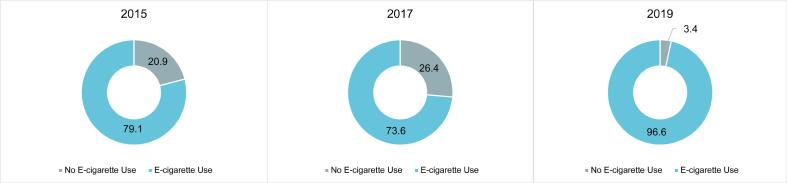
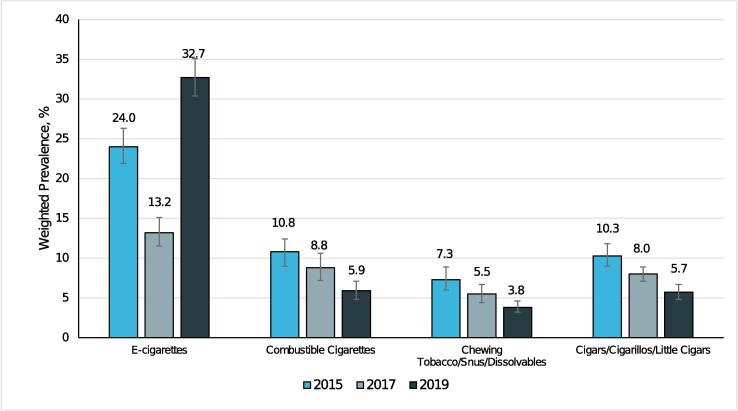
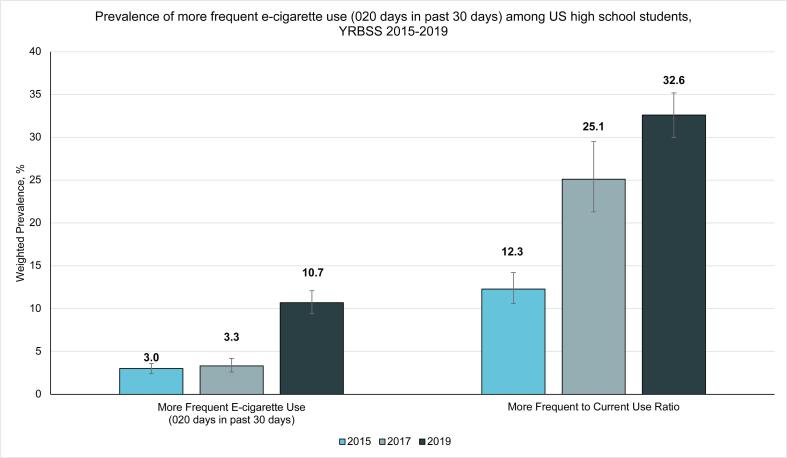
Detailed description of the prevalence and sources of e-cigarettes among youth is needed to inform effective regulatory policies. We used the Youth Risk Behavior Surveillance System data (2015-2019) to assess trends in current (past-30-day-use) and frequent (≥10 days in past-30-days) e-cigarette use among United States high schoolers before the COVID-19 pandemic. First, we assessed trends overall and then stratified by participants' sociodemographic characteristics, use of other tobacco products, and experiences of psychosocial stress. We also evaluated past year quit attempts and the changing sources of e-cigarettes. Our sample size was 41,021 (15,356-2015; 12,873-2017; 12,792-2019). The prevalence of current e-cigarette use increased from 24.0% (95%CI:21.9%-26.3%) in 2015 to 32.7% (30.4%-35.1%) in 2019. The proportion of current users who reported frequent use also increased significantly from 22.6% (20.4%-24.8%) to 45.4% (42.7%-48.2%). Thus, an increasing proportion of US high school students who use e-cigarettes reported frequent use, indicating greater nicotine dependence. The increase in current and frequent e-cigarette use was more pronounced in youth who reported other substance use and psychosocial stressors such as bullying. Between 2017 and 2019, there was a decline in the proportion of youth who bought e-cigarettes online (6.9% to 3.2%) or from convenience stores (22.0% to 16.6%). Conversely, there was an increase in the proportion who borrowed (34.5% to 40.1%) or purchased e-cigarettes through other people (10.7% to 18.0%), indicating that most youth are evading age-related restrictions by obtaining e-cigarettes from other people. Finally, a considerable proportion of youth tobacco users are making quit attempts; 47.6% (45.1%-50.1%) in 2019.
为制定有效的监管政策,需要详细描述青少年电子烟的流行情况和来源。我们使用青少年风险行为监测系统数据(2015 - 2019年)评估了新冠疫情大流行之前美国高中生当前(过去30天内使用)和频繁(过去30天内≥10天使用)电子烟使用的趋势。首先,我们评估了总体趋势,然后按参与者的社会人口学特征、其他烟草产品的使用情况以及心理社会压力经历进行分层。我们还评估了过去一年的戒烟尝试以及电子烟来源的变化。我们的样本量为41,021(2015年为15,356人;2017年为12,873人;2019年为12,792人)。当前电子烟使用的流行率从2015年的24.0%(95%置信区间:21.9% - 26.3%)增至2019年的32.7%(30.4% - 35.1%)。报告频繁使用的当前使用者比例也从22.6%(20.4% - 24.8%)显著增至45.4%(42.7% - 48.2%)。因此,使用电子烟的美国高中生中报告频繁使用的比例不断增加,表明尼古丁依赖程度更高。当前和频繁使用电子烟的增加在报告使用其他物质以及经历如欺凌等心理社会压力源的青少年中更为明显。2017年至2019年期间,在网上购买电子烟的青少年比例(从6.9%降至3.2%)以及从便利店购买电子烟的青少年比例(从22.0%降至16.6%)有所下降。相反,通过他人借用(从34.5%增至40.1%)或购买电子烟的青少年比例有所增加(从10.7%增至18.0%),这表明大多数青少年通过从他人处获取电子烟来规避与年龄相关的限制。最后,相当比例的青少年烟草使用者正在尝试戒烟;2019年为47.6%(45.1% - 50.1%)。