Stanford Prevention Research Center, Department of Medicine, Stanford University, Stanford, California.
Keck School of Medicine, Department of Preventive Medicine, University of Southern California, Los Angeles.
JAMA Netw Open. 2020 Feb 5;3(2):e1921513. doi: 10.1001/jamanetworkopen.2019.21513.
Understanding the prevalence and symptoms of electronic cigarette (e-cigarette) dependence and its association with future e-cigarette use among youth may help to guide pediatric clinical services and health policy.
To examine the cross-sectional prevalence and symptom presentation of e-cigarette dependence and to determine whether e-cigarette dependence is associated with subsequent e-cigarette use patterns 6 months later among youth with baseline past-year e-cigarette use.
DESIGN, SETTING, AND PARTICIPANTS: This prospective cohort study used baseline and 6-month follow-up surveys among students in the 12th grade during the 2016 to 2017 school year who reported any past-year e-cigarette use. Surveys were conducted on site in 10 high schools in Los Angeles, California. Data were analyzed from March 2019 to December 2019.
Self-reported checklist of 10 tobacco product dependence symptoms reflecting loss of control over use, craving or urge, or withdrawal symptoms while abstinent, completed at baseline and administered separately for e-cigarettes and combustible cigarettes. Reporting 1 or more symptoms indicated a positive screen for dependence. Vaping continuation, defined as any past 6-month vaping, and past 30-day nicotine vaping days (range, 0-30), sessions per vaping day (range, 0-20), and puffs per session (range, 0-20) at 6-month follow-up were assessed.
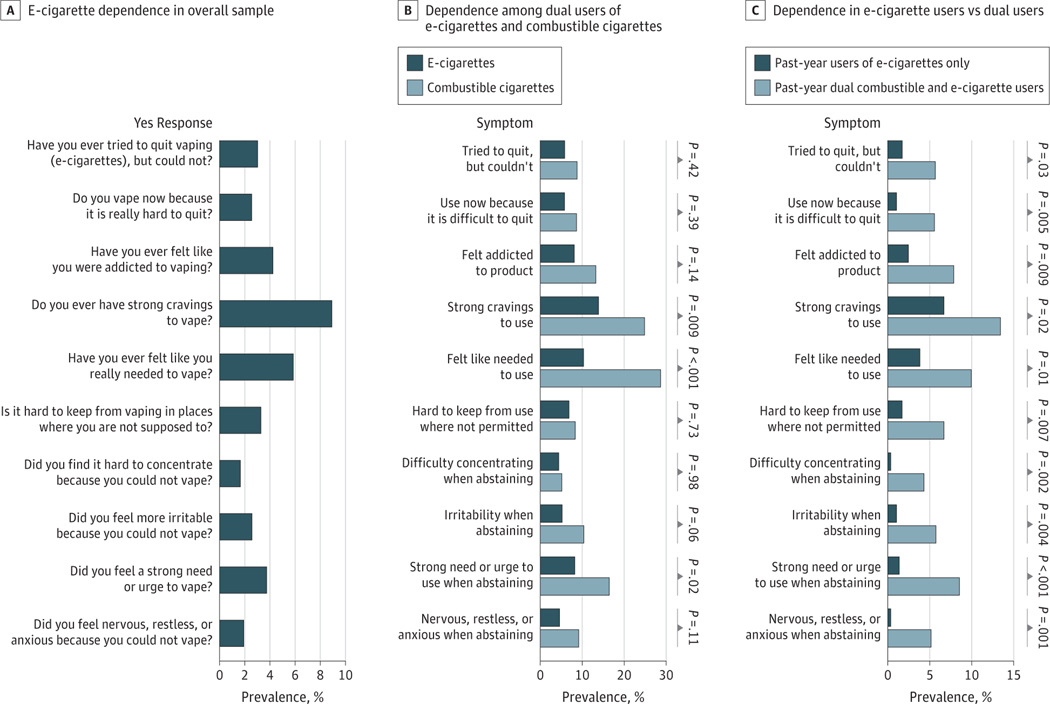
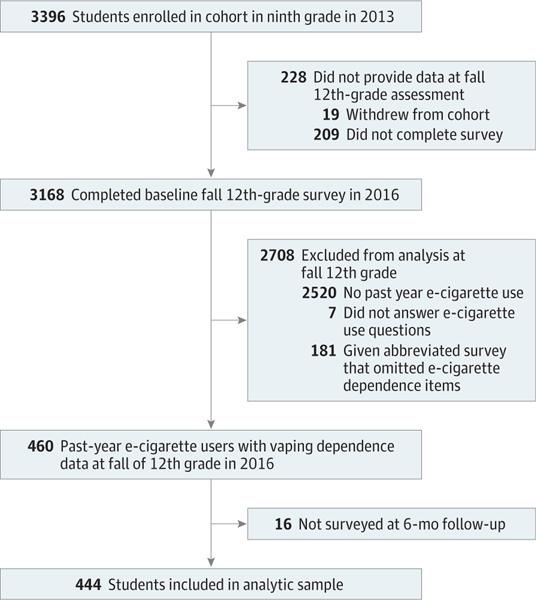
Among 3168 twelfth-grade students who completed the baseline survey, 444 youths (mean [SD] age, 17.48 [0.39] years; 217 [48.9%] female) reported past-year e-cigarette use. Among these, 52 youths (11.7%) reported at least 1 e-cigarette dependence symptom. Among youth who reported past-year dual e-cigarette and combustible cigarette use, combustible cigarette dependence, reported by 43 youths (29.7%), was more prevalent than e-cigarette dependence, which was reported by 24 youths (16.4%). The most common symptoms, craving, urge, and need to use, and least common symptoms, abstinence-related concentration and emotional problems, were similar in both combustible and e-cigarette dependence. The prevalence of e-cigarette dependence was higher among youth who reported vaping in the past month than among those who did not (41 youths [17.6%] vs 11 youths [5.2%]; P < .001) and among youth who used e-cigarettes with nicotine than among those who used e-cigarettes without nicotine (42 youths [15.2%] vs 10 youths [6.0%]; P = .004). After adjusting for baseline vaping and e-cigarette dependence risk propensity scores, baseline e-cigarette dependence symptom status was associated with vaping continuation (adjusted odds ratio, 2.30 [95% CI, 1.07-4.94]; P = .02) and past 30-day number of nicotine vaping days (adjusted rate ratio, 2.17 [95% CI, 1.44-3.28]; P < .001), vaping sessions per day (adjusted rate ratio, 2.41 [95% CI, 1.52-3.83]; P < .001), and puffs per session (adjusted rate ratio, 1.70 [95% CI, 1.09-2.66]; P = .02) at 6-month follow-up.
These findings suggest that e-cigarette dependence may be an expression of tobacco use disorder associated with future use persistence and escalation among youth. Electronic cigarette dependence may be a behavioral health consequence of adolescent vaping that warrants consideration in pediatric patient care and public health policy.
了解电子烟(电子烟)依赖的流行率和症状及其与青少年未来电子烟使用的关系,可能有助于指导儿科临床服务和卫生政策。
检查电子烟依赖的横断面流行率和症状表现,并确定在基线过去一年有电子烟使用史的青少年中,电子烟依赖是否与 6 个月后的后续电子烟使用模式相关。
设计、地点和参与者:这是一项前瞻性队列研究,在 2016 年至 2017 学年期间,对 10 所加利福尼亚州洛杉矶高中的 12 年级学生进行了基线和 6 个月随访调查,这些学生报告了过去一年有任何电子烟使用史。调查是在现场进行的。数据分析于 2019 年 3 月至 2019 年 12 月进行。
自我报告的检查表列出了 10 种烟草产品依赖症状,反映了使用控制、渴望或冲动或戒断症状的丧失,同时禁欲,分别在基线时和电子烟和可燃香烟时进行管理。报告 1 个或多个症状表明存在依赖阳性筛查。6 个月随访时评估的电子烟持续使用情况定义为过去 6 个月内的任何电子烟使用,过去 30 天内尼古丁电子烟使用天数(范围,0-30)、每天电子烟使用次数(范围,0-20)和每次电子烟使用次数(范围,0-20)。
在完成基线调查的 3168 名 12 年级学生中,有 444 名学生(平均[标准差]年龄为 17.48[0.39]岁;217[48.9%]名女性)报告过去一年有电子烟使用史。在这些学生中,有 52 名学生(11.7%)报告至少有 1 种电子烟依赖症状。在报告过去一年同时使用电子烟和可燃香烟的青少年中,有 43 名(29.7%)报告有可燃香烟依赖,而有 24 名(16.4%)报告有电子烟依赖。在可燃和电子烟依赖中,最常见的症状是渴望、冲动和需要使用,而最不常见的症状是与禁欲相关的注意力和情绪问题。在过去一个月内吸电子烟的青少年中,电子烟依赖的患病率高于未吸电子烟的青少年(41 名[17.6%]比 11 名[5.2%];P < .001),吸含尼古丁电子烟的青少年中电子烟依赖的患病率高于吸不含尼古丁电子烟的青少年(42 名[15.2%]比 10 名[6.0%];P = .004)。在校正基线电子烟使用和电子烟依赖风险倾向评分后,基线电子烟依赖症状状况与电子烟持续使用相关(调整后的优势比,2.30[95%置信区间,1.07-4.94];P = .02)和过去 30 天内尼古丁电子烟使用天数(调整后的比率比,2.17[95%置信区间,1.44-3.28];P < .001),每天电子烟使用次数(调整后的比率比,2.41[95%置信区间,1.52-3.83];P < .001)和每次电子烟使用次数(调整后的比率比,1.70[95%置信区间,1.09-2.66];P = .02)在 6 个月随访时。
这些发现表明,电子烟依赖可能是与青少年未来使用持久性和升级相关的烟草使用障碍的一种表现。电子烟依赖可能是青少年吸电子烟的行为健康后果之一,值得在儿科患者护理和公共卫生政策中考虑。