Xu Jian, Ma Yingli, Mei Haibing, Wang Qimin
Department of Radiology, Ningbo Women & Children's Hospital, Ningbo, People's Republic of China.
Department of Neurology, Ningbo Hospital of Traditional Chinese Medicine, Ningbo, People's Republic of China.
Int J Gen Med. 2022 Jul 22;15:6279-6288. doi: 10.2147/IJGM.S372154. eCollection 2022.
The status of pelvic lymph node (PLN) metastasis affects treatment and prognosis plans in patients with cervical cancer. However, it is hard to be diagnosed in clinical practice.
The present study aimed to evaluate the diagnostic value of multimodal magnetic resonance imaging (MRI) in discriminating between metastatic and non-metastatic pelvic lymph nodes (PLNs) in cervical cancer.
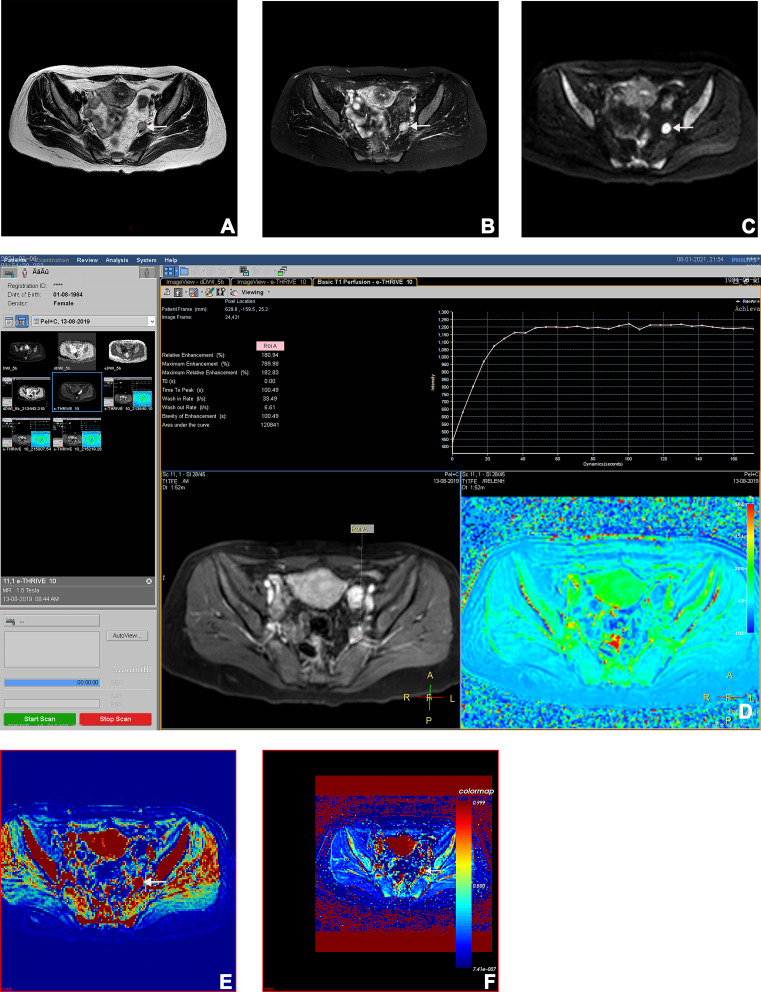
This retrospective study analyzed MRIs of 209 PLNs in 25 women with pathologically proven cervical cancer. All PLNs had been assessed by pre-treatment multimodal MRIs, and their status was finally confirmed by histopathology. In conventional MRI, lymph node characteristics were compared between metastatic and non-metastatic PLNs. Signal intensity, time-intensity curve (TIC) patterns minimal and mean apparent diffusion coefficients (ADC) were compared between them in DWI. In DCE-MRI, quantitative (K, K and V) analyses were performed on DCE-MRI sequences, and their predictive values were analyzed by ROC curves.
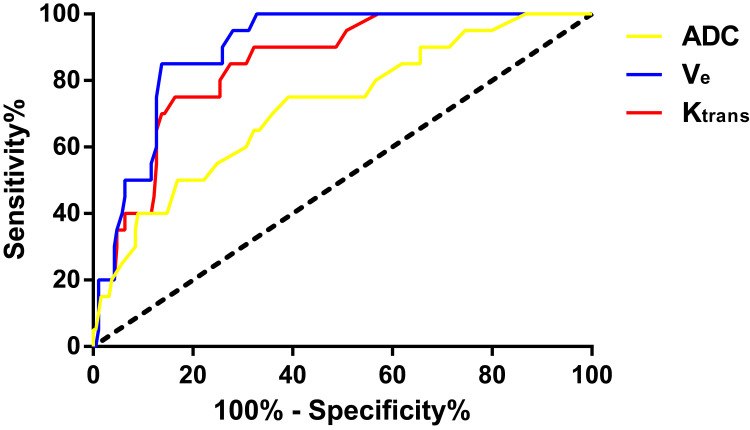
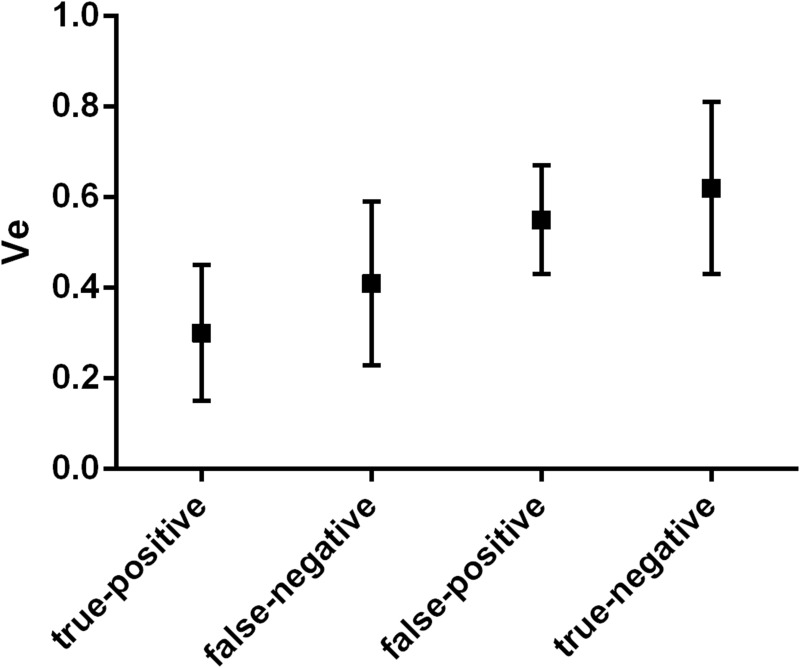
Of 209 PLNs, 22 (10.53%) were metastases and 187 (89.47%) were non-metastases at histopathologic examination. Considering a comparison of lymph node characteristics, the short axis size, the long axis size, and the boundary differed significantly between the two groups (<0.05).The differences in ADC, TIC types, K and V between metastatic and non-metastatic PLNs were significant as well (<0.05). The good diagnostic performance of multimodal MRI was shown in discriminating between metastatic and non-metastatic PLNs, with the sensitivity of 85.0% (17/20), specificity of 97.3% (184/189), and accuracy of 96.2% (201/209). ROC analyses showed that the diagnostic accuracy of ADC, K and V for discriminating between metastatic and non-metastatic PLNs in cervical cancer was 83.7%, 91.4%, and 92.4% with the cut-off values of 0.72 × 10mm/s, 0.52 min, and 0.53 min, respectively.
Multimodal MRI showed good diagnostic performance in determining PLN status in cervical cancer.
盆腔淋巴结(PLN)转移状态影响宫颈癌患者的治疗和预后方案。然而,在临床实践中很难对其进行诊断。
本研究旨在评估多模态磁共振成像(MRI)在鉴别宫颈癌转移性和非转移性盆腔淋巴结(PLN)中的诊断价值。
这项回顾性研究分析了25例经病理证实为宫颈癌的女性患者的209个PLN的MRI图像。所有PLN均在治疗前通过多模态MRI进行评估,其状态最终通过组织病理学确认。在传统MRI中,比较转移性和非转移性PLN的淋巴结特征。在弥散加权成像(DWI)中,比较它们之间的信号强度、时间-强度曲线(TIC)类型、最小表观扩散系数(ADC)和平均表观扩散系数。在动态对比增强磁共振成像(DCE-MRI)中,对DCE-MRI序列进行定量(Ktrans、Kep和V)分析,并通过ROC曲线分析其预测价值。
在209个PLN中,组织病理学检查显示22个(10.53%)为转移灶,187个(89.47%)为非转移灶。考虑淋巴结特征的比较,两组之间的短轴大小、长轴大小和边界存在显著差异(P<0.05)。转移性和非转移性PLN之间的ADC、TIC类型、Ktrans和Kep差异也具有统计学意义(P<0.05)。多模态MRI在鉴别转移性和非转移性PLN方面表现出良好的诊断性能,敏感性为85.0%(17/20),特异性为97.3%(184/189),准确性为96.2%(201/209)。ROC分析显示,ADC、Ktrans和Kep鉴别宫颈癌转移性和非转移性PLN的诊断准确性分别为83.7%、91.4%和92.4%,截断值分别为0.72×10⁻³mm²/s、0.52 min⁻¹和0.53 min⁻¹。
多模态MRI在确定宫颈癌PLN状态方面表现出良好的诊断性能。