Department of Evidence-Based Medicine, Southwest Medical University, Luzhou, China.
Department of Rheumatology and Immunology, Affiliated Hospital of Southwest Medical University, Luzhou, China.
Front Immunol. 2022 Jul 14;13:891328. doi: 10.3389/fimmu.2022.891328. eCollection 2022.
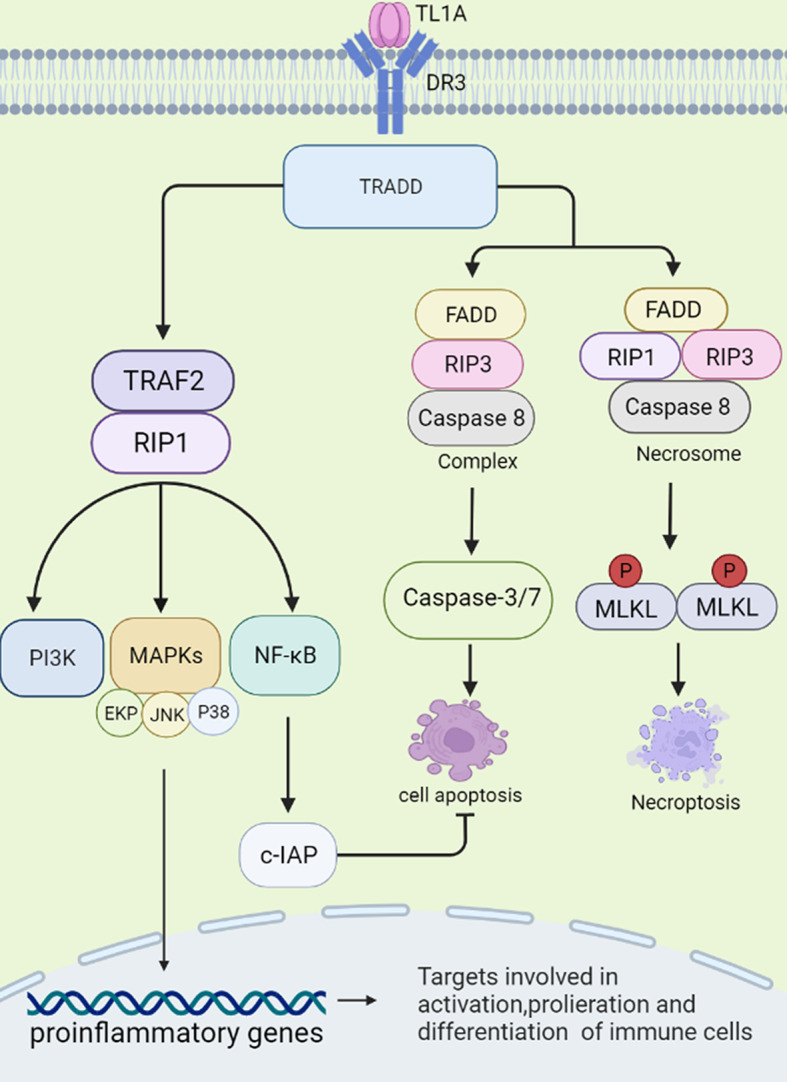
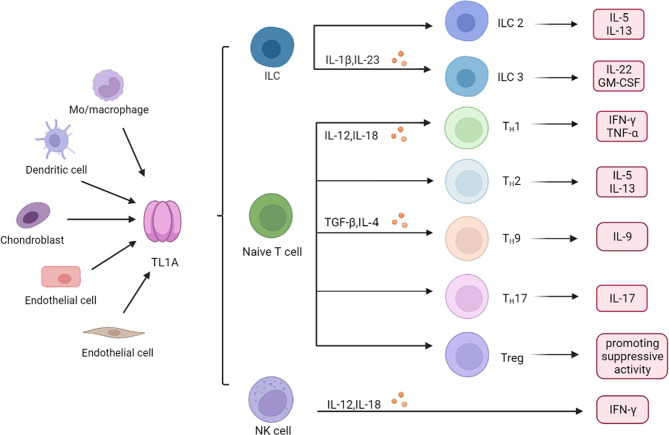
TL1A, also called TNFSF15, is a member of tumor necrosis factor family. It is expressed in different immune cell, such as monocyte, macrophage, dendritic cell, T cell and non-immune cell, for example, synovial fibroblast, endothelial cell. TL1A competitively binds to death receptor 3 or decoy receptor 3, providing stimulatory signal for downstream signaling pathways, and then regulates proliferation, activation, apoptosis of and cytokine, chemokine production in effector cells. Recent findings showed that TL1A was abnormally expressed in autoimmune diseases, including rheumatoid arthritis, inflammatory bowel disease, psoriasis, primary biliary cirrhosis, systemic lupus erythematosus and ankylosing spondylitis. and studies further demonstrated that TL1A was involved in development and pathogenesis of these diseases. In this study, we comprehensively discussed the complex immunological function of TL1A and focused on recent findings of the pleiotropic activity conducted by TL1A in inflammatory autoimmune disease. Finish of the study will provide new ideas for developing therapeutic strategies for these diseases by targeting TL1A.
TL1A,也称为 TNFSF15,是肿瘤坏死因子家族的一员。它在不同的免疫细胞中表达,如单核细胞、巨噬细胞、树突状细胞、T 细胞和非免疫细胞,例如滑膜成纤维细胞、内皮细胞。TL1A 竞争性地结合死亡受体 3 或诱饵受体 3,为下游信号通路提供刺激信号,然后调节效应细胞的增殖、激活、凋亡以及细胞因子、趋化因子的产生。最近的研究发现,TL1A 在自身免疫性疾病中异常表达,包括类风湿关节炎、炎症性肠病、银屑病、原发性胆汁性肝硬化、系统性红斑狼疮和强直性脊柱炎。进一步的研究表明,TL1A 参与了这些疾病的发展和发病机制。在本研究中,我们全面讨论了 TL1A 的复杂免疫功能,并重点介绍了 TL1A 在炎症性自身免疫性疾病中的多效性活性的最新发现。这项研究为通过靶向 TL1A 为这些疾病开发治疗策略提供了新的思路。