First School Clinical Medicine, Shaanxi University of Traditional Chinese Medicine, Xianyang 712046, China.
Xi'an Traditional Chinese Medicine Hospital, Xi'an 710016, China.
Comput Math Methods Med. 2022 Jul 20;2022:6836942. doi: 10.1155/2022/6836942. eCollection 2022.
To examine the clinical efficacy and safety of Vitamin D in the treatment of ulcerative colitis in a systematic manner.
RCT studies on Vitamin D in the treatment of ulcerative colitis were searched from CNKI, Wanfang Data, PubMed, Cochrane Library, and Web of Science databases. RevMan 5.4 software was used for analysis.
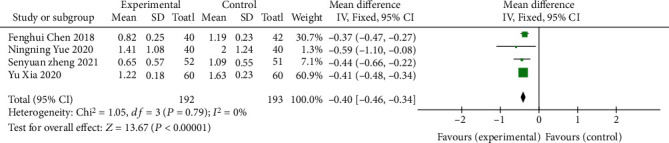
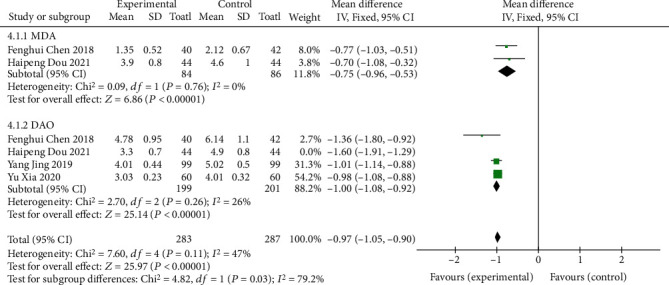
10 articles were included, including 1077 patients. Meta-analysis results showed that when clinical efficacy was used as the outcome index, the clinical efficacy of the oral vitamin group was higher than that of the conventional treatment group (OR = 4.07, 95% CI 2.64-6.27), and the difference was statistically significant ( = 6.38, < 0.00001). When the Mayo risk score was used as the outcome index, the difference was statistically significant, indicating that oral Vitamin D significantly reduced the Mayo risk score (MD: -0.41, CI = (-0.47, -0.34), = 13.09, < 0.00001). Using the intestinal mucosal barrier as the outcome index, the results showed that (1) the MDA group (MD = -0.75, 95% CI (-0.96-0.53), < 0.00001), (2) the DAO group (MD = -1.17, 95% CI (-1.39-0.95), < 0.00001), and the Vitamin D group could effectively improve intestinal mucosal barrier function after sensitivity analysis (MD = -1.00, 95% CI (-1.08-0.92), < 0.00001). When inflammatory factors were used as outcome indicators, IL-6, TNF-, and CRP groups had statistical significance (MD = -4.50, 95% CI (-5.13-3.87), < 0.00001); MD = -7.27, 95% CI (18.96-5.58), < 0.00001; and MD = -1.49, 95% CI (-1.76-1.23), < 0.00001, respectively). When the incidence of adverse reactions was used as the outcome indicator (OR = 0.73, 95% CI (0.34-1.32), = 0.23), there was no significant difference between the two groups.
Vitamin D combined with mesalazine is effective in the treatment of ulcerative colitis, by improving the Mayo score and intestinal barrier function, and reducing inflammatory factors, with no significant safety difference. However, due to the quality of the included researches, more RCT researches needed to provide sufficient evidence to support clinical application. This study is registered with INPLASY 202250044.
系统评价维生素 D 治疗溃疡性结肠炎的临床疗效和安全性。
计算机检索中国知网、万方数据、PubMed、Cochrane 图书馆、Web of Science 数据库中关于维生素 D 治疗溃疡性结肠炎的随机对照试验(RCT),采用 RevMan 5.4 软件进行分析。
共纳入 10 篇文献,包括 1077 例患者。Meta 分析结果显示,以临床疗效为结局指标时,口服维生素组的临床疗效优于常规治疗组(OR = 4.07,95%CI 2.646.27),差异有统计学意义( = 6.38,< 0.00001)。以梅奥风险评分(Mayo risk score)为结局指标时,差异有统计学意义,表明口服维生素 D 可显著降低梅奥风险评分(MD:-0.41,CI = (-0.47,-0.34), = 13.09,< 0.00001)。以肠黏膜屏障为结局指标时,结果显示(1)MDA 组(MD = -0.75,95%CI (-0.96-0.53),< 0.00001),(2)DAO 组(MD = -1.17,95%CI (-1.390.95),< 0.00001),且经敏感性分析后,维生素 D 组能有效改善肠黏膜屏障功能(MD = -1.00,95%CI (-1.080.92),< 0.00001)。以炎症因子为结局指标时,IL-6、TNF-α 和 CRP 组均有统计学意义(MD = -4.50,95%CI (-5.133.87),< 0.00001);MD = -7.27,95%CI (18.965.58),< 0.00001;MD = -1.49,95%CI (-1.76-1.23),< 0.00001)。以不良反应发生率为结局指标时(OR = 0.73,95%CI (0.341.32), = 0.23),两组间差异无统计学意义。
维生素 D 联合美沙拉嗪治疗溃疡性结肠炎可提高临床疗效,改善梅奥评分和肠屏障功能,降低炎症因子水平,安全性差异无统计学意义。但由于纳入研究质量较低,需要更多高质量 RCT 研究提供充分证据支持临床应用。本研究已在 INPLASY 202250044 注册。