Ohashi Eri, Hayakawa Itaru, Tsutsumi Yoshiyuki, Kamei Koichi, Ide Kentaro, Abe Yuichi
Division of Neurology, National Center for Child Health and Development, 2-10-1 Okura, Setagaya-ku, Tokyo 157-8535, Japan.
Department of Radiology, National Center for Child Health and Development, Tokyo, Japan.
Radiol Case Rep. 2022 Jul 27;17(10):3475-3480. doi: 10.1016/j.radcr.2022.07.024. eCollection 2022 Oct.
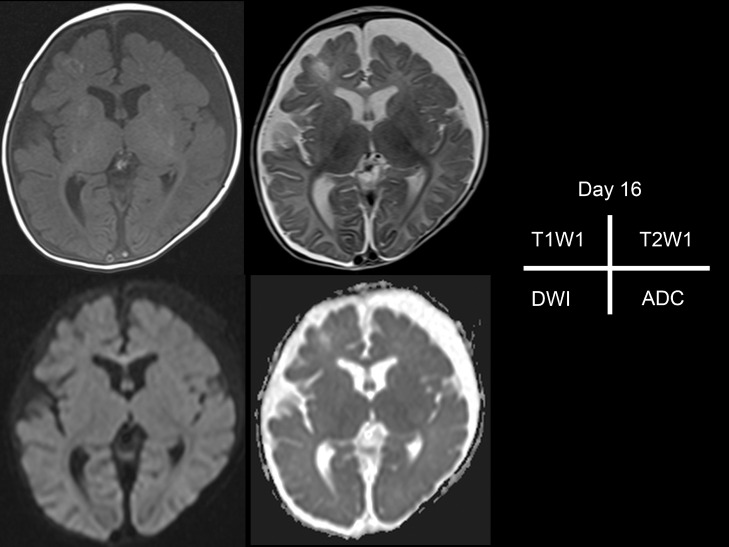
Central-variant posterior reversible encephalopathy syndrome is an atypical subtype of posterior reversible encephalopathy syndrome that occurs during rapid fluctuations in blood pressure, leading to cerebrovascular autoregulatory failure and endothelial dysfunction. Few reports have described posterior reversible encephalopathy syndrome in infants. A 4-month-old girl, who was diagnosed a month before with hypoxic ischemic encephalopathy due to sudden cardiac arrest, showed persistent renovascular hypertension with a systolic blood pressure of 200 mmHg. Computed tomography of the head revealed a new-onset low-attenuation area in the bilateral basal ganglia, and computed tomography of the trunk revealed severe long-segment narrowing of the abdominal aorta encompassing the bilateral renal arteries. She was treated with antihypertensive drugs and peritoneal dialysis. Follow-up imaging after blood pressure stabilization showed resolution of the low-attenuation area in the bilateral basal ganglia. We diagnosed her basal ganglia lesions as central-variant posterior reversible encephalopathy syndrome. She suffered from neurological sequelae attributable to hypoxic ischemic encephalopathy but showed no evidence of basal ganglia dysfunction. Here, we report a case of infantile central-variant posterior reversible encephalopathy syndrome involving bilateral basal ganglia lesions with mid-aortic syndrome. The differential diagnosis of infantile symmetric bilateral basal ganglia lesions is broad and includes genetic, acquired metabolic or toxic, infectious, inflammatory, vascular, and neoplastic pathologies. Among them, central-variant posterior reversible encephalopathy syndrome is rare but important because neurological prognosis may be favorable, and specific treatment, such as administration of antihypertensive drugs or discontinuation of drugs that induce posterior reversible encephalopathy syndrome, is possible.
中枢型变异型后部可逆性脑病综合征是后部可逆性脑病综合征的一种非典型亚型,发生于血压快速波动时,导致脑血管自动调节功能衰竭和内皮功能障碍。关于婴儿期后部可逆性脑病综合征的报道较少。一名4个月大的女孩,1个月前因心脏骤停被诊断为缺氧缺血性脑病,表现为持续性肾血管性高血压,收缩压达200 mmHg。头颅计算机断层扫描显示双侧基底节区出现新发低密度区,躯干计算机断层扫描显示腹主动脉严重长节段狭窄,累及双侧肾动脉。她接受了降压药物治疗和腹膜透析。血压稳定后的随访影像学检查显示双侧基底节区低密度区消失。我们将她的基底节病变诊断为中枢型变异型后部可逆性脑病综合征。她患有缺氧缺血性脑病所致的神经后遗症,但未显示基底节功能障碍的证据。在此,我们报告一例婴儿期中枢型变异型后部可逆性脑病综合征,累及双侧基底节病变并伴有主动脉中段综合征。婴儿期对称性双侧基底节病变的鉴别诊断范围广泛,包括遗传、后天代谢性或中毒性、感染性、炎症性、血管性和肿瘤性病变。其中,中枢型变异型后部可逆性脑病综合征罕见但重要,因为神经预后可能良好,且有可能进行特定治疗,如给予降压药物或停用诱发后部可逆性脑病综合征的药物。