Department of Environmental Sciences, COMSATS University Islamabad, Vehari Campus, Islamabad, 61100, Pakistan.
Asian Disaster Preparedness Center (ADPC), Bangkok, Thailand.
Sci Rep. 2022 Aug 1;12(1):13210. doi: 10.1038/s41598-022-17454-y.
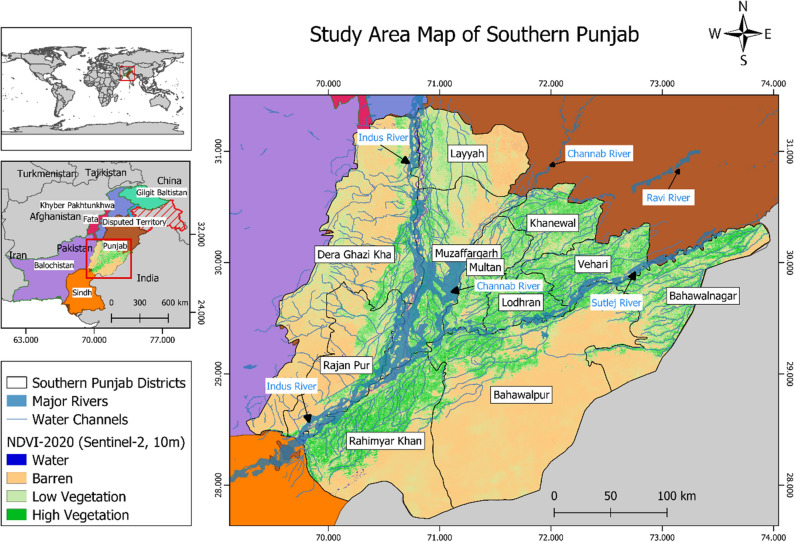
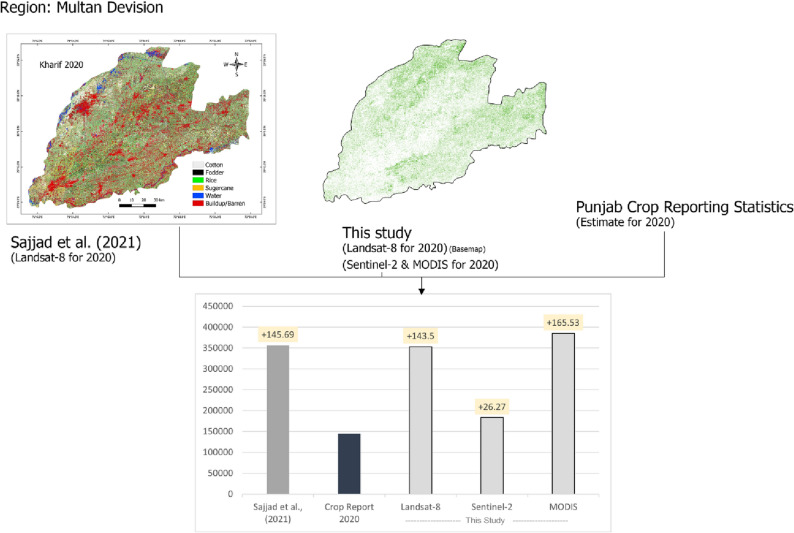
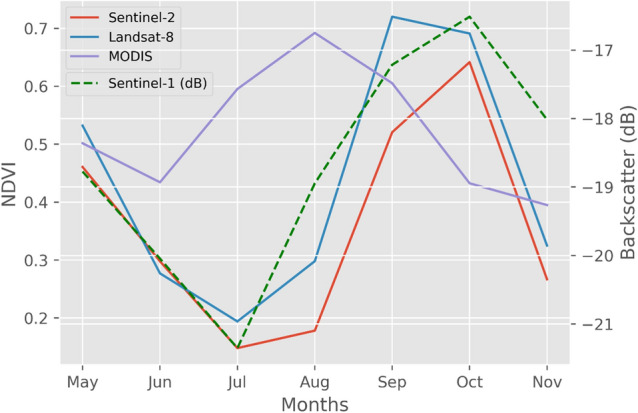
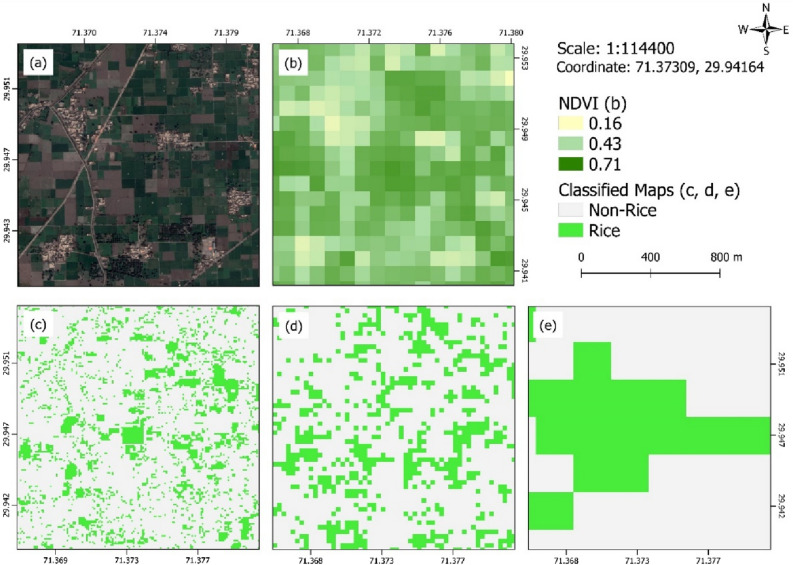
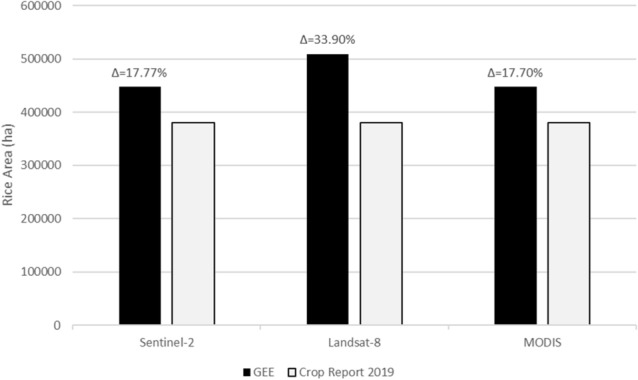
Timely and accurate estimation of rice-growing areas and forecasting of production can provide crucial information for governments, planners, and decision-makers in formulating policies. While there exists studies focusing on paddy rice mapping, only few have compared multi-scale datasets performance in rice classification. Furthermore, rice mapping of large geographical areas with sufficient accuracy for planning purposes has been a challenge in Pakistan, but recent advancements in Google Earth Engine make it possible to analyze spatial and temporal variations within these areas. The study was carried out over southern Punjab (Pakistan)-a region with 380,400 hectares devoted to rice production in year 2020. Previous studies support the individual capabilities of Sentinel-2, Landsat-8, and Moderate Resolution Imaging Spectroradiometer (MODIS) for paddy rice classification. However, to our knowledge, no study has compared the efficiencies of these three datasets in rice crop classification. Thus, this study primarily focuses on comparing these satellites' data by estimating their potential in rice crop classification using accuracy assessment methods and area estimation. The overall accuracies were found to be 96% for Sentinel-2, 91.7% for Landsat-8, and 82.6% for MODIS. The F1-Scores for derived rice class were 83.8%, 75.5%, and 65.5% for Sentinel-2, Landsat-8, and MODIS, respectively. The rice estimated area corresponded relatively well with the crop statistics report provided by the Department of Agriculture, Punjab, with a mean percentage difference of less than 20% for Sentinel-2 and MODIS and 33% for Landsat-8. The outcomes of this study highlight three points; (a) Rice mapping accuracy improves with increase in spatial resolution, (b) Sentinel-2 efficiently differentiated individual farm level paddy fields while Landsat-8 was not able to do so, and lastly (c) Increase in rice cultivated area was observed using satellite images compared to the government provided statistics.
及时准确地估算水稻种植面积和预测产量,可以为政府、规划者和决策者提供制定政策的关键信息。虽然已经有研究专注于稻田制图,但很少有研究比较过多尺度数据集在水稻分类中的性能。此外,对于规划目的而言,对巴基斯坦这样的大面积地区进行准确的水稻制图一直是一个挑战,但谷歌地球引擎的最新进展使得分析这些地区的时空变化成为可能。该研究在巴基斯坦南部旁遮普省进行,该地区 2020 年有 38 万公顷用于水稻生产。之前的研究支持 Sentinel-2、Landsat-8 和中等分辨率成像光谱仪(MODIS)在稻田分类方面的单独能力。然而,据我们所知,没有研究比较过这三个数据集在水稻作物分类中的效率。因此,本研究主要侧重于通过使用精度评估方法和面积估算来比较这些卫星数据,以评估它们在水稻作物分类中的潜力。Sentinel-2 的总体精度为 96%,Landsat-8 的总体精度为 91.7%,MODIS 的总体精度为 82.6%。Sentinel-2、Landsat-8 和 MODIS 生成的水稻分类的 F1 分数分别为 83.8%、75.5%和 65.5%。与旁遮普省农业部提供的作物统计报告相比,估算的水稻面积相对吻合,Sentinel-2 和 MODIS 的平均百分比差异小于 20%,而 Landsat-8 的平均百分比差异为 33%。本研究的结果突出了三点:(a)随着空间分辨率的提高,水稻制图精度提高;(b)Sentinel-2 能够有效地区分单个农田级别的稻田,而 Landsat-8 则不能;(c)与政府提供的统计数据相比,使用卫星图像观察到水稻种植面积增加。