Nanotechnology Department, Faculty of Science, Urmia University, Urmia, Iran.
Sci Rep. 2022 Aug 1;12(1):13179. doi: 10.1038/s41598-022-17616-y.
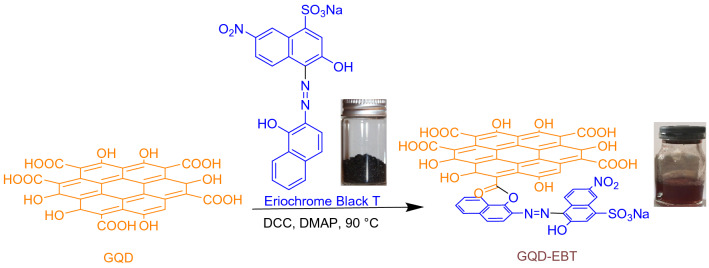
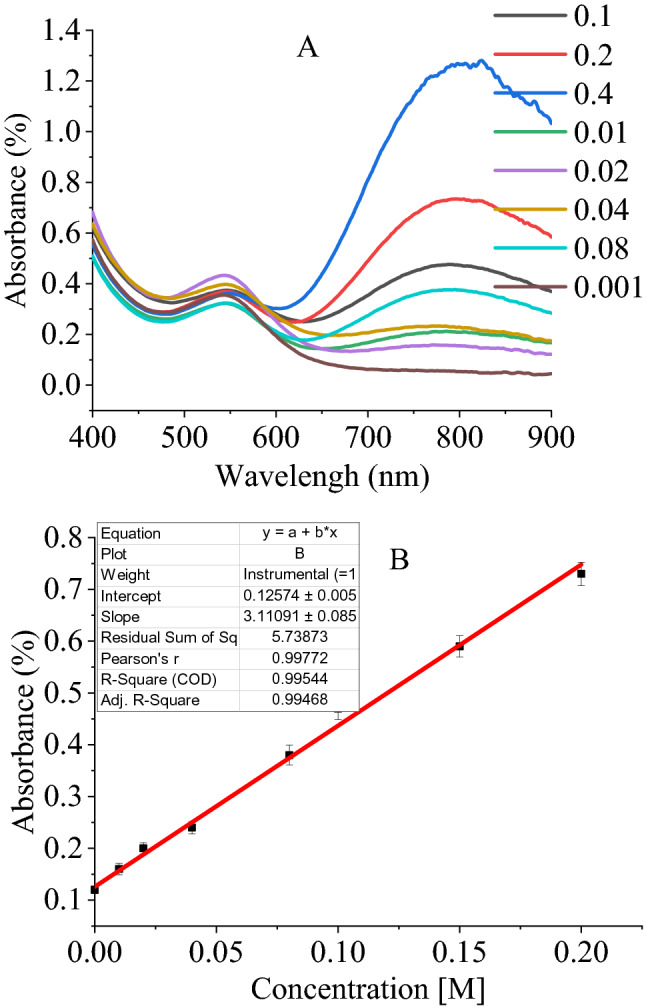
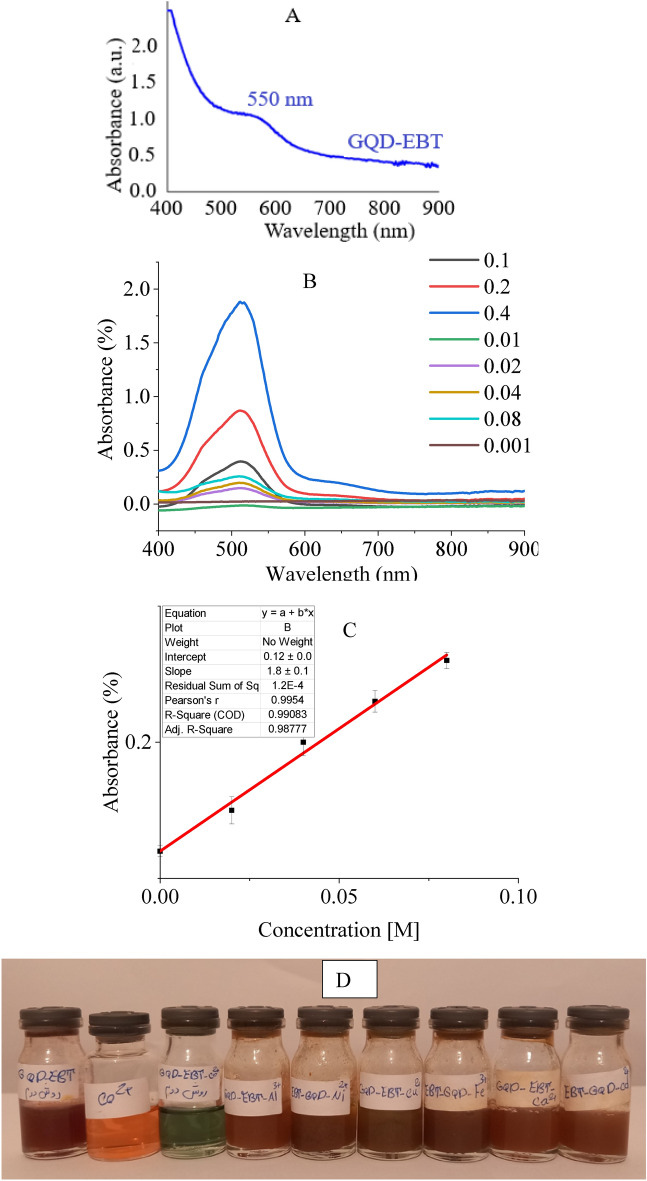
Detection of heavy transition metals is of importance protecting humans and the environment from their toxicity. Amongst them, copper(II) and cobalt(II) need more attention due to their wide applications in industry, in which exposures with excess amounts of them cause heathy concerns. Hence, fast and efficient distinguishing copper(II) and cobalt(II) could be worthy. While electrochemical approaches could determine these cations, expensive instrumentation and time-consuming analysis are significant drawbacks, leading to concentrations on spectroscopic and colorimetric pathways. Herein, graphene quantum dot was modified with Eriochrome Black T (EBT) to generate a novel sensor with the ability of sensing mentioned cations. This new nanocompound demonstrated new optical properties when complexed with cobalt(II) in natural pH, and copper(II) in acidic media. Both cations successfully were detected by the new nanosensor through revealing distinct spectroscopic signals. Moreover, cobalt(II) was distinguished by this sensor colorimetrical, appearing green solution. Linear ranges of cobalt(II) and copper(II) were obtained as 0.02-0.08 M and 0.015-0.2 M, with the limit of detections 0.014 and 0.018 M, respectively.
检测重金属对于保护人类和环境免受其毒性非常重要。其中,铜(II)和钴(II)由于在工业中的广泛应用而需要更多的关注,过量的这些金属会引起健康问题。因此,快速有效地区分铜(II)和钴(II)是值得的。电化学方法可以测定这些阳离子,但是昂贵的仪器和耗时的分析是显著的缺点,因此人们倾向于采用光谱和比色法。在这里,石墨烯量子点用铬天青 S(EBT)进行修饰,生成了一种具有感测上述阳离子能力的新型传感器。在自然 pH 值下与钴(II)络合时,以及在酸性介质中与铜(II)络合时,这种新的纳米复合物表现出了新的光学性质。通过揭示不同的光谱信号,新的纳米传感器成功地检测到了这两种阳离子。此外,这种传感器还可以通过显色来区分钴(II),溶液呈现绿色。钴(II)和铜(II)的线性范围分别为 0.02-0.08 M 和 0.015-0.2 M,检测限分别为 0.014 和 0.018 M。