Vanhala Heidi, Junttila Eija, Kataja Anneli, Huhtala Heini, Luostarinen Teemu, Luoto Teemu
Department of Anesthesia and Intensive Care, Tampere University Hospital, Tampere, Finland.
Medical Imaging Center, Department of Radiology, Tampere University Hospital, Tampere, Finland.
Neurocrit Care. 2022 Dec;37(3):629-637. doi: 10.1007/s12028-022-01561-9. Epub 2022 Aug 2.
Anemia might contribute to the development of secondary injury in patients with acute traumatic brain injury (TBI). Potential determinants of anemia are still poorly acknowledged, and reported incidence of declined hemoglobin concentration varies widely between different studies. The aim of this study was to investigate the incidence of severe anemia among patients with moderate to severe TBI and to evaluate patient- and trauma-related factors that might be associated with the development of anemia.
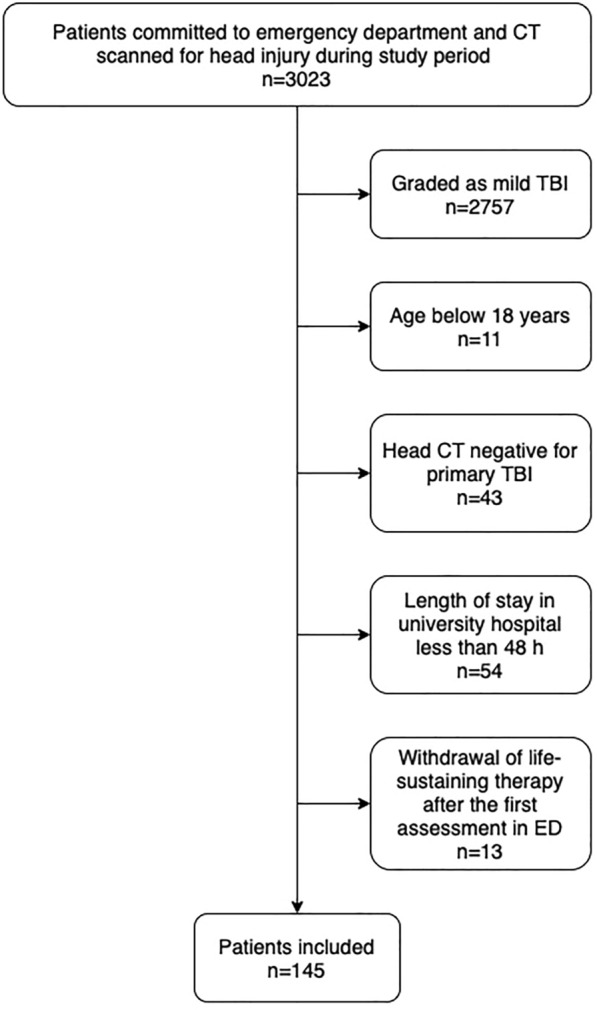
This retrospective cohort study involved all adult patients admitted to Tampere University Hospital's emergency department for moderate to severe TBI (August 2010 to July 2012). Detailed information on patient demographics and trauma characteristics were obtained, including data on posttraumatic care, data on neurosurgical procedures, and all measured in-hospital hemoglobin values. Severe anemia was defined as a hemoglobin level less than 100 g/L. Both univariate and multivariable analyses were performed, and hemoglobin trajectories were created.
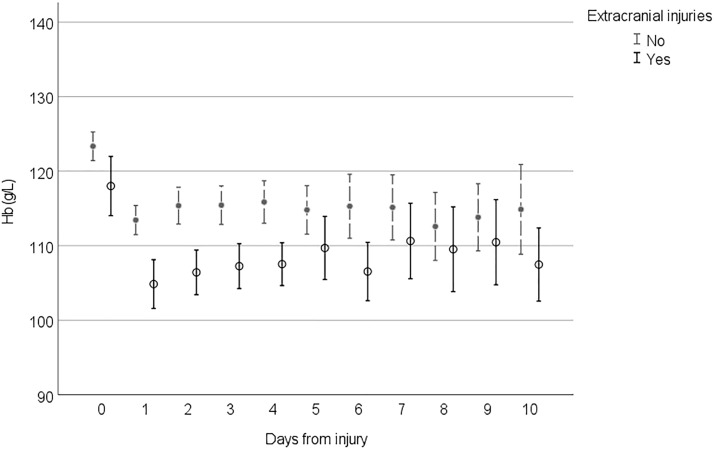
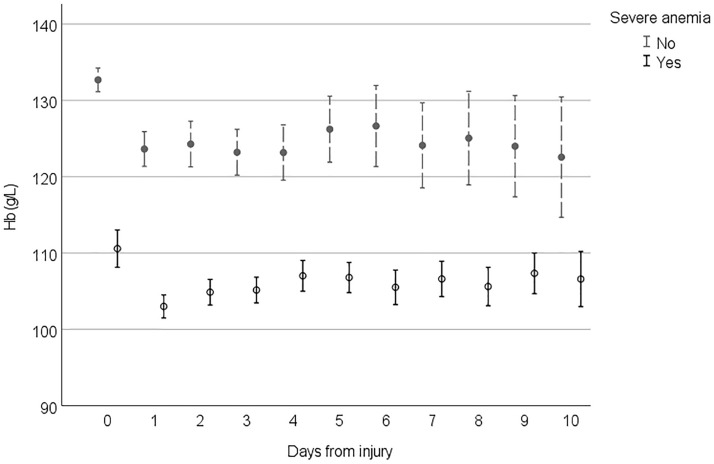
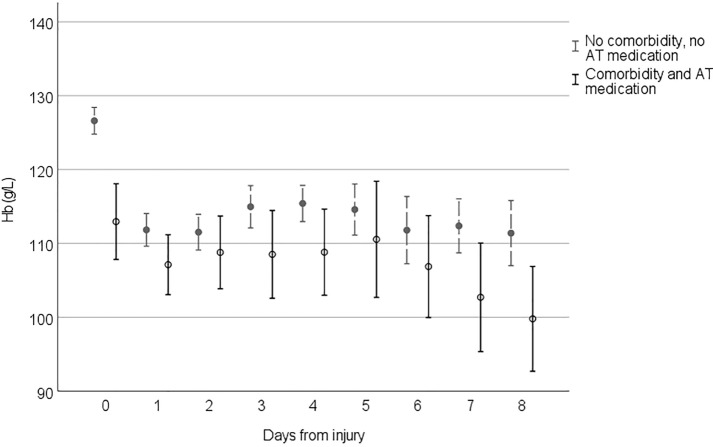
The study included 145 patients with moderate to severe TBI (male 83.4%, mean age 55.0 years). Severe anemia, with a hemoglobin level less than 100 g/L, was detected in 66 patients (45.5%) and developed during the first 48 h after the trauma. In the univariate analysis, anemia was more common among women (odds ratio [OR] 2.84; 95% confidence interval [CI] 1.13-7.15), patients with antithrombotic medication prior to trauma (OR 3.33; 95% CI 1.34-8.27), patients with cardiovascular comorbidities (OR 3.12; 95% CI 1.56-6.25), patients with diabetes (OR 4.56; 95% CI 1.69-12.32), patients with extracranial injuries (OR 3.14; 95% CI 1.69-12.32), and patients with midline shift on primary head computed tomography (OR 2.03; 95% CI 1.03-4.01). In the multivariable analysis, midline shift and extracranial traumas were associated with the development of severe anemia (OR 2.26 [95% CI 1.05-4.48] and OR 4.71 [95% CI 1.74-12.73], respectively).
Severe anemia is common after acute moderate to severe TBI, developing during the first 48 h after the trauma. Possible anemia-associated factors include extracranial traumas and midline shift on initial head computed tomography.
贫血可能促使急性创伤性脑损伤(TBI)患者发生继发性损伤。贫血的潜在决定因素仍未得到充分认识,不同研究报道的血红蛋白浓度下降发生率差异很大。本研究的目的是调查中度至重度TBI患者中严重贫血的发生率,并评估可能与贫血发生相关的患者及创伤相关因素。
这项回顾性队列研究纳入了2010年8月至2012年7月期间因中度至重度TBI入住坦佩雷大学医院急诊科的所有成年患者。获取了患者人口统计学和创伤特征的详细信息,包括创伤后护理数据、神经外科手术数据以及所有测量的住院期间血红蛋白值。严重贫血定义为血红蛋白水平低于100 g/L。进行了单因素和多因素分析,并绘制了血红蛋白变化轨迹。
该研究纳入了145例中度至重度TBI患者(男性占83.4%,平均年龄55.0岁)。66例患者(45.5%)检测到严重贫血,血红蛋白水平低于100 g/L,且在创伤后的头48小时内发生。在单因素分析中,贫血在女性中更常见(比值比[OR] 2.84;95%置信区间[CI] 1.13 - 7.15)、创伤前使用抗血栓药物的患者(OR 3.33;95% CI 1.34 - 8.27)、患有心血管合并症的患者(OR 3.12;95% CI 1.56 - 6.25)、患有糖尿病的患者(OR 4.56;95% CI 1.69 - 12.32)、有颅外损伤的患者(OR 3.14;95% CI 1.69 - 12.32)以及初次头颅计算机断层扫描有中线移位的患者(OR 2.03;95% CI 1.03 - 4.01)中更常见。在多因素分析中,中线移位和颅外创伤与严重贫血的发生相关(分别为OR 2.26 [95% CI 1.05 - 4.48]和OR 4.71 [95% CI 从1.74 - 12.73])。
急性中度至重度TBI后严重贫血很常见,在创伤后的头48小时内发生。可能与贫血相关的因素包括颅外创伤和初次头颅计算机断层扫描的中线移位。