Katsuki Fujika, Watanabe Norio, Yamada Atsurou, Hasegawa Takaaki
Department of Psychiatric and Mental Health Nursing, Nagoya City University Graduate School of Nursing, Nagoya, Japan.
Department of Psychiatry, Soseikai General Hospital, Kyoto, Japan.
BJPsych Open. 2022 Aug 2;8(5):e148. doi: 10.1192/bjo.2022.543.
Although its effect has not been verified, family therapy - such as family psychoeducation (FPE) - is a widely used intervention for treating major depressive disorder (MDD). To our knowledge, no systematic review and meta-analysis exists that examines the effect of FPE on MDD.
To assess evidence on the effectiveness of FPE on depressive symptoms in people with MDD.
We searched several databases - including PubMed, MEDLINE and Web of Science, among others - to identify eligible studies on the topic published up to March 2022. Our criteria included studies on participants with a primary MDD diagnosis and their family members and excluded studies on people with bipolar disorders and other mental illnesses. In the included studies, family members in the control groups did not receive FPE. Participants in both the intervention and control groups received standard treatment. Two researchers independently selected relevant publications, extracted data and evaluated methodological quality using the Cochrane risk of bias assessment tool and GRADE evaluation. The protocol was registered with PROSPERO (no. CRD42020185884).
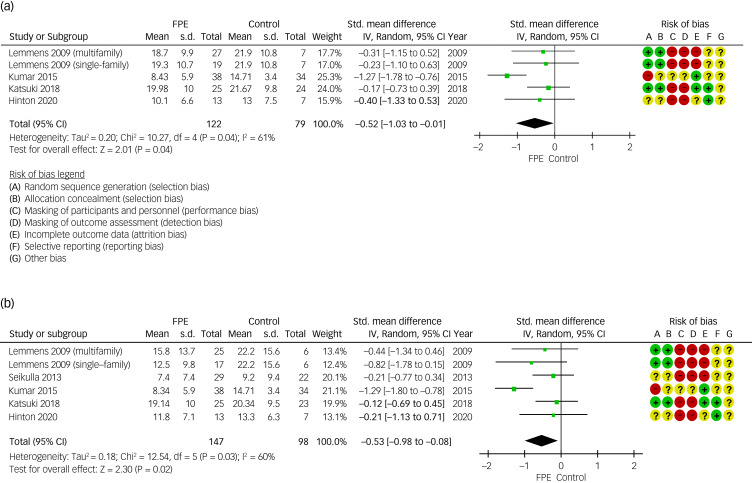
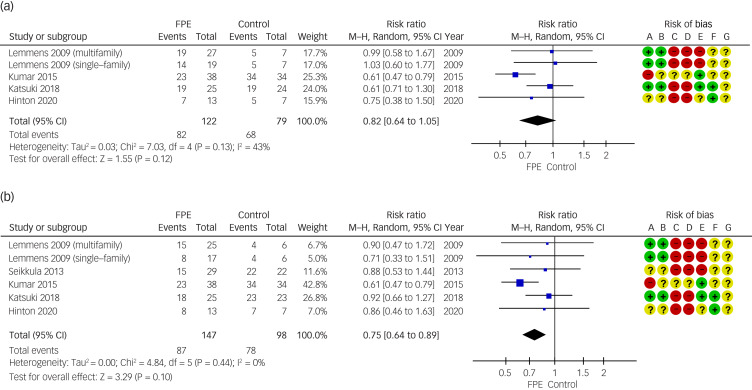
The meta-analysis included five studies with 301 patients with MDD and their family members. The effect of FPE on patients' symptom severity, compared with the control condition, at 16 weeks was available for five comparisons of four randomised control trials (RCTs); a final follow-up was available for six comparisons of five RCTs. The meta-analysis showed a statistically significant improvement in patients' symptoms, compared with control, at 16 weeks (s.m.d. = -0.52, 95% CI -1.03 to -0.01) and at a final follow-up (s.m.d. = -0.53, 95% CI -0.98 to -0.08). The meta-analysis on the effect of FPE on family functioning showed a non-significant improvement both at 16 weeks and at final follow-up.
FPE had a small but statistically significant effect on depressive symptoms in people with MDD, in both the short and long term. However, according to the GRADE framework, all outcomes are graded very low on certainty; therefore, more high-quality research is needed.
尽管家庭治疗(如家庭心理教育,FPE)的效果尚未得到验证,但它是治疗重度抑郁症(MDD)广泛使用的干预措施。据我们所知,尚无系统评价和荟萃分析来研究FPE对MDD的影响。
评估FPE对MDD患者抑郁症状有效性的证据。
我们检索了多个数据库,包括PubMed、MEDLINE和Web of Science等,以识别截至2022年3月发表的关于该主题的符合条件的研究。我们的标准包括对原发性MDD诊断患者及其家庭成员的研究,并排除对双相情感障碍和其他精神疾病患者的研究。在纳入的研究中,对照组的家庭成员未接受FPE。干预组和对照组的参与者均接受标准治疗。两名研究人员独立选择相关出版物,提取数据,并使用Cochrane偏倚风险评估工具和GRADE评估来评估方法学质量。该方案已在PROSPERO注册(编号CRD42020185884)。
荟萃分析纳入了五项研究,共301名MDD患者及其家庭成员。四项随机对照试验(RCT)的五次比较提供了16周时FPE与对照条件相比对患者症状严重程度的影响;五项RCT的六次比较提供了最终随访结果。荟萃分析显示,与对照组相比,患者在16周时(标准化均数差=-0.52,95%CI -1.03至-0.01)和最终随访时(标准化均数差=-0.53,95%CI -0.98至-0.08)症状有统计学显著改善。关于FPE对家庭功能影响的荟萃分析显示,在16周和最终随访时均无显著改善。
FPE对MDD患者的抑郁症状在短期和长期均有小但具有统计学意义的影响。然而,根据GRADE框架,所有结局的确定性等级都非常低;因此,需要更多高质量的研究。