Department of Chemistry, Biochemistry and Pharmaceutical Sciences, University of Bern, Freiestrasse 3, 3012 Bern, Switzerland.
Soft Matter. 2022 Aug 10;18(31):5877-5893. doi: 10.1039/d2sm00551d.
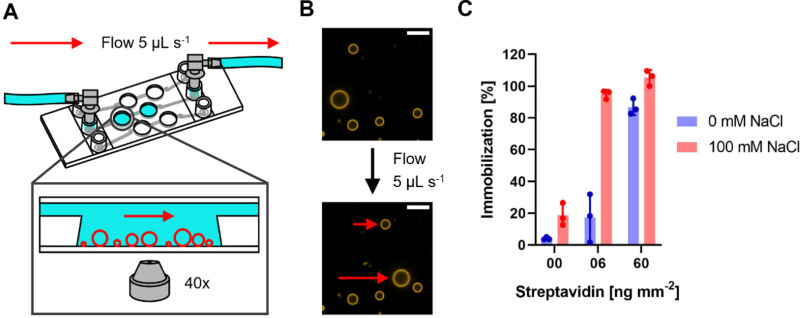
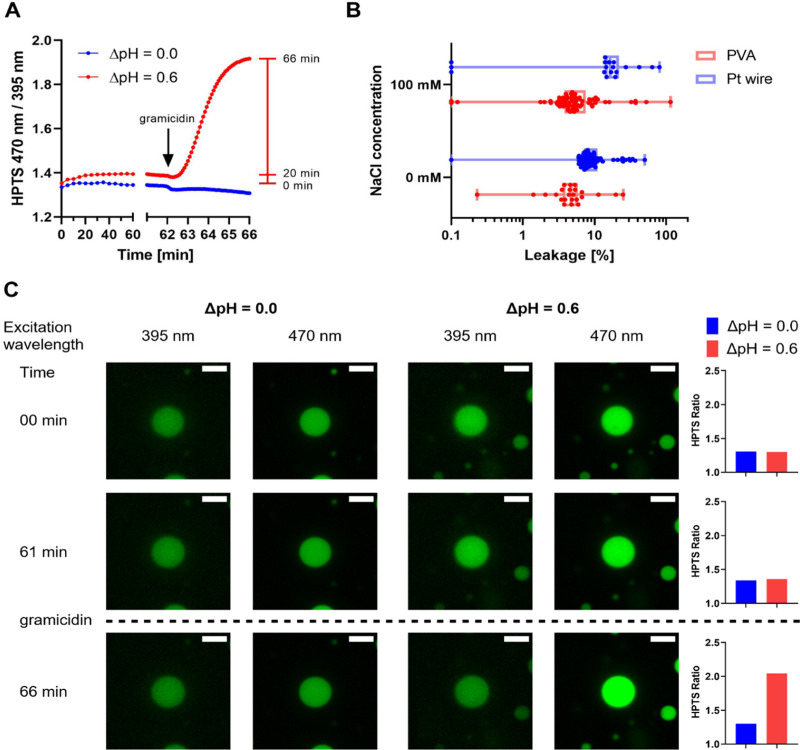
Giant unilamellar vesicles (GUVs) are micrometer-sized model membrane systems that can be viewed directly under the microscope. They serve as scaffolds for the bottom-up creation of synthetic cells, targeted drug delivery and have been widely used to study membrane related phenomena . GUVs are also of interest for the functional investigation of membrane proteins that carry out many key cellular functions. A major hurdle to a wider application of GUVs in this field is the diversity of existing protocols that are optimized for individual proteins. Here, we compare PVA assisted and electroformation techniques for GUV formation under physiologically relevant conditions, and analyze the effect of immobilization on vesicle structure and membrane tightness towards small substrates and protons. There, differences in terms of yield, size, and leakage of GUVs produced by PVA assisted swelling and electroformation were found, dependent on salt and buffer composition. Using fusion of oppositely charged membranes to reconstitute a model membrane protein, we find that empty vesicles and proteoliposomes show similar fusion behavior, which allows for a rapid estimation of protein incorporation using fluorescent lipids.
巨大的单层囊泡 (GUVs) 是微米级的模型膜系统,可以在显微镜下直接观察。它们可作为自下而上合成细胞的支架,靶向药物输送,并广泛用于研究与膜相关的现象。GUVs 对于研究执行许多关键细胞功能的膜蛋白的功能也很有意义。在该领域更广泛地应用 GUV 的主要障碍是针对个别蛋白质进行优化的现有方案的多样性。在这里,我们比较了生理相关条件下 PVA 辅助和电成形技术用于 GUV 形成,并分析了固定化对囊泡结构和对小分子底物和质子的膜密封性的影响。发现 PVA 辅助膨胀和电成形产生的 GUV 在产量、大小和泄漏方面存在差异,这取决于盐和缓冲液的组成。使用带相反电荷的膜融合来重建模型膜蛋白,我们发现空囊泡和载脂蛋白体显示出相似的融合行为,这允许使用荧光脂质快速估计蛋白质的掺入。