Public Health Microbiology, Forensic and Scientific Services, Queensland Health, Archerfield, Queensland, Australia.
Australian National University Research School of Population Health, Canberra, Australian Capital Territory, Australia.
BMJ Open. 2022 Aug 2;12(8):e061040. doi: 10.1136/bmjopen-2022-061040.
Gonorrhoea caused by is the second most notified sexually transmitted infection (STI) in Australia and the case numbers for this STI have been increasing globally. Progressive gonococcal infection may lead to disseminated gonococcal infection (DGI), which causes significant morbidity among patients. This study aims to examine the genetic diversity of isolates collected in Queensland from January 2010 to August 2015 and to determine factors associated with DGI in Queensland.
Retrospective surveillance study for epidemiological purposes.
All gonorrhoeae isolates referred by private and public pathology laboratories to the state of Queensland, Australia Neisseria reference laboratory.
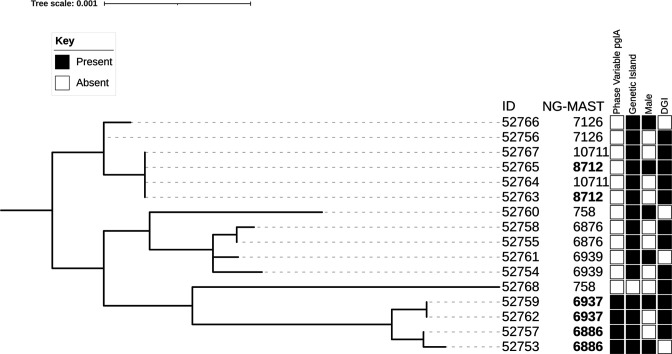
Between January 2010 and August 2015, 3953 isolates from both metropolitan and regional Queensland infections were typed with NG-MAST ( multiantigen sequence typing) to assess the genetic diversity between strains. Whole-genome sequencing (WGS) was used to investigate strain-related factors associated with DGI.
ST6876 was the most common NG-MAST type, detected in 7.6% of the isolates. DGI was significantly more likely in females <30 years (OR 13.02, p<0.0001) and in older males >30 years (OR 6.04, p<0.0001), with most cases originating from North Queensland (OR 8.5, p<0.0001). Strains harbouring PIA class of type were associated with DGI (OR 33.23, p<0.0001).
Genotyping techniques, such as NG-MAST and WGS, are proving instrumental in providing an insight into the population structure of , and genetic mechanisms of pathogenesis, such as for DGI.
引起的淋病是澳大利亚第二大通报的性传播感染(STI),这种 STI 的病例数在全球范围内一直在增加。进行性淋病感染可能导致播散性淋病感染(DGI),这会给患者带来严重的发病。本研究旨在检查 2010 年 1 月至 2015 年 8 月在昆士兰州采集的 分离株的遗传多样性,并确定昆士兰州与 DGI 相关的因素。
为流行病学目的进行的回顾性监测研究。
澳大利亚昆士兰州所有淋病分离株均由私人和公共病理学实验室转至该州的淋病参考实验室。
在 2010 年 1 月至 2015 年 8 月期间,使用 NG-MAST(多抗原序列分型)对来自昆士兰州大都市和地区的 3953 株感染进行分型,以评估菌株之间的遗传多样性。使用全基因组测序(WGS)调查与 DGI 相关的菌株相关因素。
NG-MAST 检测到的最常见的 ST6876 型,在 7.6%的分离株中检测到。30 岁以下的女性(OR 13.02,p<0.0001)和 30 岁以上的男性(OR 6.04,p<0.0001)中 DGI 的可能性明显更高,大多数病例来自北昆士兰(OR 8.5,p<0.0001)。携带 PIA 类 型的菌株与 DGI 相关(OR 33.23,p<0.0001)。
基因分型技术,如 NG-MAST 和 WGS,正在为了解 种群结构和发病机制的遗传机制(如 DGI)提供重要的见解。