Department of Fish Ecology and Evolution, Centre of Ecology, Evolution and Biogeochemistry, EAWAG Swiss Federal Institute of Aquatic Science and Technology, Kastanienbaum, Switzerland.
Division of Aquatic Ecology and Evolution, Institute of Ecology and Evolution, University of Bern, Bern, Switzerland.
Nat Commun. 2022 Aug 2;13(1):4479. doi: 10.1038/s41467-022-32181-8.
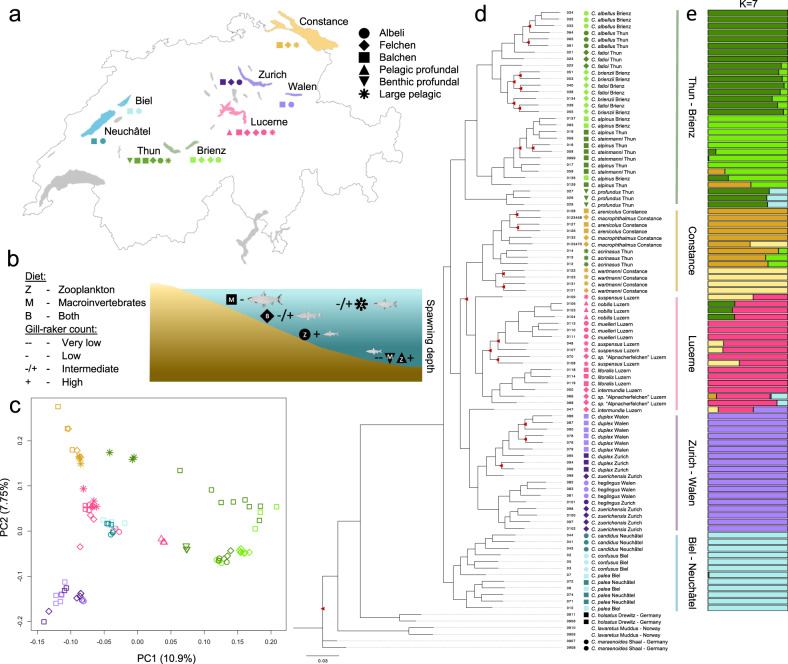
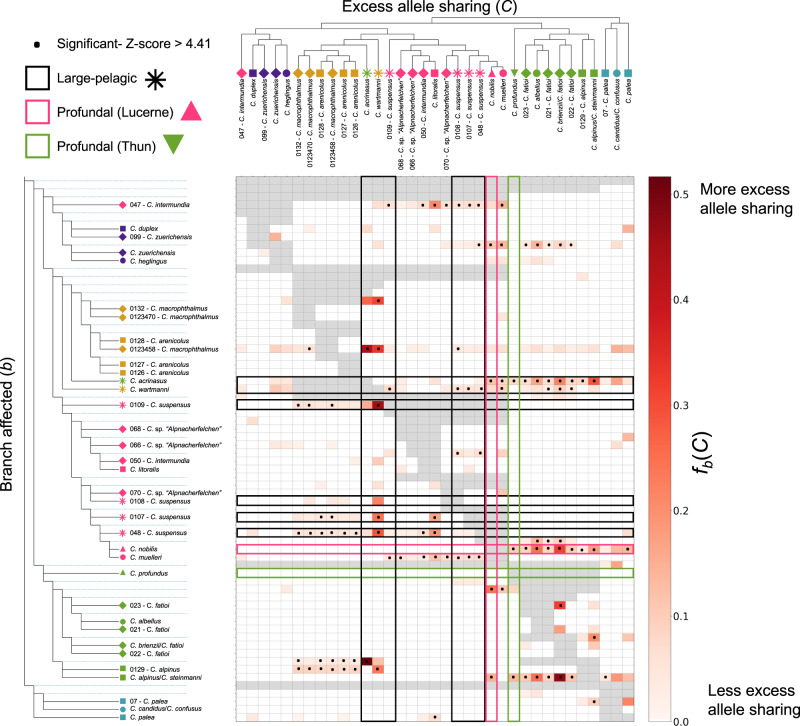
Adaptive radiations represent some of the most remarkable explosions of diversification across the tree of life. However, the constraints to rapid diversification and how they are sometimes overcome, particularly the relative roles of genetic architecture and hybridization, remain unclear. Here, we address these questions in the Alpine whitefish radiation, using a whole-genome dataset that includes multiple individuals of each of the 22 species belonging to six ecologically distinct ecomorph classes across several lake-systems. We reveal that repeated ecological and morphological diversification along a common environmental axis is associated with both genome-wide allele frequency shifts and a specific, larger effect, locus, associated with the gene edar. Additionally, we highlight the possible role of introgression between species from different lake-systems in facilitating the evolution and persistence of species with unique trait combinations and ecology. These results highlight the importance of both genome architecture and secondary contact with hybridization in fuelling adaptive radiation.
适应辐射是生命之树上最显著的多样化爆炸之一。然而,快速多样化的限制以及如何克服这些限制,特别是遗传结构和杂交的相对作用,仍然不清楚。在这里,我们使用包含来自六个生态明显生态类群的 22 个物种的多个个体的全基因组数据集,解决了阿尔卑斯白鱼辐射中的这些问题,这些物种分布在多个湖泊系统中。我们发现,沿着共同环境轴的反复生态和形态多样化与全基因组等位基因频率变化以及与基因 edar 相关的特定、更大效应基因座都有关。此外,我们还强调了来自不同湖泊系统的物种之间的基因渐渗在促进具有独特特征组合和生态的物种的进化和生存中的可能作用。这些结果强调了基因组结构和与杂交的二次接触在推动适应辐射中的重要性。