Tsuji Keiko, Ishida Masaru, Itoh Tomonori, Kimura Takumi, Kikuchi Tatsuo, Okubo Munenori, Hayashi Takatoshi, Otake Hiromasa, Shinke Toshiro, Morino Yoshihiro
Division of Cardiology, Department of Internal Medicine, Iwate Medical University, 2-1-1 Idaidori, Yahaba-cho, Shiwa-gun, Iwate 028-3695, Japan.
Division of Cardiology, Edogawa Hospital, 2-24-18 Higashikoiwa, Edogawa-ku, Tokyo 133-0052, Japan.
Eur Heart J Open. 2022 Feb 4;2(1):oeac005. doi: 10.1093/ehjopen/oeac005. eCollection 2022 Jan.
The incidence and temporal change in coronary evagination (CE) after first-generation drug-eluting stent implantation is well established, whereas that after biodegradable polymer sirolimus-eluting stent (BP-SES) implantation has not yet been evaluated. The aim of this study is to assess the incidence and natural history of CE after BP-SES implantation.
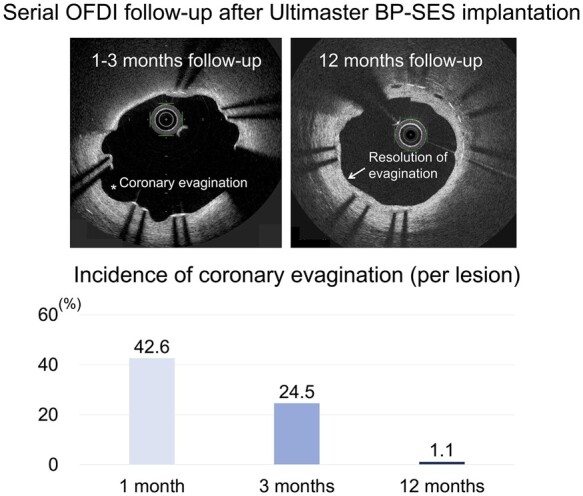
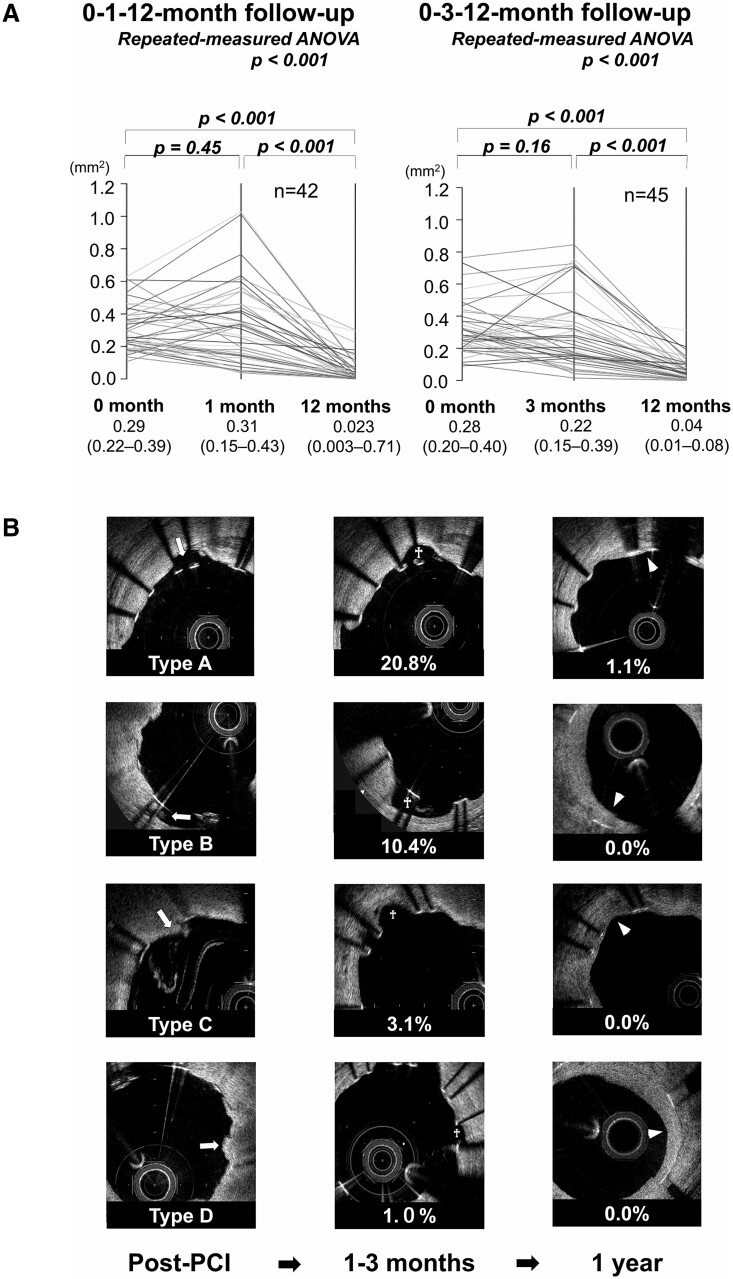
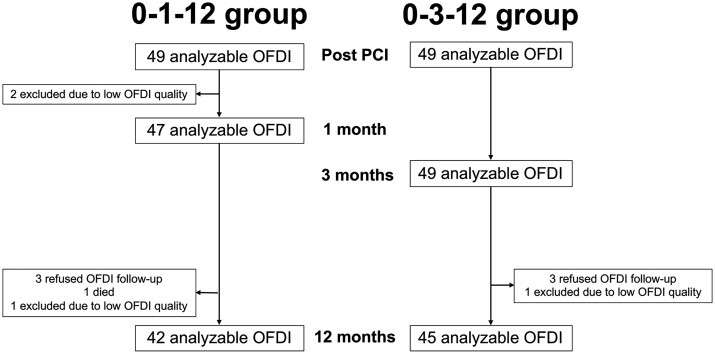
In this multicenter registry, stable coronary lesions treated by Ultimaster BP-SES were evaluated by serial optical frequency domain imaging (OFDI) (at 0-1-12 or 0-3-12 months) and the incidence of CE was assessed. Coronary evagination was defined as the presence of an outward bulge in luminal vessel contour between apposed struts according to the following criteria: (i) evagination depth ≥10% of nominal stent diameter and (ii) evagination length ≥3.0 mm. Optical frequency domain imaging was obtained in 98, 47, 49, and 87 lesions at 0, 1, 3, and 12 months, respectively. Coronary evagination was observed in 20 (42.6%) and 12 (24.5%) lesions at 1 and 3 months, respectively, and all but one CE had resolved at 12 months. At 12 months, the mean CE area was almost zero and the mean malapposed stent area was also decreased. Comparison of the serial OFDI images indicated that CEs originated mostly from acute stent malapposition or coronary dissection behind the implanted stent.
In stable lesions, CE was occasionally observed with Ultimaster BP-SES at 1-3 months but mostly resolved within 12 months, without late-acquired stent malapposition. These findings suggest the safety and feasibility of biodegradable polymer coating on DES.
第一代药物洗脱支架植入术后冠状动脉外翻(CE)的发生率及时间变化已得到充分证实,而生物可降解聚合物西罗莫司洗脱支架(BP-SES)植入术后的情况尚未得到评估。本研究的目的是评估BP-SES植入术后CE的发生率及自然病程。
在这项多中心注册研究中,通过连续光学频域成像(OFDI)(在0、1、12个月或0、3、12个月)对接受Ultimaster BP-SES治疗的稳定冠状动脉病变进行评估,并评估CE的发生率。冠状动脉外翻的定义为根据以下标准在相邻支架小梁之间的管腔血管轮廓中出现向外凸起:(i)外翻深度≥标称支架直径的10%,(ii)外翻长度≥3.0毫米。分别在0、1、3和12个月对98、47、49和87个病变进行了光学频域成像。在1个月和3个月时分别在20个(42.6%)和12个(24.5%)病变中观察到冠状动脉外翻,除1例CE外,所有CE在12个月时均已消退。在12个月时,平均CE面积几乎为零,平均贴壁不良支架面积也有所减少。连续OFDI图像的比较表明,CE大多起源于急性支架贴壁不良或植入支架后方的冠状动脉夹层。
在稳定病变中,使用Ultimaster BP-SES时在1至3个月偶尔观察到CE,但大多在12个月内消退,无晚期获得性支架贴壁不良。这些发现提示了DES上生物可降解聚合物涂层的安全性和可行性。