Husted Gitte Reventlov, Hansen Rikke Nørgaard, El-Souri Mira, Lorenzen Janne Kunchel, Iversen Peter Bindslev, Rossing Charlotte Verner
PhD, MScN, Consultant, Department of Research and Development, Danish College of Pharmacy Practice, Pharmakon, Denmark.
MSc Pharmacy, Head of Research and Development, Danish College of Pharmacy Practice, Pharmakon, Denmark.
Pharm Pract (Granada). 2022 Apr-Jun;20(2):2677. doi: 10.18549/PharmPract.2022.2.2677. Epub 2022 Jun 17.
Diabetes is a demanding disease with a complex treatment regimen. Many persons with diabetes have difficulty managing their disease and taking medication as prescribed, possibly because they lack knowledge and sometimes misinterpret medical benefits. Community pharmacies continuously provide professional counselling to persons with diabetes.
This study aimed to explore 1) which services adults with type 1 and type 2 diabetes want from community pharmacies and 2) how pharmacies can meet these wishes.
A qualitative, explorative study design using focus group interviews was chosen. Informants were recruited from Region Zealand in Denmark. Data were digitally recorded, transcribed verbatim and analyzed by means of thematic analysis.
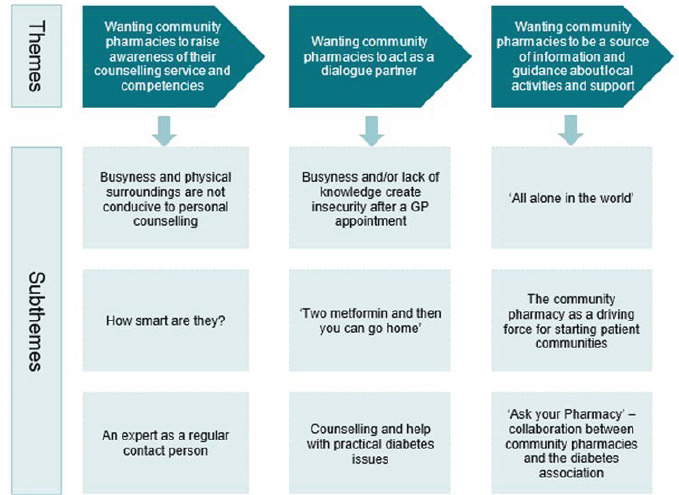
Thirteen adults (11 female) with the mean age of 66.2 years (range 49-81 years) participated in one physical (n=6) or one online (n=7) focus group interview. Ten had type 2 diabetes, three had type 1 diabetes. The average duration of participants' diabetes was 13.4 years (range 2.3-33.0 years). The analysis revealed three overall themes of the functions which the informants would like community pharmacies to fulfil: 1) raise awareness of pharmacies' counselling service and competences; 2) act as a dialogue partner; 3) be a source of information and guidance about local activities and support.
The informants did not regard community pharmacies as a natural part of the healthcare system or as a place where they would expect counselling. They would like the community pharmacy to make their medical competences and services obvious and the community pharmacy staff to act as a dialogue partner and provide competent counselling. The informants would like to have a contact person with diabetes competences with whom they can book an appointment to complement over-the-counter counselling. They experience a gap in their care between routine visits in the healthcare system and suggest that community pharmacies counselling services become a natural supplement and that healthcare professionals in the primary and secondary sectors inform patients about the services - especially for patients newly diagnosed with diabetes. Finally, they would like a formal collaboration between diabetes associations and community pharmacies to make their competences, services and information visible.
糖尿病是一种需要严格治疗方案的疾病。许多糖尿病患者在管理疾病和按规定服药方面存在困难,这可能是因为他们缺乏相关知识,有时还会误解医疗益处。社区药房持续为糖尿病患者提供专业咨询服务。
本研究旨在探讨:1)1型和2型糖尿病成年患者希望社区药房提供哪些服务;2)药房如何满足这些需求。
采用焦点小组访谈的定性探索性研究设计。从丹麦西兰岛地区招募受访者。数据进行数字录音、逐字转录,并通过主题分析进行分析。
13名成年人(11名女性)参与了一项面对面(n = 6)或一项在线(n = 7)焦点小组访谈,平均年龄为66.2岁(范围49 - 81岁)。其中10人患有2型糖尿病,3人患有1型糖尿病。参与者患糖尿病的平均时长为13.4年(范围2.3 - 33.0年)。分析揭示了受访者希望社区药房履行的三项总体功能主题:1)提高对药房咨询服务和能力的认知;2)充当对话伙伴;3)成为有关当地活动和支持的信息与指导来源。
受访者并不认为社区药房是医疗保健系统的自然组成部分,也不认为它是一个能期待获得咨询服务的地方。他们希望社区药房彰显其医疗能力和服务,社区药房工作人员充当对话伙伴并提供专业咨询。受访者希望有一位具备糖尿病相关能力的联系人,以便他们可以预约,以补充非处方咨询。他们感到在医疗保健系统的常规就诊之间存在护理缺口,并建议社区药房咨询服务成为自然的补充,且初级和二级医疗保健部门的专业人员应告知患者这些服务——尤其是对新诊断出糖尿病的患者。最后,他们希望糖尿病协会与社区药房建立正式合作,使它们的能力、服务和信息更加明显。