Jeon Hee Jung, Koo Tai Yeon, Ju Man Ki, Chae Dong-Wan, Choi Soo Jin Na, Kim Myoung Soo, Ryu Jung-Hwa, Jeon Jong Cheol, Ahn Curie, Yang Jaeseok
Department of Internal Medicine, Kangdong Sacred Heart Hospital, Hallym University College of Medicine, Seoul, Republic of Korea.
Department of Internal Medicine, Seongnam Citizens Medical Center, Seongnam, Republic of Korea.
Kidney Res Clin Pract. 2022 Jul;41(4):492-507. doi: 10.23876/j.krcp.21.185. Epub 2022 Jul 28.
As the need for a nationwide organ-transplant registry emerged, a prospective registry, the Korean Organ Transplantation Registry (KOTRY), was initiated in 2014. Here, we present baseline characteristics and outcomes of the kidney-transplant cohort for 2014 through 2019.
The KOTRY consists of five organ-transplant cohorts (kidney, liver, lung, heart, and pancreas). Data and samples were prospectively collected from transplant recipients and donors at baseline and follow-up visits; and epidemiological trends, allograft outcomes, and patient outcomes, such as posttransplant complications, comorbidities, and mortality, were analyzed.
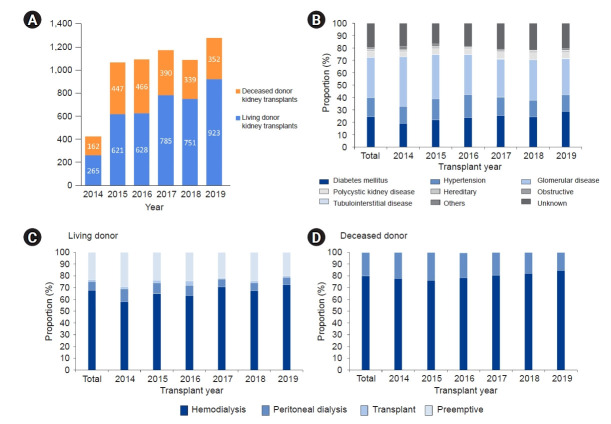
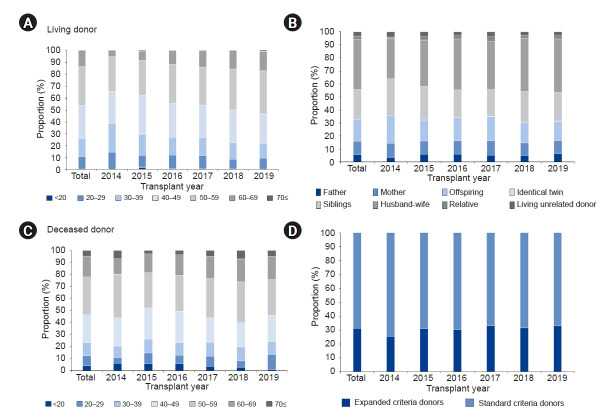
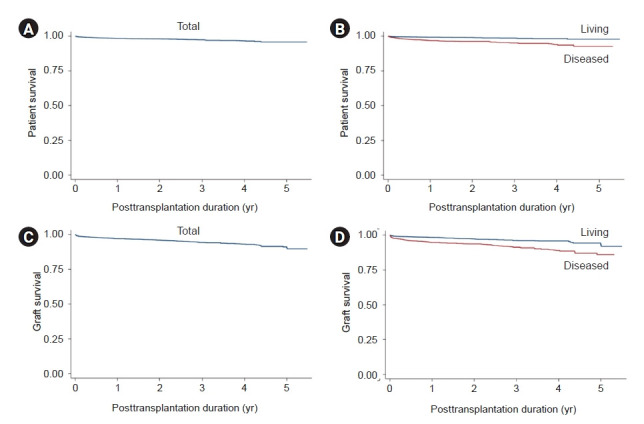
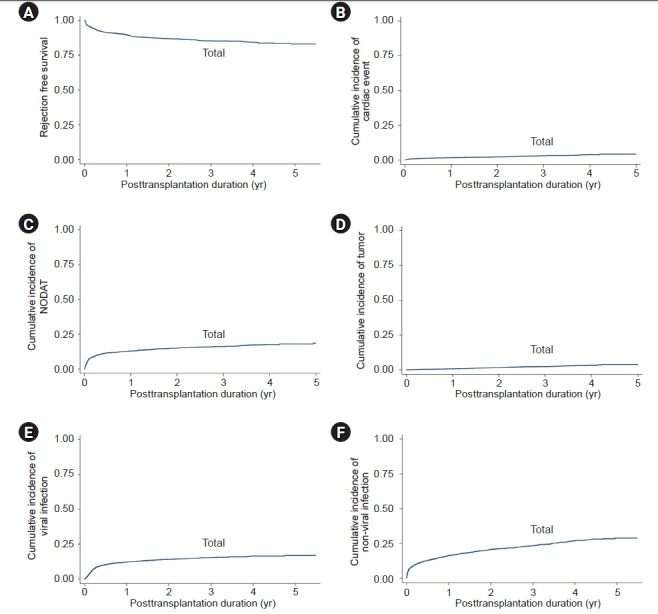
From 2014 to 2019, there were a total of 6,129 registered kidney transplants (64.8% with living donors and 35.2% with deceased donors) with a mean recipient age of 49.4 ± 11.5 years, and 59.7% were male. ABO-incompatible transplants totaled 17.4% of all transplants, and 15.0% of transplants were preemptive. The overall 1- and 5-year patient survival rates were 98.4% and 95.8%, respectively, and the 1- and 5-year graft survival rates were 97.1% and 90.5%, respectively. During a mean follow-up of 3.8 years, biopsy-proven acute rejection episodes occurred in 17.0% of cases. The mean age of donors was 47.3 ± 12.9 years, and 52.6% were male. Among living donors, the largest category of donors was spouses, while, among deceased donors, 31.2% were expanded-criteria donors. The mean serum creatinine concentrations of living donors were 0.78 ± 0.62 mg/dL and 1.09 ± 0.24 mg/dL at baseline and 1 year after kidney transplantation, respectively.
The KOTRY, a systematic Korean transplant cohort, can serve as a valuable epidemiological database of Korean kidney transplants.
随着全国器官移植登记系统需求的出现,一个前瞻性登记系统——韩国器官移植登记系统(KOTRY)于2014年启动。在此,我们展示了2014年至2019年肾移植队列的基线特征和结果。
KOTRY由五个器官移植队列(肾脏、肝脏、肺、心脏和胰腺)组成。在基线和随访时前瞻性收集移植受者和供者的数据及样本;并分析流行病学趋势、同种异体移植物结果以及患者结果,如移植后并发症、合并症和死亡率。
2014年至2019年,共有6129例登记肾移植(64.8%为活体供肾,35.2%为尸体供肾),受者平均年龄为49.4±11.5岁,59.7%为男性。ABO血型不相容移植占所有移植的17.4%,15.0%的移植为抢先移植。总体1年和5年患者生存率分别为98.4%和95.8%,1年和5年移植物生存率分别为97.1%和90.5%。在平均3.8年的随访期间,17.0%的病例发生了活检证实的急性排斥反应。供者平均年龄为47.3±12.9岁,52.6%为男性。在活体供者中,最大的供者类别是配偶,而在尸体供者中,31.2%为扩大标准供者。活体供者在基线和肾移植后1年的平均血清肌酐浓度分别为0.78±0.62mg/dL和1.09±0.24mg/dL。
KOTRY作为一个系统的韩国移植队列,可作为韩国肾移植有价值的流行病学数据库。