Faculdade Ilapeo, Curitiba, Brasil.
Neodent, Curitiba, Brasil.
J Appl Oral Sci. 2022 Aug 1;30:e20220089. doi: 10.1590/1678-7757-2022-0089. eCollection 2022.
This study aimed to retrospectively collect clinical data to evaluate the influence of possible risk factors on the long-term success of implant treatment with extra-narrow (2.9 mm diameter) implants in a daily dental practice setting.
Data were collected from records of patients who received at least one extra-narrow implant from 2012 to 2017, regarding implant survival, prosthesis survival, patient characteristics, and implant characteristics. The association between the dependent variables "implant survival", "prosthesis survival," and "adverse events" related to patient and implant characteristics was statistically evaluated by chi-square tests. Moreover, implant and prosthesis survival were analyzed by Kaplan-Meier survival curves.
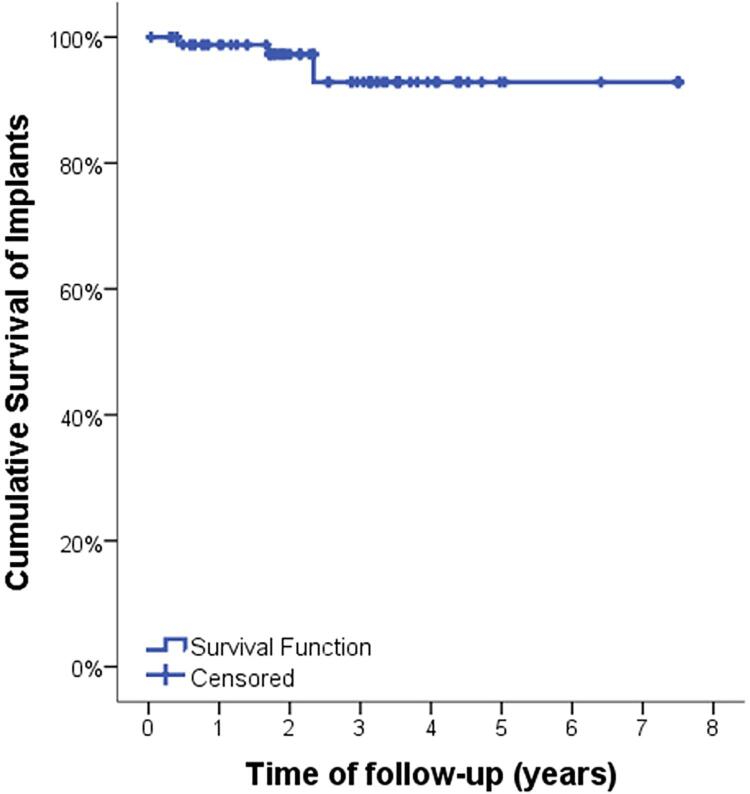
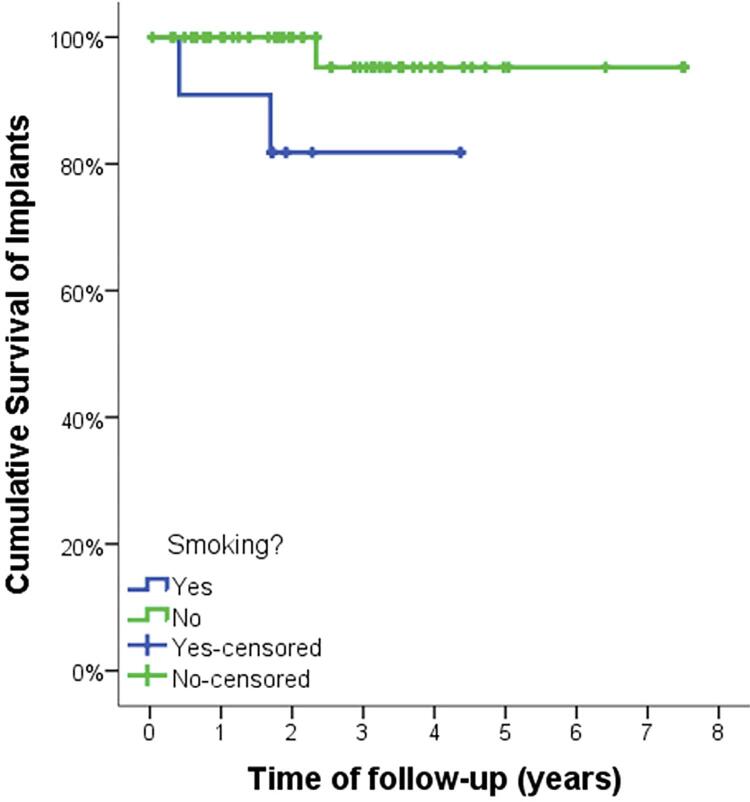
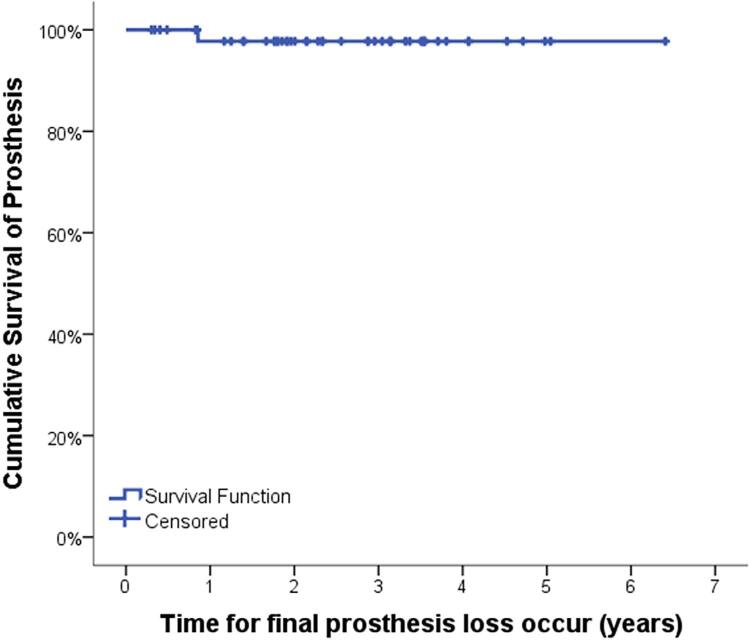
The sample was constituted of 58 patients (37 women and 21 men) with a mean age of 54.8 years old (SD: 12.5), followed up for up to eight years. In total, 86 extra-narrow implants were placed within this sample. Four implants were lost, resulting in an implant survival rate of 95.3%. A total of 55 prostheses were inserted and only one (1.8%) was lost, resulting in a prosthesis survival rate of 98.2%. The mean implant and prosthesis survival time was, respectively, 7.1 years and 6.3 years, according to the Kaplan-Meier survival analysis. A correlation was found between smoking and implant loss, which makes implant loss eight times more likely to occur in smokers than non-smokers. A significant association was also found between prosthesis loss and previous need of prosthesis repair. However, it was not considered clinically relevant. No association was found between the occurrence of adverse events and later implant or prosthesis loss.
High implant and prosthesis survival rates were found in the long term for treatment with extra-narrow implants. Moreover, a significant correlation between smoking and implant loss was observed.
本研究旨在回顾性收集临床数据,评估在日常牙科实践中,额外狭窄(直径 2.9 毫米)种植体的长期成功与可能的风险因素的关系。
从 2012 年至 2017 年期间接受至少一个额外狭窄种植体的患者记录中收集数据,包括种植体存活率、修复体存活率、患者特征和种植体特征。通过卡方检验对与患者和种植体特征相关的依赖变量“种植体存活率”、“修复体存活率”和“不良事件”之间的关系进行统计学评估。此外,通过 Kaplan-Meier 生存曲线分析种植体和修复体的存活率。
样本由 58 名患者(37 名女性和 21 名男性)组成,平均年龄为 54.8 岁(标准差:12.5),随访时间最长达 8 年。总共有 86 个额外狭窄种植体被植入该样本中。有 4 个种植体脱落,种植体存活率为 95.3%。共插入 55 个修复体,其中只有 1 个(1.8%)脱落,修复体存活率为 98.2%。根据 Kaplan-Meier 生存分析,种植体和修复体的平均存活时间分别为 7.1 年和 6.3 年。发现吸烟与种植体脱落之间存在相关性,吸烟者种植体脱落的可能性是非吸烟者的 8 倍。修复体脱落与之前需要修复体修复之间也存在显著相关性,但未被认为具有临床意义。不良事件的发生与后期种植体或修复体脱落之间未发现关联。
长期使用额外狭窄种植体治疗可获得较高的种植体和修复体存活率。此外,还观察到吸烟与种植体脱落之间存在显著相关性。