Department of Parasitology, Leiden University Center for Infectious Diseases (LU-CID), Leiden University Medical Center, Albinusdreef 2, 2333 ZA, Leiden, The Netherlands.
Centre de Recherches Médicales de Lambaréné (CERMEL), Lambaréné, Gabon.
Sci Rep. 2022 Aug 3;12(1):13303. doi: 10.1038/s41598-022-17725-8.
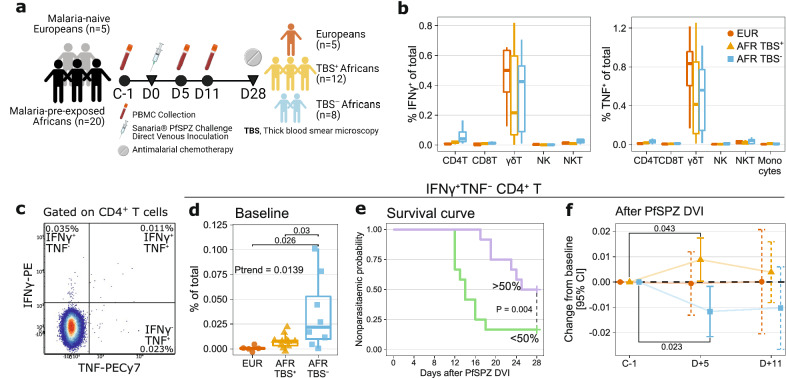
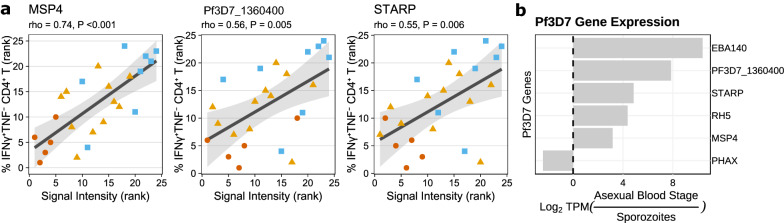
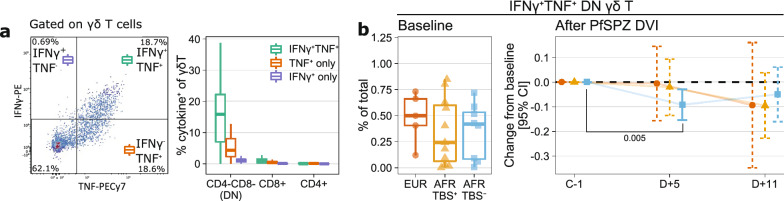
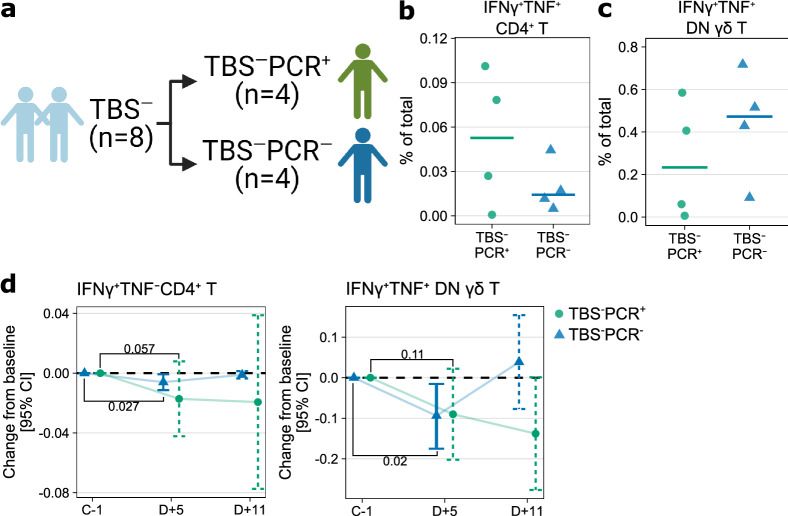
Controlled human malaria infection (CHMI) using cryopreserved non-attenuated Plasmodium falciparum sporozoites (PfSPZ) offers a unique opportunity to investigate naturally acquired immunity (NAI). By analyzing blood samples from 5 malaria-naïve European and 20 African adults with lifelong exposure to malaria, before, 5, and 11 days after direct venous inoculation (DVI) with Sanaria PfSPZ Challenge, we assessed the immunological patterns associated with control of microscopic and submicroscopic parasitemia. All (5/5) European individuals developed parasitemia as defined by thick blood smear (TBS), but 40% (8/20) of the African individuals controlled their parasitemia, and therefore remained thick blood smear-negative (TBS Africans). In the TBS Africans, we observed higher baseline frequencies of CD4 T cells producing interferon-gamma (IFNγ) that significantly decreased 5 days after PfSPZ DVI. The TBS Africans, which represent individuals with either very strong and rapid blood-stage immunity or with immunity to liver stages, were stratified into subjects with sub-microscopic parasitemia (TBSPCR) or those with possibly sterilizing immunity (TBSPCR). Higher frequencies of IFNγTNFCD8 γδ T cells at baseline, which later decreased within five days after PfSPZ DVI, were associated with those who remained TBSPCR. These findings suggest that naturally acquired immunity is characterized by different cell types that show varying strengths of malaria parasite control. While the high frequencies of antigen responsive IFNγCD4 T cells in peripheral blood keep the blood-stage parasites to a sub-microscopic level, it is the IFNγTNFCD8 γδ T cells that are associated with either immunity to the liver-stage, or rapid elimination of blood-stage parasites.
使用冷冻非减毒疟原虫孢子(PfSPZ)进行受控人体疟疾感染(CHMI)为研究自然获得性免疫(NAI)提供了独特的机会。通过分析 5 名疟原虫-naive 的欧洲人和 20 名终身暴露于疟疾的非洲成年人在接受 Sanaria PfSPZ Challenge 直接静脉接种(DVI)前、后 5 天和 11 天的血液样本,我们评估了与控制微观和亚微观寄生虫血症相关的免疫模式。所有(5/5)名欧洲个体都出现了厚血涂片(TBS)定义的寄生虫血症,但 40%(8/20)名非洲个体控制了寄生虫血症,因此保持 TBS 阴性(TBS 非洲人)。在 TBS 非洲人中,我们观察到产生干扰素-γ(IFNγ)的 CD4 T 细胞的基线频率更高,这些细胞在 PfSPZ DVI 后 5 天显著下降。TBS 非洲人代表具有非常强和快速的血期免疫或对肝期免疫的个体,分为亚微观寄生虫血症(TBSPCR)或可能具有绝育免疫(TBSPCR)的个体。在 PfSPZ DVI 后五天内,基线时 IFNγTNFCD8 γδ T 细胞的频率更高,与那些保持 TBSPCR 的个体相关。这些发现表明,自然获得性免疫的特征是不同的细胞类型,这些细胞表现出不同的疟原虫控制强度。虽然外周血中抗原反应性 IFNγCD4 T 细胞的高频率使血液期寄生虫保持在亚微观水平,但与肝期免疫或血液期寄生虫快速消除相关的是 IFNγTNFCD8 γδ T 细胞。