Department of Preventive Medicine, Griffin Hospital, CT, Derby, USA.
Department of Medicine, John A Burns School of Medicine, University of Hawaii at Manoa, Honolulu, HI, USA.
Intern Emerg Med. 2022 Nov;17(8):2229-2235. doi: 10.1007/s11739-022-03053-2. Epub 2022 Aug 3.
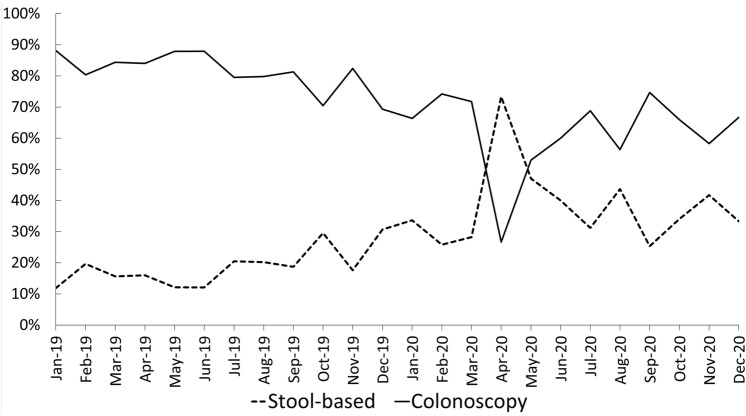
Colorectal cancer (CRC) is one of the leading causes of cancer death worldwide. Many communities remain under the 80% CRC screening goal. We aimed to identify factors associated with non-adherence to CRC screening and to describe the effect of the COVID-19 pandemic in CRC screening patterns. A retrospective review of patients aged 50-75 years seen at the Griffin Faculty Physicians primary care offices between January 2019 and December 2020 was performed. Logistic regression models were used to identify factors associated with CRC screening non-adherence. Of 12,189 patients, 66.2% had an updated CRC screen. On univariable logistic regression, factors associated with CRC screening non-adherence included age ≤ 55 years [odds ratio (OR) 2.267, p < 0.001], White/Caucasian race (OR 0.858, p = 0.030), Medicaid insurance (OR 2.097, p < 0.001), morbid obesity (OR 1.436, p < 0.001), current cigarette smoking (OR 1.849, p < 0.001), and elevated HbA1c (OR 1.178, p = 0.004). Age, Medicaid insurance, morbid obesity, current smoking, and HbA1c ≥ 6.5% remained significant in the final multivariable model. Compared to 2019, there was an 18.2% decrease in the total number of CRC screening tests in 2020. The proportion of colonoscopy procedures was lower in 2020 compared to the proportion of colonoscopy procedures conducted in 2019 (65.9% vs 81.7%, p < 0.001), with a concurrent increase in stool-based tests. CRC screening rates in our population are comparable to national statistics but below the 80% goal. COVID-19 affected CRC screening. Our results underscore the need to identify patient groups most vulnerable to missing CRC screening and highlight the importance of stool-based testing to bridge screening gaps.
结直肠癌(CRC)是全球癌症死亡的主要原因之一。许多社区的结直肠癌筛查率仍未达到 80%。我们旨在确定与结直肠癌筛查不依从相关的因素,并描述 COVID-19 大流行对结直肠癌筛查模式的影响。对 2019 年 1 月至 2020 年 12 月在格里芬教职员工初级保健办公室就诊的 50-75 岁患者进行了回顾性研究。使用逻辑回归模型确定与 CRC 筛查不依从相关的因素。在 12189 名患者中,66.2%的患者进行了最新的 CRC 筛查。单变量逻辑回归显示,与 CRC 筛查不依从相关的因素包括年龄≤55 岁[比值比(OR)2.267,p<0.001]、白种/高加索人(OR 0.858,p=0.030)、医疗补助保险(OR 2.097,p<0.001)、病态肥胖(OR 1.436,p<0.001)、当前吸烟(OR 1.849,p<0.001)和糖化血红蛋白(HbA1c)升高(OR 1.178,p=0.004)。年龄、医疗补助保险、病态肥胖、当前吸烟和 HbA1c≥6.5%在最终多变量模型中仍然具有统计学意义。与 2019 年相比,2020 年 CRC 筛查总数减少了 18.2%。与 2019 年相比,2020 年结肠镜检查的比例较低(65.9%比 81.7%,p<0.001),同时粪便检测的比例增加。我们人群中的 CRC 筛查率与全国统计数据相当,但低于 80%的目标。COVID-19 影响了 CRC 筛查。我们的研究结果强调了需要确定最容易错过 CRC 筛查的患者群体,并强调了基于粪便的检测对于弥合筛查差距的重要性。