Bora Kaustubh, Barman Bhupen, Pala Star, Das Ananya, Doke Goter, Tripura Amar
Hematology Division, ICMR-Regional Medical Research Centre North East Region, Dibrugarh, India.
Department of General Medicine, North Eastern Indira Gandhi Regional Institute of Health and Medical Sciences, Shillong, India.
Front Nutr. 2022 Jul 18;9:894245. doi: 10.3389/fnut.2022.894245. eCollection 2022.
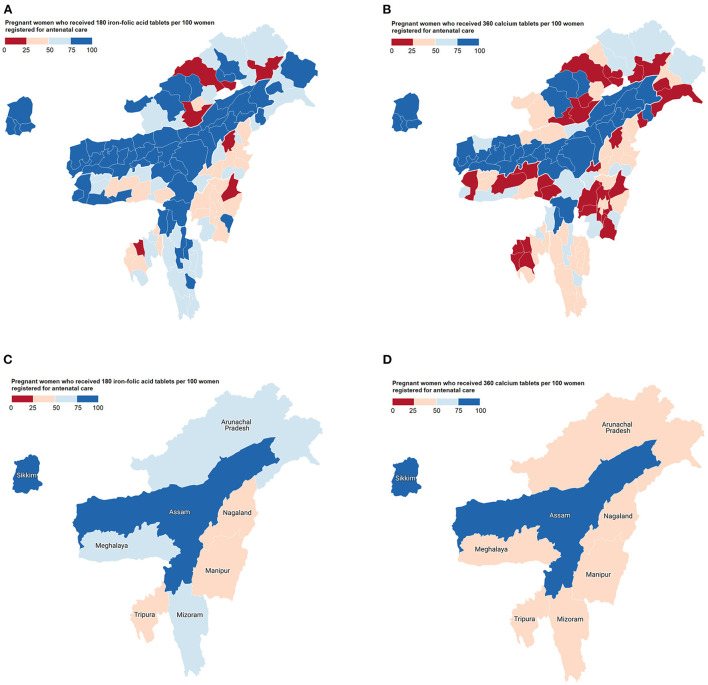
Iron-folic acid (IFA) and calcium supplementation are nutritional interventions recommended prophylactically (against maternal anemia and preeclampsia, respectively) to all antenatal mothers in India under basic antenatal care (ANC) services. Using Health Management Information System data (reporting period: 2018-19 to 2020-21), we mapped the coverage of antenatal IFA and calcium distribution across the remote northeastern region of India relative to the number of pregnant women (PW) who registered for ANC, disaggregated by states and districts. Variations in coverage were also investigated by subgroups based on contextual attributes, ., physiography (hilly/ plateau/ plain), socioeconomic development ("aspirational"/ "non-aspirational") and proportion of early ANC visits (low/ medium/ high). Full course of antenatal IFA and calcium supplements were received by 79.36 (95% CI: 79.31-79.40) and 61.26 (95% CI: 61.21-61.32) PW per 100 ANC registered women, respectively. There was widespread heterogeneity in outreach, with calcium coverage generally trailing behind IFA coverage. Among states, coverage of the two interventions (per 100 ANC registered women) was highest in Assam (97.06 and 78.11 PW, respectively) and lowest in Nagaland (24.87 and 16.77 PW, respectively). At the district-level, the two interventions failed to reach even 50 PW per 100 ANC registered women in 32 (out of 115) districts. The coverage tended to be inferior in districts that were hilly, "non-aspirational" and had low proportion of early ANC visits. The granular information provided by our findings will facilitate monitoring, root cause analyses, microplanning, informed resource allocation and tailoring of locally appropriate solutions to achieve targeted coverage improvements.
铁叶酸(IFA)和补钙是印度基本产前保健(ANC)服务中预防性推荐给所有产前母亲的营养干预措施(分别用于预防孕产妇贫血和先兆子痫)。利用健康管理信息系统数据(报告期:2018 - 19年至2020 - 21年),我们根据登记接受ANC的孕妇数量,按邦和地区划分,绘制了印度东北部偏远地区产前IFA和钙分配的覆盖率。还根据环境属性(如地形(山区/高原/平原)、社会经济发展水平(“有抱负的地区”/“非有抱负的地区”)和早期ANC就诊比例(低/中/高))对亚组的覆盖率差异进行了调查。每100名登记接受ANC的孕妇中,分别有79.36(95%置信区间:79.31 - 79.40)和61.26(95%置信区间:61.21 - 61.32)名孕妇接受了全程产前IFA和钙补充剂。推广工作存在广泛的异质性,钙的覆盖率普遍落后于IFA的覆盖率。在各邦中,这两项干预措施(每100名登记接受ANC的孕妇)的覆盖率在阿萨姆邦最高(分别为97.06和78.11名孕妇),在那加兰邦最低(分别为24.87和16.77名孕妇)。在地区层面,在115个地区中的32个地区,这两项干预措施每100名登记接受ANC的孕妇中甚至未能覆盖到50名孕妇。在山区、“非有抱负的地区”以及早期ANC就诊比例较低的地区,覆盖率往往较低。我们研究结果提供的详细信息将有助于监测、根本原因分析、微观规划、明智的资源分配以及制定适合当地的解决方案以实现目标覆盖率的提高。