Negi Sonakshi, Benau Erik M, Strowger Megan, Grammer Anne Claire, Timko C Alix
Department of Child and Adolescent Psychiatry and Behavioral Sciences, Children's Hospital of Philadelphia, Philadelphia, PA, United States.
Department of Psychology, University of Kansas, Lawrence, KS, United States.
Front Psychol. 2022 Jul 18;13:843717. doi: 10.3389/fpsyg.2022.843717. eCollection 2022.
Studies that examine disordered eating in samples of Asian individuals living in the United States frequently combine all individuals of Asian descent into a single group, which can obscure important differences between groups and their experiences of acculturation. The goal of the present study was to establish the relation of acculturation, internalization of appearance ideals, and religiosity as predicting body dissatisfaction and disordered eating in women of South and Southeast Asian (SSEA) descent.
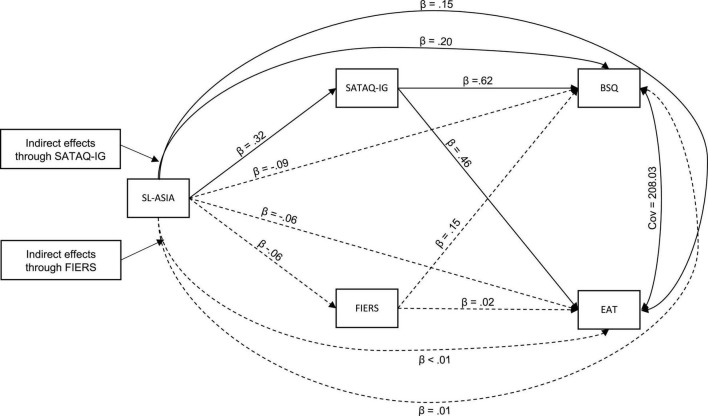
Women of SSEA descent ( = 112) aged 18-51 years ( = 23.10, = 6.4) completed a battery of questionnaires that inquire about these variables. A path analysis was conducted with acculturation serving as the independent (exogenous) variable, religiosity and internalization of the thin ideal as mediators, and body dissatisfaction and disordered eating as dependent (endogenous) variables.
Direct paths from acculturation to both body dissatisfaction and disordered eating were not significant. Thin ideal internalization completely accounted for the path from acculturation to both endogenous variables; whereas, religiosity did not significantly account for any indirect effect.
For SSEA women, internalization of appearance ideals is a potentially greater risk factor for disordered eating than acculturation or religiosity. As this was an atemporal mediation analysis, more work needs to be done exploring predictors of internalization in this population and how that may impact the development of disordered eating.
研究美国亚裔人群饮食失调情况时,常将所有亚裔个体归为一组,这可能掩盖了不同群体间的重要差异以及他们的文化适应经历。本研究旨在确定文化适应、外表理想内化和宗教信仰之间的关系,以此预测南亚和东南亚(SSEA)裔女性的身体不满和饮食失调情况。
112名年龄在18至51岁之间(平均年龄23.10岁,标准差6.4)的SSEA裔女性完成了一系列询问这些变量的问卷。进行路径分析,将文化适应作为自变量(外生变量),宗教信仰和瘦身理想内化作为中介变量,身体不满和饮食失调作为因变量(内生变量)。
从文化适应到身体不满和饮食失调的直接路径不显著。瘦身理想内化完全解释了从文化适应到两个内生变量的路径;而宗教信仰并未显著解释任何间接效应。
对于SSEA裔女性,外表理想内化可能比文化适应或宗教信仰更易引发饮食失调。由于这是一项非时间性中介分析,需要开展更多工作来探索该人群内化的预测因素以及这可能如何影响饮食失调的发展。