Paul Ryan W, DeBernardis Dennis A, Hameed Daniel, Clements Ari, Kamel Sarah I, Freedman Kevin B, Bishop Meghan E
Rothman Orthopaedic Institute, Philadelphia, Pennsylvania, USA.
Cooper Medical School of Rowan University, Camden, New Jersey, USA.
Orthop J Sports Med. 2022 Jul 26;10(7):23259671221083967. doi: 10.1177/23259671221083967. eCollection 2022 Jul.
Preoperative coracoid dimensions may affect the size of the bone graft transferred to the glenoid rim and thus the postoperative outcomes of Latarjet coracoid transfer.
To determine the effect of coracoid length and width as measured on preoperative magnetic resonance imaging (MRI) on outcomes after Latarjet treatment of anterior shoulder instability.
Cohort study; Level of evidence, 3.
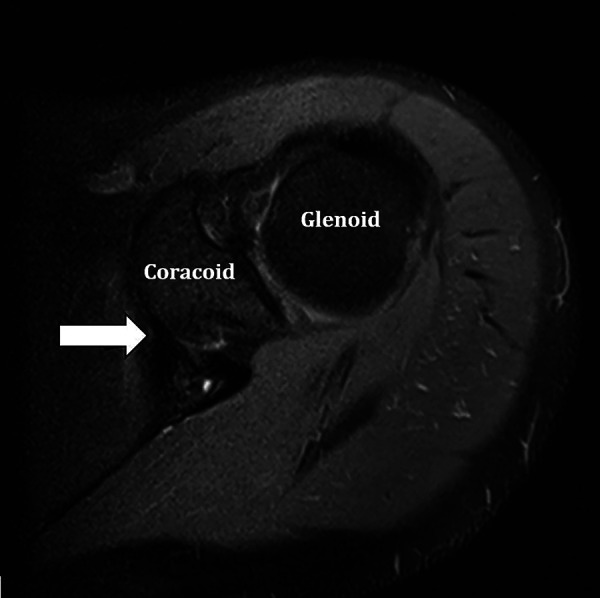
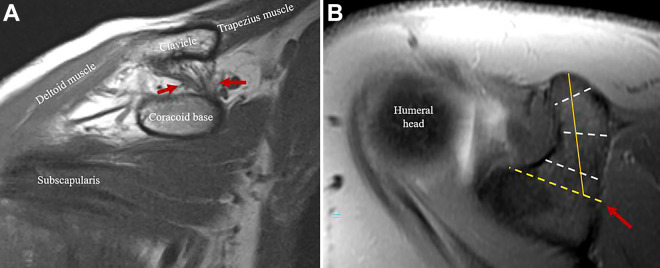
Included were patients who underwent primary Latarjet surgery between 2009 and 2019 and had preoperative MRI scans and minimum 2-year postoperative outcomes. Longitudinal coracoid length was measured on axial MRI sequences as the distance from the coracoclavicular ligament insertion to the distal tip. Comparisons were made between shorter and longer coracoids and between narrower and wider coracoids. The outcomes of interest were recurrent instability, reoperation, complications, return to sport (RTS), and American Shoulder and Elbow Surgeons (ASES) score. Independent-samples test, Mann-Whitney test, chi-square test, and Fisher exact test were used to compare outcomes between groups, and univariate correlation coefficients were calculated to evaluate the relationships between demographics and coracoid dimensions.
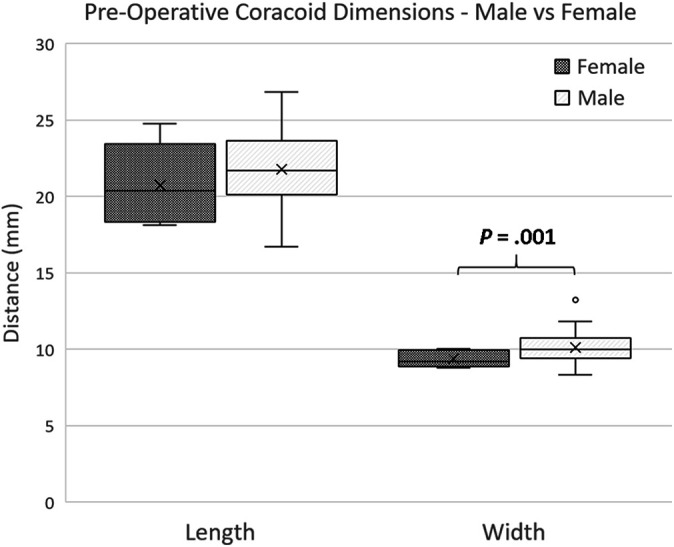
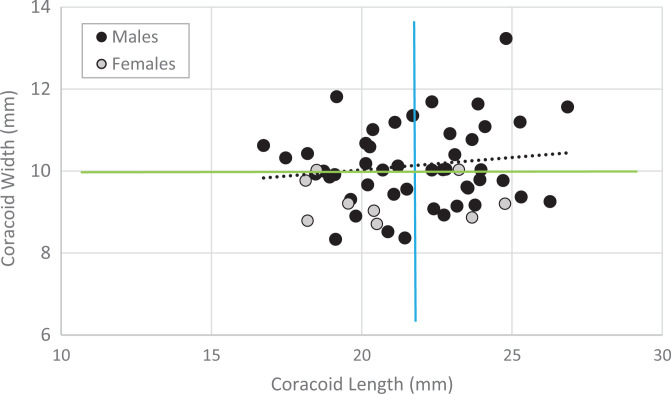
Overall, 56 patients were included (mean age, 28.4 years). The mean ± SD coracoid length was 21.6 ± 2.4 mm and width 10.0 ± 1.0 mm. Relative to patients with a longer coracoid (≥22 mm; n = 26), patients with a shorter coracoid (<22 mm; n = 30) had similar rates of recurrent instability (shorter vs longer; 6.7% vs 3.8%), complications (10.0% vs 15.4%), reoperation (3.3% vs 7.7%), and RTS (76.5% vs 58.8%) and similar postoperative ASES scores (85.0 vs 81.6) ( ≥ .05 for all). Likewise, relative to patients with a wider coracoid (≥10 mm; n = 27), patients with a narrower coracoid (<10 mm; n = 29) had similar prevalences of recurrent instability (narrower vs wider; 6.9% vs 3.7%), complications (17.2% vs 7.4%), reoperation (3.5% vs 7.4%), and RTS (66.7% vs 68.4%) and similar postoperative ASES scores (87.1 vs 80.0) ( ≥ .05 for all).
Patients undergoing Latarjet coracoid transfer had similar postoperative outcomes regardless of preoperative coracoid dimensions. These findings should be confirmed in a larger cohort before further clinical recommendations are made.
术前喙突尺寸可能会影响转移至肩胛盂边缘的骨移植块大小,进而影响Latarjet喙突转移术的术后效果。
确定术前磁共振成像(MRI)测量的喙突长度和宽度对Latarjet治疗前肩不稳术后效果的影响。
队列研究;证据等级,3级。
纳入2009年至2019年间接受初次Latarjet手术且术前行MRI扫描及术后至少随访2年的患者。在轴向MRI序列上测量喙突纵径,即从喙锁韧带附着点至远端的距离。比较喙突较短与较长以及较窄与较宽患者之间的情况。关注的结果指标包括复发性不稳、再次手术、并发症、恢复运动(RTS)以及美国肩肘外科医师(ASES)评分。采用独立样本t检验、Mann - Whitney检验、卡方检验和Fisher精确检验比较组间结果,并计算单变量相关系数以评估人口统计学特征与喙突尺寸之间的关系。
共纳入56例患者(平均年龄28.4岁)。喙突平均长度±标准差为21.6 ± 2.4 mm,宽度为10.0 ± 1.0 mm。与喙突较长(≥22 mm;n = 26)的患者相比,喙突较短(<22 mm;n = 30)的患者复发性不稳发生率(较短者与较长者相比:6.7%对3.8%)、并发症发生率(10.0%对15.4%)、再次手术率(3.3%对7.7%)和RTS率(76.5%对58.8%)相似,术后ASES评分也相似(85.0对81.6)(所有比较P≥0.05)。同样,与喙突较宽(≥10 mm;n = 27)的患者相比,喙突较窄(<10 mm;n = 29)的患者复发性不稳发生率(较窄者与较宽者相比:6.9%对3.