
一项关于非诺贝特用于对熊去氧胆酸反应不完全的原发性胆汁性胆管炎患者的随机对照试验。
A randomized, controlled trial on fenofibrate in primary biliary cholangitis patients with incomplete response to ursodeoxycholic acid.
作者信息
Li Chunlei, Zheng Kunyu, Chen Yiran, He Chengmei, Liu Suying, Yang Yunjiao, Li Mengtao, Zeng Xiaofeng, Wang Li, Zhang Fengchun
机构信息
Department of Internal Medicine, Peking Union Medical College Hospital, Chinese Academy of Medical Sciences & Peking Union Medical College, Beijing, China.
出版信息
Ther Adv Chronic Dis. 2022 Jul 26;13:20406223221114198. doi: 10.1177/20406223221114198. eCollection 2022.
INTRODUCTION
About one-third of primary biliary cholangitis (PBC) patients do not exhibit complete response to ursodeoxycholic acid (UDCA). Some of these patients were reported to benefit from the combination therapy of fibrates and UDCA, but more clinical evidence is required. In this study, we conducted a randomized, controlled trial on the safety and efficacy of fenofibrate in the treatment of patients with PBC.
METHODS
Forty-eight PBC patients with incomplete response to UDCA were enrolled and randomly assigned to two groups (24 in the experiment group and 24 in the control group). For the experimental group, the patients were administered 13-15 mg/kg/day UDCA in combination with 200 mg/day fenofibrate. For the control group, the patients continued to receive UDCA at 13-15 mg/kg/day. The patients were followed up for at least 12 months. The serum levels of alkaline phosphatase (ALP), gamma-glutamyl transferase (γ-GT), aspartate aminotransferase (AST), and other biochemical parameters were measured at 3, 6, and 12 months during the trial to assess patient conditions.
RESULTS
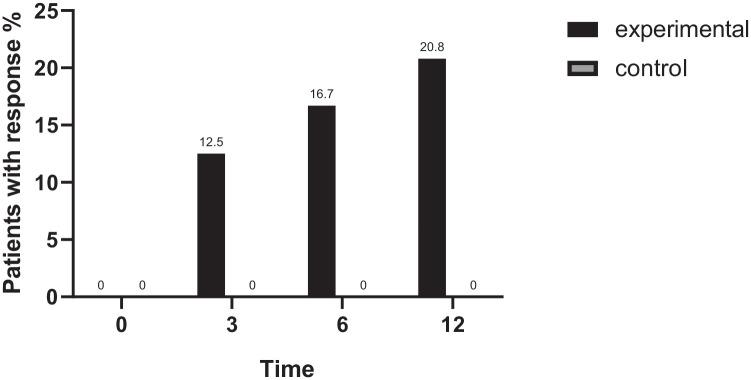
At 12 months, 20.8% of the patients in the experimental group had all three indexes of serum ALP, γ-GT, and total bilirubin normalized, while 0% of patients in the control group reached the primary outcome (difference, 20.8 percentage points; 95% CI, 4.6-37.0). 54.2% of the patients had normal ALP levels in the experimental group and 4.2% in the control group (difference, 50 percentage points; 95% CI, 28.5-71.5). The experimental group had greater improvement of ALP ( < 0.001) and IgG ( = 0.026) than the control group. The biochemical indexes of the patients in the experimental group also significantly improved during the treatment of fenofibrate.
CONCLUSION
Addition of fenofibrate can improve biochemical indexes of PBC patients who had an incomplete response to UDCA. Reversible elevation of serum creatine and transaminases is observed in some patients.The trial was registered in the Chinese Clinical Trial Registry (ChiCTR) as ChiCTR1800020160 (protocol available online: http://www.chictr.org.cn/showproj.aspx?proj=32443).
引言
约三分之一的原发性胆汁性胆管炎(PBC)患者对熊去氧胆酸(UDCA)未表现出完全反应。据报道,其中一些患者从贝特类药物与UDCA的联合治疗中获益,但仍需要更多临床证据。在本研究中,我们对非诺贝特治疗PBC患者的安全性和有效性进行了一项随机对照试验。
方法
纳入48例对UDCA反应不完全的PBC患者,随机分为两组(试验组24例,对照组24例)。试验组患者接受13 - 15mg/kg/天的UDCA联合200mg/天的非诺贝特治疗。对照组患者继续接受13 - 15mg/kg/天的UDCA治疗。对患者进行至少12个月的随访。在试验期间的3、6和12个月测量血清碱性磷酸酶(ALP)、γ-谷氨酰转移酶(γ-GT)、天冬氨酸转氨酶(AST)及其他生化指标,以评估患者病情。
结果
12个月时,试验组20.8%的患者血清ALP、γ-GT和总胆红素三项指标均恢复正常,而对照组0%的患者达到主要终点(差异为20.8个百分点;95%CI,4.6 - 37.0)。试验组54.2%的患者ALP水平正常,对照组为4.2%(差异为50个百分点;95%CI,28.5 - 71.5)。试验组的ALP(P < 0.001)和IgG(P = 0.026)改善程度均高于对照组。在非诺贝特治疗期间,试验组患者的生化指标也有显著改善。
结论
添加非诺贝特可改善对UDCA反应不完全的PBC患者的生化指标。部分患者出现血清肌酸和转氨酶可逆性升高。该试验已在中国临床试验注册中心(ChiCTR)注册,注册号为ChiCTR1800020160(方案可在线获取:http://www.chictr.org.cn/showproj.aspx?proj=32443)。



 Zotero 插件