Li Jia-Shang, Su Shu-Lan, Xu Zhuo, Zhao Li-Hui, Fan Ruo-Ying, Guo Jian-Ming, Qian Da-Wei, Duan Jin-Ao
Jiangsu Collaborative Innovation Center of Chinese Medicinal Resources Industrialization, National and Local Collaborative Engineering Center of Chinese Medicinal Resources Industrialization and Formulae Innovative Medicine, and Jiangsu Key Laboratory for High Technology Research of TCM Formulae, Nanjing University of Chinese Medicine, Nanjing, P.R. China.
Jiangsu Collaborative Innovation Center of Chinese Medicinal Resources Industrialization, National and Local Collaborative Engineering Center of Chinese Medicinal Resources Industrialization and Formulae Innovative Medicine, and Jiangsu Key Laboratory for High Technology Research of TCM Formulae, Nanjing University of Chinese Medicine, 138 Xianlin Road, Nanjing 210023, P.R. China.
Ther Adv Chronic Dis. 2022 Jul 28;13:20406223221091177. doi: 10.1177/20406223221091177. eCollection 2022.
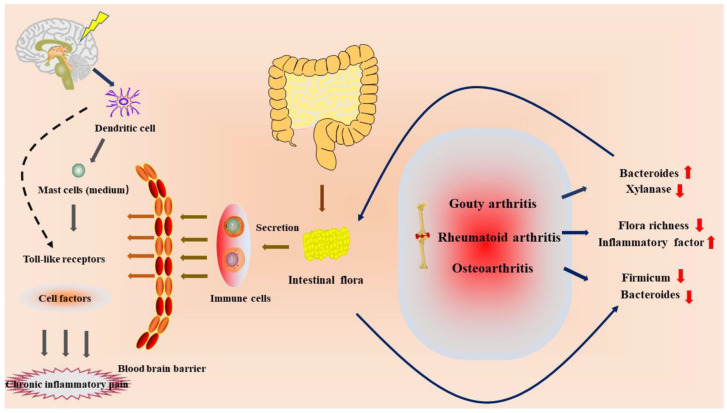
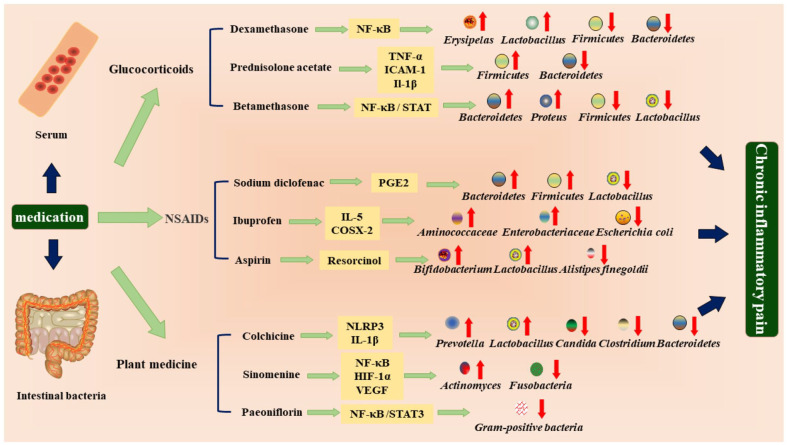
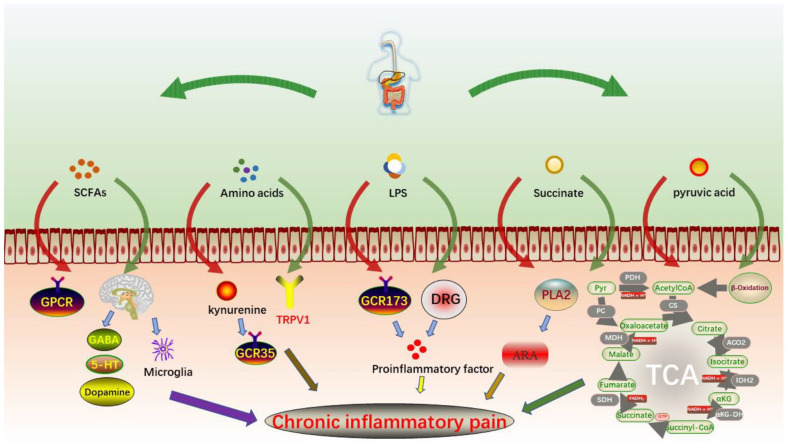
Observational findings achieved that gut microbes mediate human metabolic health and disease risk. The types of intestinal microorganisms depend on the intake of food and drugs and are also related to their metabolic level and genetic factors. Recent studies have shown that chronic inflammatory pain is closely related to intestinal microbial homeostasis. Compared with the normal intestinal flora, the composition of intestinal flora in patients with chronic inflammatory pain had significant changes in , , , etc. At the same time, short-chain fatty acids and amino acids, the metabolites of intestinal microorganisms, can regulate neural signal molecules and signaling pathways, thus affecting the development trend of chronic inflammatory pain. Glucocorticoids and non-steroidal anti-inflammatory drugs in the treatment of chronic inflammatory pain, the main mechanism is to affect the secretion of inflammatory factors and the abundance of intestinal bacteria. This article reviews the relationship between intestinal microorganisms and their metabolites on chronic inflammatory pain and the possible mechanism.
观察结果表明,肠道微生物介导人类代谢健康和疾病风险。肠道微生物的种类取决于食物和药物的摄入,也与它们的代谢水平和遗传因素有关。最近的研究表明,慢性炎性疼痛与肠道微生物稳态密切相关。与正常肠道菌群相比,慢性炎性疼痛患者的肠道菌群组成在 、 、 等方面有显著变化。同时,肠道微生物的代谢产物短链脂肪酸和氨基酸可调节神经信号分子和信号通路,从而影响慢性炎性疼痛的发展趋势。糖皮质激素和非甾体类抗炎药在治疗慢性炎性疼痛时,主要机制是影响炎症因子的分泌和肠道细菌的丰度。本文综述了肠道微生物及其代谢产物与慢性炎性疼痛之间的关系及可能机制。