Fan Linyuan, Liu Zhaohui, Zhang Zhan, Li Ting, Zong Xiaonan, Bai Huihui
Department of Gynecology, Beijing Obstetrics and Gynecology Hospital, Capital Medical University. Beijing Maternal and Child Health Care Hospital, Beijing, China.
Department of Microecological Laboratory, Beijing Obstetrics and Gynecology Hospital, Capital Medical University. Beijing Maternal and Child Health Care Hospital, Beijing, China.
Front Pharmacol. 2022 Jul 18;13:894149. doi: 10.3389/fphar.2022.894149. eCollection 2022.
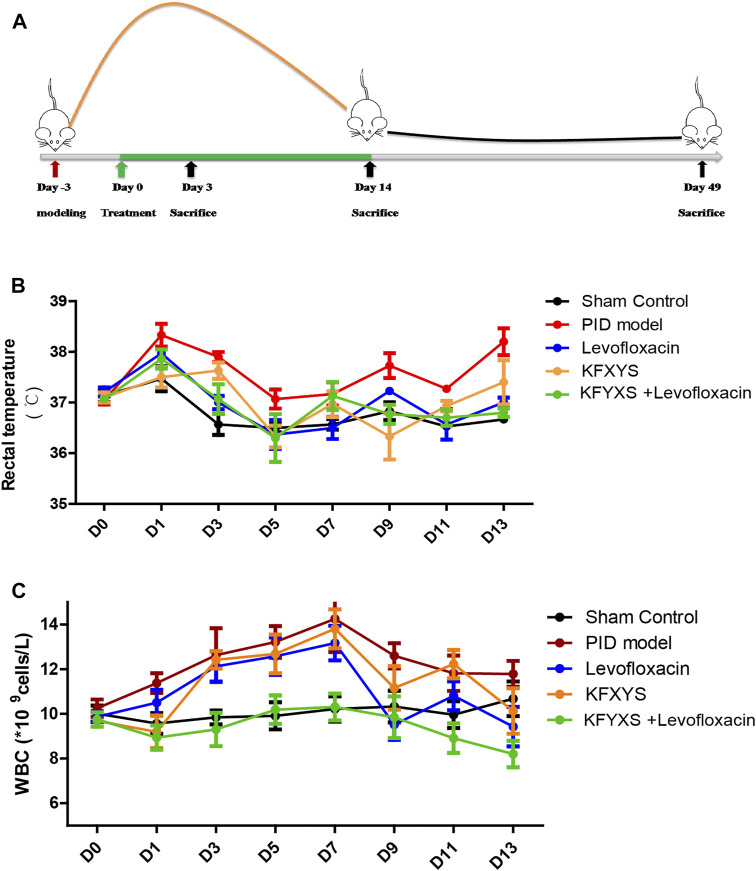
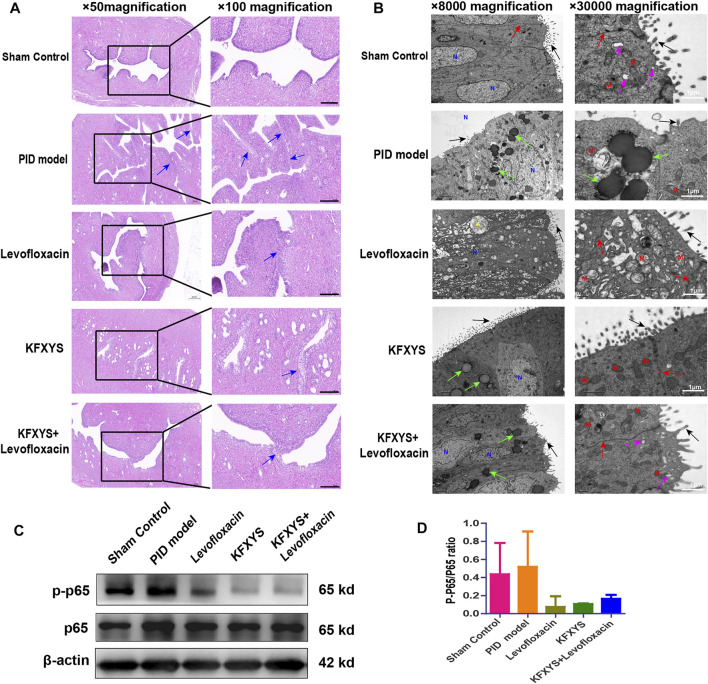
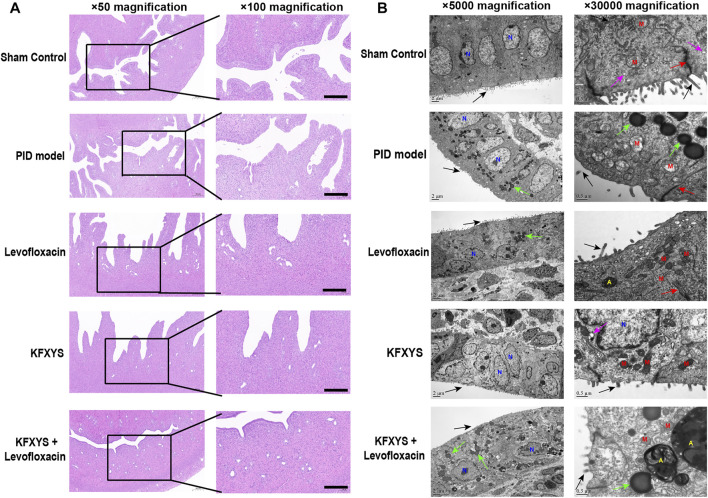
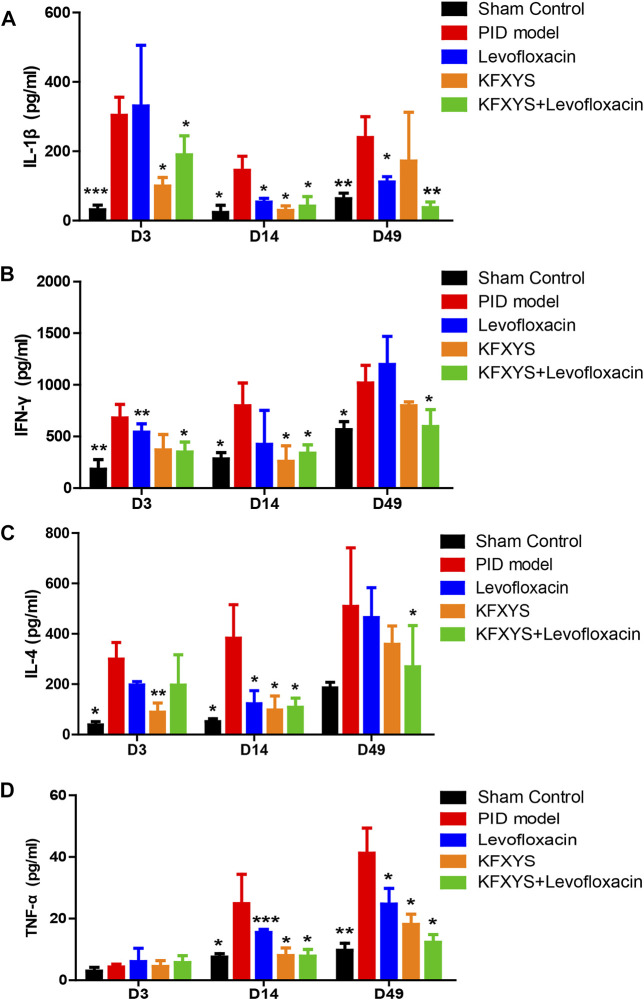
Pelvic inflammatory disease (PID) is infection-induced inflammation of the female upper reproductive tract that results in high fever, ectopic pregnancy, infertility, and varying degrees of chronic pelvic pain. Recent clinical studies have shown that Kangfuxiaoyanshuan (KFXYS), a Traditional Chinese Medicine (TCM) formulation, may short the course of the disease and reduce the occurrence of PID sequelae, but its pharmacological action and potential mechanism have not been fully elucidated. Here, we aimed to investigate the therapeutic effects and mechanism of KFXYS in rats with PID. A PID rat model was constructed through endometrial mechanical injury and pathogen infection. The rectal temperature was measured during the 14-days course of treatment, and the white blood cell (WBC) count in the blood and the levels of cytokines (IFN-γ, IL-1β, IL-4, TNF-α) in the serum were evaluated by ELISA. Hematoxylin and eosin (HE) staining was performed to analyze pathological changes, and transmission electron microscopy (TEM) was used to observe ultrastructural changes. The p-p65/p65 protein expression was evaluated by western blotting and the levels of MMP-2 and TGF-β in adhesion tissues were assessed by immunohistochemistry. KFXYS lowered the rectal temperature and the WBC counts in the blood in the acute stage of PID and alleviated inflammatory cell infiltration of the uterus, especially when combined with levofloxacin. KFXYS significantly decreased the levels of proinflammatory cytokines (IFN-γ, IL-1β, IL-4) and adhesion-related factors (TNF-α) and protected the ultrastructure of endometrial epithelial cells. Mechanistically, KFXYS inhibited the NF-κB activation by decreasing phosphorylation of p65, thus the alleviation of inflammation further reduced the expression of TGF-β and MMP-2, and inhibited the occurrence of uterine adhesions. These results revealed that KFXYS alleviated pelvic inflammation and effectively inhibits inflammation-associated adhesion, which indicated the potential role of KFXYS for treatment of PID and the prevention of PID sequelae.
盆腔炎(PID)是由感染引起的女性上生殖道炎症,可导致高热、异位妊娠、不孕以及不同程度的慢性盆腔疼痛。近期临床研究表明,中药制剂康复消炎栓(KFXYS)可能缩短疾病疗程并减少PID后遗症的发生,但其药理作用和潜在机制尚未完全阐明。在此,我们旨在研究KFXYS对PID大鼠的治疗作用及机制。通过子宫内膜机械损伤和病原体感染构建PID大鼠模型。在为期14天的治疗过程中测量直肠温度,采用酶联免疫吸附测定法(ELISA)评估血液中的白细胞(WBC)计数以及血清中细胞因子(IFN-γ、IL-1β、IL-4、TNF-α)的水平。进行苏木精-伊红(HE)染色以分析病理变化,并用透射电子显微镜(TEM)观察超微结构变化。通过蛋白质免疫印迹法评估p-p65/p65蛋白表达,采用免疫组织化学法评估粘连组织中MMP-2和TGF-β的水平。KFXYS可降低PID急性期的直肠温度和血液中的WBC计数,并减轻子宫的炎性细胞浸润,尤其是与左氧氟沙星联合使用时。KFXYS可显著降低促炎细胞因子(IFN-γ、IL-1β、IL-4)和粘连相关因子(TNF-α)的水平,并保护子宫内膜上皮细胞的超微结构。机制上,KFXYS通过降低p65的磷酸化抑制NF-κB激活,因此炎症减轻进一步降低了TGF-β和MMP-2的表达,并抑制了子宫粘连的发生。这些结果表明,KFXYS可减轻盆腔炎症并有效抑制炎症相关粘连,这表明KFXYS在治疗PID和预防PID后遗症方面具有潜在作用。