Zhang Qianning, Gong Xiaoling, Sun Lei, Miao Liyun, Zhou Yujie
Department of Pharmacy, Nanjing Drum Tower Hospital, The Affiliated Hospital of Nanjing University Medical School, Nanjing, China.
School of Basic Medicine and Clinical Pharmacy, China Pharmaceutical University Nanjing Drum Tower Hospital, Nanjing, China.
Front Oncol. 2022 Jul 18;12:791496. doi: 10.3389/fonc.2022.791496. eCollection 2022.
The Lung Immune Prognostic Index (LIPI) combines the lactate dehydrogenase (LDH) level and the derived neutrophil-to-lymphocyte ratio (dNLR). A lot of studies have shown that LDH and dNLR are associated with the prognosis of advanced non-small cell lung cancer (NSCLC) in patients treated with programmed cell death protein 1 (PD-1) or programmed death-ligand 1 (PD-L1) inhibitors. However, previous results were inconsistent, and the conclusions remain unclear. This meta-analysis aimed to investigate the predictive value of pretreatment LDH and dNLR for NSCLC progression in patients treated with PD-1/PD-L1 inhibitors.
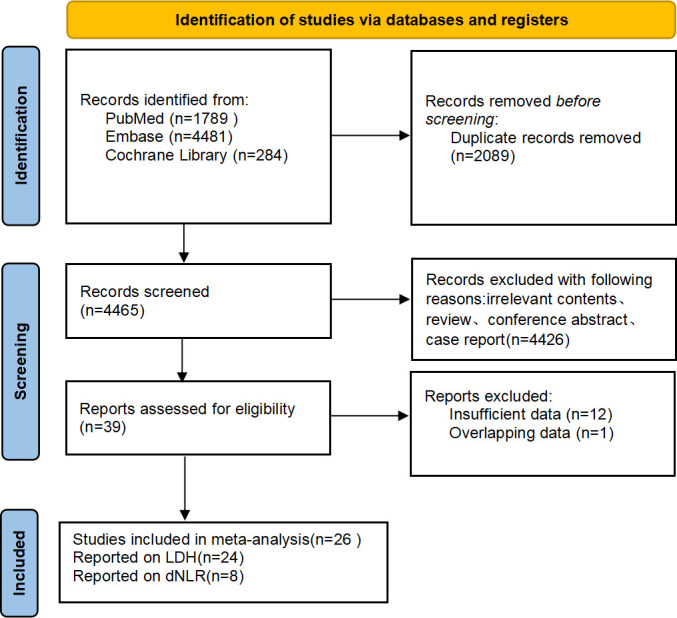
PubMed, Embase, and the Cochrane Library were searched by two researchers independently for related literature before March 2020. Hazard ratios (HRs) with 95% confidence intervals (CIs) for progression-free survival (PFS) and overall survival (OS) were extracted to assess the predictive value of LDH and dNLR. STATA 15. 0 was used to perform the meta-analysis.
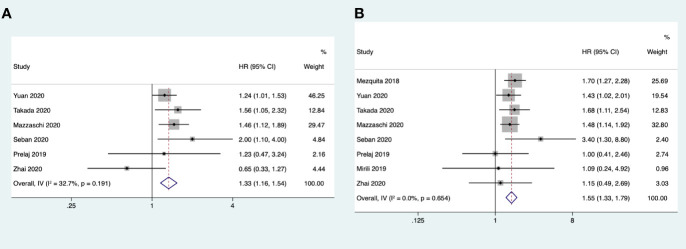
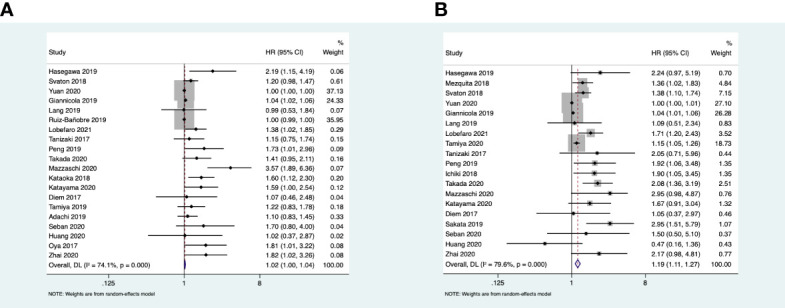
A total of 3,429 patients from 26 studies were included in this meta-analysis. The results revealed that high pretreatment LDH was related to poor OS (HR = 1.19, 95%CI = 1.11-1.24, < 0.001), but not closely related to poor PFS (HR = 1.02, 95%CI = 1.00-1.04, = 0.023 < 0.05). The pooled results for dNLR suggested that high pretreatment dNLR was related to poor OS (HR = 1.55, 95%CI = 1.33-1.80, < 0.001) and PFS (HR = 1.33, 95%CI = 1.16-1.54, < 0.001).
Both pretreatment LDH and dNLR have the potential to serve as peripheral blood biomarkers for patients with advanced NSCLC treated with PD-1/PD-L1 inhibitors. However, more studies on LDH are needed to evaluate its predictive value for PFS in patients with NSCLC.
肺免疫预后指数(LIPI)结合了乳酸脱氢酶(LDH)水平和衍生的中性粒细胞与淋巴细胞比值(dNLR)。许多研究表明,LDH和dNLR与接受程序性细胞死亡蛋白1(PD-1)或程序性死亡配体1(PD-L1)抑制剂治疗的晚期非小细胞肺癌(NSCLC)患者的预后相关。然而,先前的结果并不一致,结论仍不明确。这项荟萃分析旨在研究治疗前LDH和dNLR对接受PD-1/PD-L1抑制剂治疗的NSCLC患者疾病进展的预测价值。
由两名研究人员独立检索PubMed、Embase和Cochrane图书馆,检索2020年3月之前的相关文献。提取无进展生存期(PFS)和总生存期(OS)的风险比(HR)及95%置信区间(CI),以评估LDH和dNLR的预测价值。使用STATA 15.0进行荟萃分析。
本荟萃分析共纳入来自26项研究的3429例患者。结果显示,治疗前LDH水平高与OS差相关(HR = 1.19,95%CI = 1.11 - 1.24,P < 0.001),但与PFS差的相关性不密切(HR = 1.02,95%CI = 1.00 - 1.04,P = 0.023 < 0.05)。dNLR的汇总结果表明,治疗前dNLR高与OS差(HR = 1.55,95%CI = 1.33 - 1.80,P < 0.001)和PFS差(HR = 1.33,95%CI = 1.16 - 1.54,P < 0.001)相关。
治疗前LDH和dNLR均有可能作为接受PD-1/PD-L1抑制剂治疗的晚期NSCLC患者的外周血生物标志物。然而,需要更多关于LDH的研究来评估其对NSCLC患者PFS的预测价值。