Fraunhofer Institute for Toxicology and Experimental Medicine ITEM, Member of German Center for Lung Research (DZL), Hannover, Germany.
Biomedical Research in Endstage and Obstructive Lung Disease Hannover (BREATH), Member of Fraunhofer International Consortium for Anti-Infective Research (iCAIR), Member of Fraunhofer Cluster of Excellence Immune-Mediated Diseases (CIMD), Hannover, Germany.
Respir Res. 2022 Aug 4;23(1):201. doi: 10.1186/s12931-022-02116-4.
Aberrant extracellular matrix (ECM) deposition and remodelling is important in the disease pathogenesis of pulmonary fibrosis (PF). We characterised neoepitope biomarkers released by ECM turnover in lung tissue from bleomycin-treated rats and patients with PF and analysed the effects of two antifibrotic drugs: nintedanib and pirfenidone.
Precision-cut lung slices (PCLS) were prepared from bleomycin-treated rats or patients with PF. PCLS were incubated with nintedanib or pirfenidone for 48 h, and levels of neoepitope biomarkers of type I, III and VI collagen formation or degradation (PRO-C1, PRO-C3, PRO-C6 and C3M) as well as fibronectin (FBN-C) were assessed in the culture supernatants.
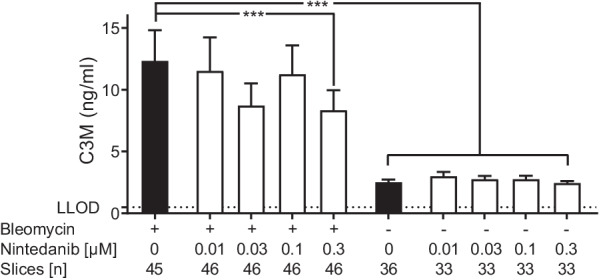
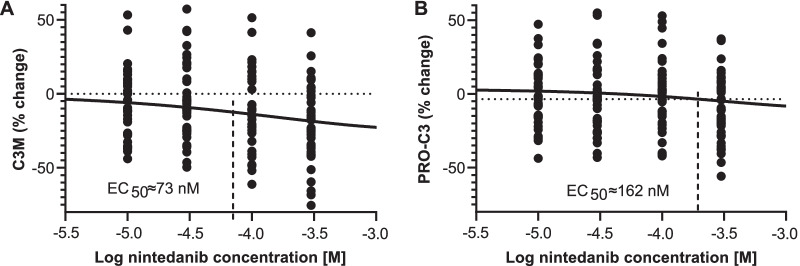
In rat PCLS, incubation with nintedanib led to a reduction in C3M, reflecting type III collagen degradation. In patient PCLS, incubation with nintedanib reduced the levels of PRO-C3 and C3M, thus showing effects on both formation and degradation of type III collagen. Incubation with pirfenidone had a marginal effect on PRO-C3. There were no other notable effects of either nintedanib or pirfenidone on the other neoepitope biomarkers studied.
This study demonstrated that nintedanib modulates neoepitope biomarkers of type III collagen turnover and indicated that C3M is a promising translational neoepitope biomarker of PF in terms of therapy assessment.
细胞外基质(ECM)的异常沉积和重塑在肺纤维化(PF)的发病机制中很重要。我们对博来霉素处理的大鼠和 PF 患者肺组织中 ECM 代谢释放的新表位生物标志物进行了特征描述,并分析了两种抗纤维化药物:尼达尼布和吡非尼酮的作用。
从博来霉素处理的大鼠或 PF 患者中制备精密切割肺切片(PCLS)。将 PCLS 与尼达尼布或吡非尼酮孵育 48 小时,评估 I 型、III 型和 VI 型胶原形成或降解的新表位生物标志物(PRO-C1、PRO-C3、PRO-C6 和 C3M)以及纤维连接蛋白(FBN-C)在培养上清液中的水平。
在大鼠 PCLS 中,尼达尼布孵育导致 C3M 减少,反映 III 型胶原降解。在患者 PCLS 中,尼达尼布孵育降低了 PRO-C3 和 C3M 的水平,因此对 III 型胶原的形成和降解均有作用。吡非尼酮孵育对 PRO-C3 仅有轻微影响。尼达尼布或吡非尼酮对其他研究的新表位生物标志物均无其他明显影响。
本研究表明尼达尼布调节 III 型胶原代谢的新表位生物标志物,并表明 C3M 是 PF 治疗评估的一种有前途的转化新表位生物标志物。