Tan Xin, Wu Jinjian, Ma Xiaomeng, Kang Shangyu, Yue Xiaomei, Rao Yawen, Li Yifan, Huang Haoming, Chen Yuna, Lyu Wenjiao, Qin Chunhong, Li Mingrui, Feng Yue, Liang Yi, Qiu Shijun
First Clinical Medical College, Guangzhou University of Chinese Medicine, Guangzhou, China.
Medical Imaging Center, First Affiliated Hospital of Guangzhou University of Chinese Medicine, Guangzhou, China.
Front Neurosci. 2022 Jul 19;16:926486. doi: 10.3389/fnins.2022.926486. eCollection 2022.
Cognitive impairment is generally found in individuals with type 2 diabetes mellitus (T2DM). Although they may not have visible symptoms of cognitive impairment in the early stages of the disorder, they are considered to be at high risk. Therefore, the classification of these patients is important for preventing the progression of cognitive impairment.
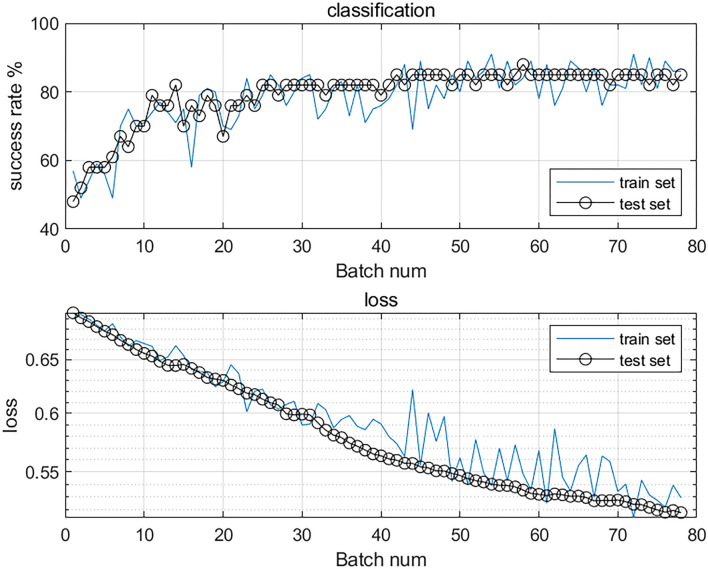
In this study, a convolutional neural network was used to construct a model for classifying 107 T2DM patients with and without cognitive impairment based on T1-weighted structural MRI. The Montreal cognitive assessment score served as an index of the cognitive status of the patients.
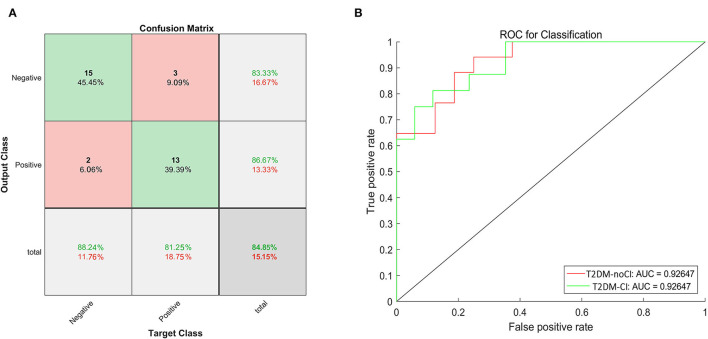
The classifier could identify T2DM-related cognitive decline with a classification accuracy of 84.85% and achieved an area under the curve of 92.65%.
The model can help clinicians analyze and predict cognitive impairment in patients and enable early treatment.
认知障碍在2型糖尿病(T2DM)患者中普遍存在。尽管在疾病早期他们可能没有明显的认知障碍症状,但仍被认为处于高风险状态。因此,对这些患者进行分类对于预防认知障碍的进展很重要。
在本研究中,基于T1加权结构磁共振成像(MRI),使用卷积神经网络构建了一个用于对107例有或无认知障碍的T2DM患者进行分类的模型。蒙特利尔认知评估得分作为患者认知状态的指标。
该分类器能够识别与T2DM相关的认知衰退,分类准确率为84.85%,曲线下面积为92.65%。
该模型可帮助临床医生分析和预测患者的认知障碍,并实现早期治疗。