Jin Dan, Zhou Bo, Han Ying, Ren Jiaji, Han Tong, Liu Bing, Lu Jie, Song Chengyuan, Wang Pan, Wang Dawei, Xu Jian, Yang Zhengyi, Yao Hongxiang, Yu Chunshui, Zhao Kun, Wintermark Max, Zuo Nianming, Zhang Xinqing, Zhou Yuying, Zhang Xi, Jiang Tianzi, Wang Qing, Liu Yong
Brainnetome Center & National Laboratory of Pattern Recognition Institute of Automation Chinese Academy of Sciences Beijing 100190 China.
School of Artificial Intelligence University of Chinese Academy of Sciences Beijing 100049 China.
Adv Sci (Weinh). 2020 Jun 9;7(14):2000675. doi: 10.1002/advs.202000675. eCollection 2020 Jul.
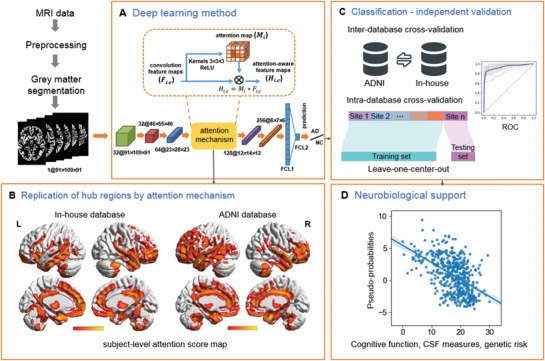
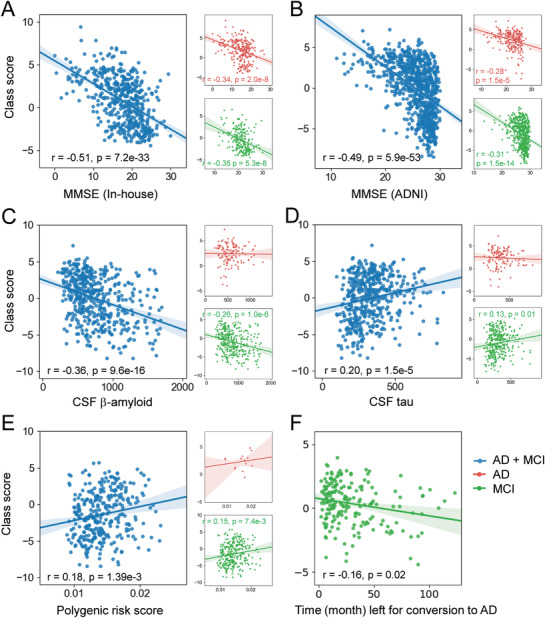
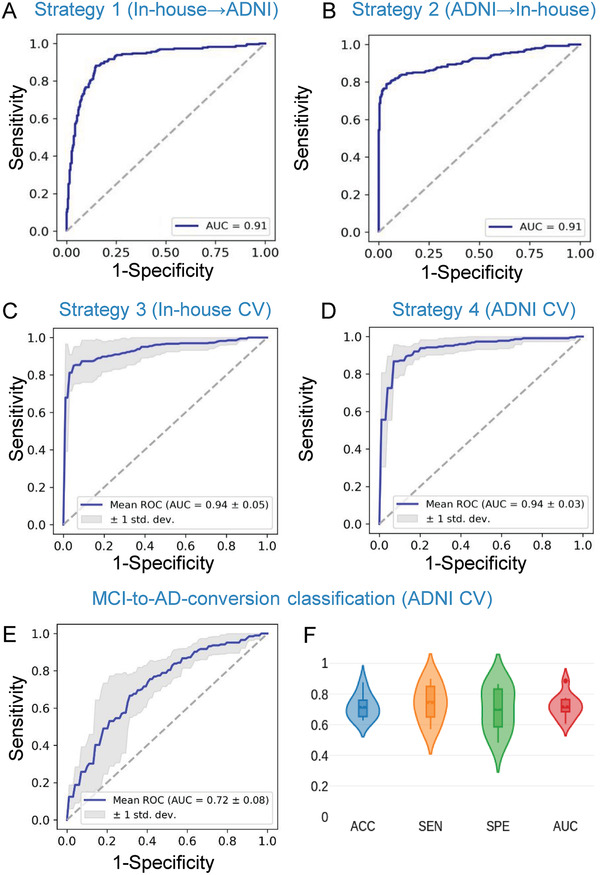
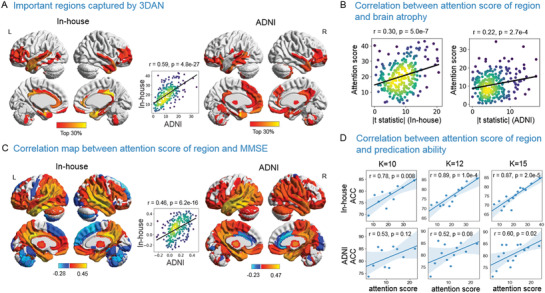
Precision medicine for Alzheimer's disease (AD) necessitates the development of personalized, reproducible, and neuroscientifically interpretable biomarkers, yet despite remarkable advances, few such biomarkers are available. Also, a comprehensive evaluation of the neurobiological basis and generalizability of the end-to-end machine learning system should be given the highest priority. For this reason, a deep learning model (3D attention network, 3DAN) that can simultaneously capture candidate imaging biomarkers with an attention mechanism module and advance the diagnosis of AD based on structural magnetic resonance imaging is proposed. The generalizability and reproducibility are evaluated using cross-validation on in-house, multicenter ( = 716), and public ( = 1116) databases with an accuracy up to 92%. Significant associations between the classification output and clinical characteristics of AD and mild cognitive impairment (MCI, a middle stage of dementia) groups provide solid neurobiological support for the 3DAN model. The effectiveness of the 3DAN model is further validated by its good performance in predicting the MCI subjects who progress to AD with an accuracy of 72%. Collectively, the findings highlight the potential for structural brain imaging to provide a generalizable, and neuroscientifically interpretable imaging biomarker that can support clinicians in the early diagnosis of AD.
阿尔茨海默病(AD)的精准医学需要开发个性化、可重复且具有神经科学可解释性的生物标志物,然而,尽管取得了显著进展,但此类生物标志物却寥寥无几。此外,应将对端到端机器学习系统的神经生物学基础和通用性进行全面评估作为重中之重。因此,提出了一种深度学习模型(3D注意力网络,3DAN),该模型可以通过注意力机制模块同时捕获候选成像生物标志物,并基于结构磁共振成像推进AD的诊断。使用内部、多中心(=716)和公共(=1116)数据库进行交叉验证,评估其通用性和可重复性,准确率高达92%。AD和轻度认知障碍(MCI,痴呆的中期阶段)组的分类输出与临床特征之间的显著关联为3DAN模型提供了坚实的神经生物学支持。3DAN模型在预测进展为AD的MCI受试者方面表现良好,准确率为72%,进一步验证了其有效性。总体而言,这些发现突出了结构脑成像提供一种可通用且具有神经科学可解释性的成像生物标志物的潜力,该生物标志物可支持临床医生早期诊断AD。