Poojari Vidyashree Ganesh, Jose Aiswarya, Pai Muralidhar V
Department of Obstetrics and Gynecology, Kasturba Medical College, Manipal, Manipal Academy of Higher Education (MAHE), Manipal, Karnataka India.
J Obstet Gynaecol India. 2022 Aug;72(Suppl 1):134-138. doi: 10.1007/s13224-021-01574-y. Epub 2021 Oct 9.
Sonographic measurement of fetal head circumference (HC) is an essential parameter for the estimation of fetal weight as well as in cases with abnormal fetal head size. Since there is a lack of data, the present study was to assess the accuracy of ultrasonographic estimation of fetal HC and to identify factors that affect the accuracy of fetal HC estimation.
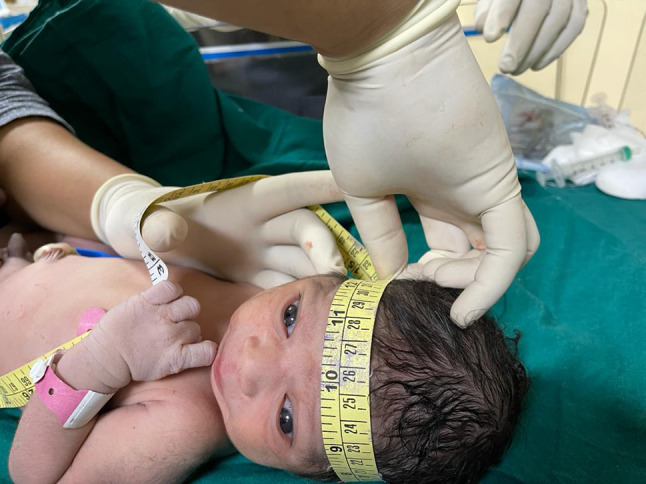
A prospective cohort observational study was conducted for a year. Sonographic fetal biometry including HC was performed, and fetal HC was measured postnatally. Measures of accuracy and various factors which affect the accuracy are analyzed.
Ultrasonographic HC underestimated actual postnatal HC in 87.5% and overestimated actual HC in 12.5%. Sonographic underestimation of HC persisted throughout gestation and became more pronounced as gestational age increased. Error in HC was statistically significant in those with low liquor and anterior placenta and in those who had instrumental delivery. Parity, fetal presentation, and maternal diabetes did not affect the error in ultrasonographic measurement of head circumference. When the HC was beyond 95th centile on ultrasound, the error detected postnatally was significant (- 14 mm vs. - 8 mm), though not statistically significant ( value 0.82). The difference between the sonographic and postnatal HC was also related to the mode of delivery with the highest error seen in those who had instrumental vaginal delivery ( value 0.031).
The ultrasound estimation of fetal HC is associated with significant underestimation of the actual HC measured postnatally. The error in measuring fetal HC increased in those with advanced gestational age, low liquor, and anterior location of the placenta and in those who had instrumental vaginal delivery. The measurement error may have important implications in specific clinical scenarios like monitoring pregnancy with fetal growth restriction, suspected fetal head growth abnormalities, and labor outcome.
超声测量胎儿头围(HC)是估计胎儿体重以及胎儿头部大小异常情况时的一项重要参数。由于缺乏相关数据,本研究旨在评估超声估计胎儿HC的准确性,并确定影响胎儿HC估计准确性的因素。
进行了为期一年的前瞻性队列观察研究。进行包括HC在内的超声胎儿生物测量,并在产后测量胎儿HC。分析准确性测量结果以及影响准确性的各种因素。
超声测量的HC在87.5%的情况下低估了实际产后HC,在12.5%的情况下高估了实际HC。整个孕期超声对HC的低估持续存在,且随着孕周增加而更加明显。羊水过少、前置胎盘以及器械助产的产妇,其HC测量误差具有统计学意义。产次、胎儿先露部位和母亲糖尿病并不影响超声测量头围的误差。当超声测量的HC超过第95百分位数时,产后检测到的误差显著(-14毫米对-8毫米),尽管无统计学意义(P值0.82)。超声与产后HC之间的差异也与分娩方式有关,器械阴道分娩者误差最大(P值0.031)。
超声估计胎儿HC与产后实际测量的HC存在显著低估相关。孕周增加、羊水过少、胎盘前置以及器械阴道分娩的产妇,测量胎儿HC的误差会增加。测量误差在特定临床场景中可能具有重要意义,如监测胎儿生长受限、疑似胎儿头部生长异常的妊娠以及分娩结局。