Li Yueyue, Li Jingjie, Shi Yuhuan, Zhou Xuhui, Feng Wanqing, Han Lu, Ma Daqing, Jiang Hong, Yuan Yongfang
Department of Pharmacy, Shanghai Ninth People's Hospital, Shanghai JiaoTong University School of Medicine, Shanghai, China.
Department of Anaesthesiology, Shanghai Ninth People's Hospital, Shanghai Jiao Tong University School of Medicine, Shanghai, China.
Front Pharmacol. 2022 Jul 19;13:932776. doi: 10.3389/fphar.2022.932776. eCollection 2022.
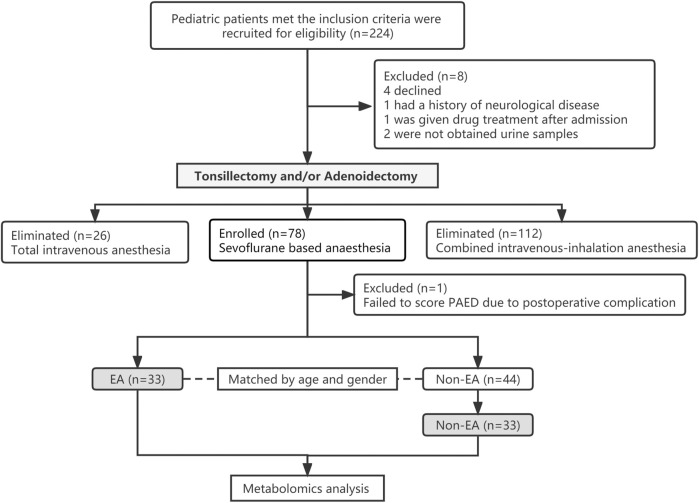
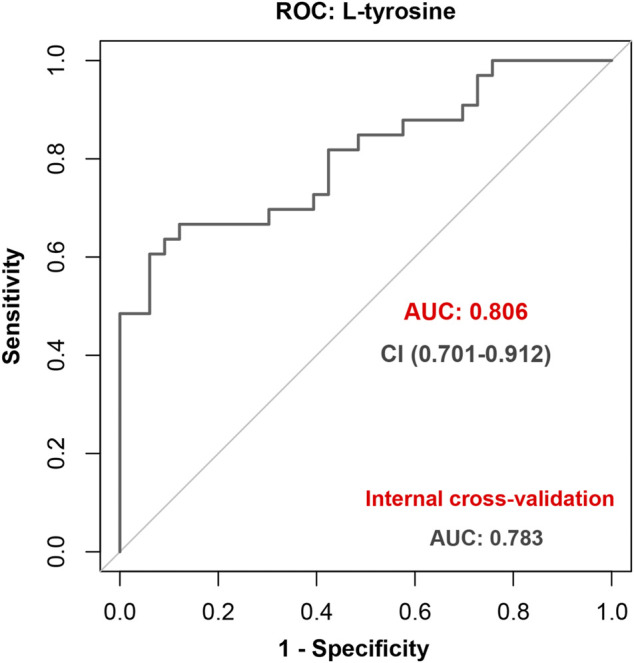
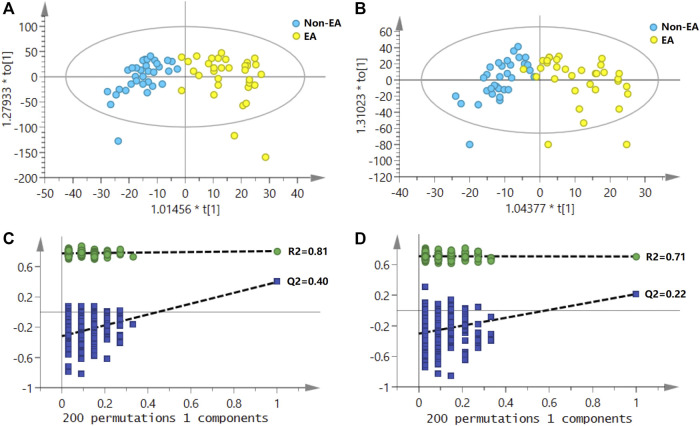
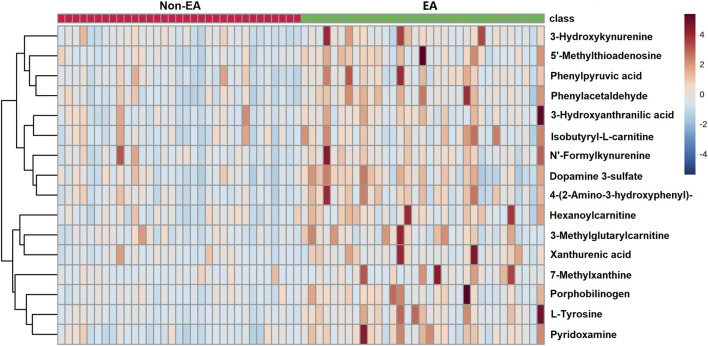
Emergence agitation (EA) is very common in paediatric patients during recovery from general anaesthesia, but underlying mechanisms remain unknown. This prospective study was designed to profile preoperative urine metabolites and identify potential biomarkers that can predict the occurrence of EA. A total of 224 patients were screened for recruitment; of those, preoperative morning urine samples from 33 paediatric patients with EA and 33 non-EA gender- and age-matched patients after being given sevoflurane general anaesthesia were analysed by ultra-high-performance liquid chromatography (UHPLC) coupled with a Q Exactive Plus mass spectrometer. Univariate analysis and orthogonal projection to latent structures squares-discriminant analysis (OPLS-DA) were used to analyse these metabolites. The least absolute shrinkage and selection operator (LASSO) regression was used to identify predictive variables. The predictive model was evaluated through the receiver operating characteristic (ROC) analysis and then further assessed with 10-fold cross-validation. Seventy-seven patients completed the study, of which 33 (42.9%) patients developed EA. EA and non-EA patients had many differences in preoperative urine metabolic profiling. Sixteen metabolites including nine aromatic amino acid metabolites, acylcarnitines, pyridoxamine, porphobilinogen, 7-methylxanthine, and 5'-methylthioadenosine were found associated with an increased risk of EA, and they all exhibited higher levels in the EA group than in the non-EA group. The main metabolic pathways involved in these metabolic changes included phenylalanine, tyrosine and tryptophan metabolisms. Among these potential biomarkers, L-tyrosine had the best predictive value with an odds ratio (OR) (95% CI) of 5.27 (2.20-12.63) and the AUC value of 0.81 (0.70-0.91) and was robust with internal 10-fold cross-validation. Urinary aromatic amino acid metabolites are closely associated with EA in paediatric patients, and further validation with larger cohorts and mechanistic studies is needed. clinicaltrials.gov, identifier NCT04807998.
苏醒期躁动(EA)在小儿患者全身麻醉苏醒过程中非常常见,但其潜在机制尚不清楚。本前瞻性研究旨在分析术前尿液代谢物谱,并确定可预测EA发生的潜在生物标志物。共筛选了224例患者以纳入研究;其中,对33例接受七氟醚全身麻醉后发生EA的小儿患者和33例性别及年龄匹配的未发生EA的患者的术前晨尿样本进行了超高效液相色谱(UHPLC)结合Q Exactive Plus质谱仪分析。采用单变量分析和正交投影到潜在结构判别分析(OPLS-DA)对这些代谢物进行分析。使用最小绝对收缩和选择算子(LASSO)回归来识别预测变量。通过受试者工作特征(ROC)分析对预测模型进行评估,然后用10倍交叉验证进一步评估。77例患者完成了研究,其中33例(42.9%)患者发生了EA。EA患者和未发生EA的患者在术前尿液代谢谱方面存在许多差异。发现16种代谢物与EA风险增加相关,包括9种芳香族氨基酸代谢物、酰基肉碱、吡哆胺、胆色素原、7-甲基黄嘌呤和5'-甲硫腺苷,且它们在EA组中的水平均高于未发生EA的组。这些代谢变化涉及的主要代谢途径包括苯丙氨酸、酪氨酸和色氨酸代谢。在这些潜在生物标志物中,L-酪氨酸具有最佳预测价值,优势比(OR)(95%CI)为5.27(2.20-12.63),AUC值为0.81(0.70-0.91),并且在内部10倍交叉验证中表现稳健。小儿患者尿液中的芳香族氨基酸代谢物与EA密切相关,需要更大样本队列和机制研究进行进一步验证。clinicaltrials.gov标识符:NCT04807998