Yang Ruoyu, Wang Yi, Yuan Chunhua, Shen Xunzhang, Cai Ming, Wang Liyan, Hu Jingyun, Song Haihan, Wang Hongbiao, Zhang Lei
College of Rehabilitation Sciences, Shanghai University of Medicine and Health Sciences, Shanghai, China.
Surgery Ward, Shanghai Health Rehabilitation Hospital, Shanghai, China.
Front Physiol. 2023 Jun 14;14:1197224. doi: 10.3389/fphys.2023.1197224. eCollection 2023.
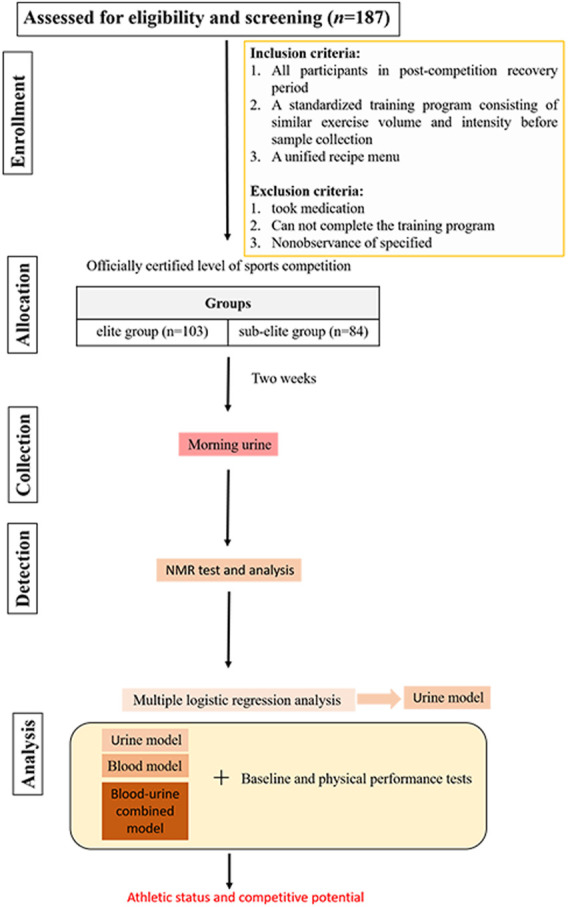
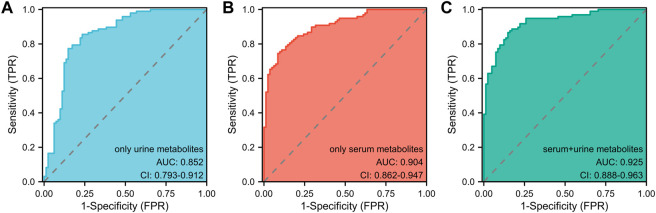
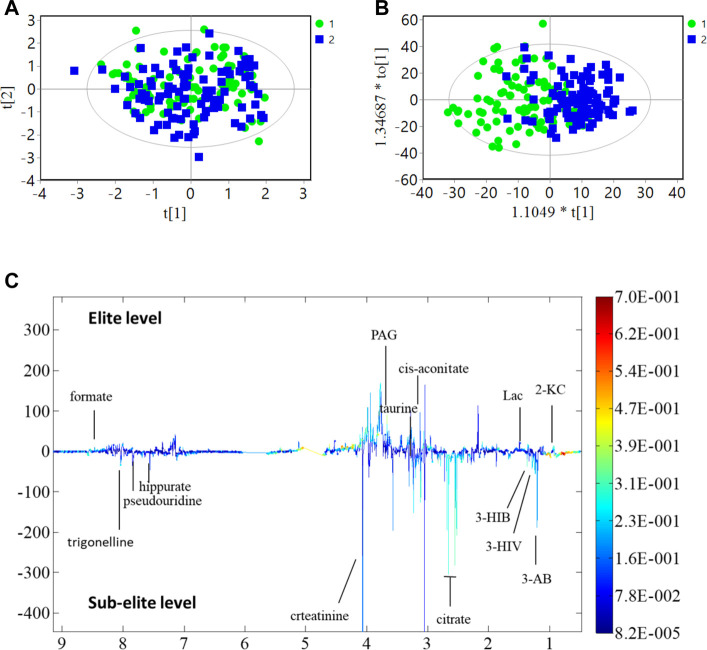
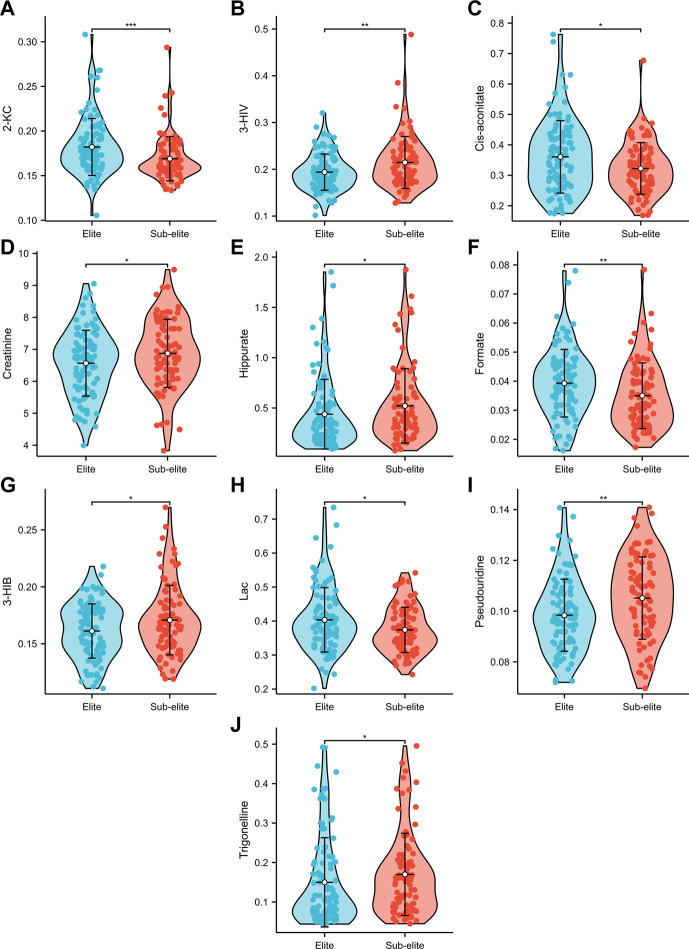
The purpose of this study was to employ metabolomics for the analysis of urine metabolites in swimmers, with the aim of establishing models for assessing their athletic status and competitive potential. Furthermore, the study sought to compare the identification efficacy of multi-component (urine and blood) model versus single-component (urine or blood) models, in order to determine the optimal approach for evaluating training and competitive status. A total of 187 Chinese professional swimmers, comprising 103 elite and 84 sub-elite level athletes, were selected as subjects for this study. Urine samples were obtained from each participant and subjected to nuclear magnetic resonance (NMR) metabolomics analysis. Significant urine metabolites were screened through multivariable logistic regression analysis, and an identification model was established. Based on the previously established model of blood metabolites, this study compared the discriminative and predictive performance of three models: either urine or blood metabolites model and urine + blood metabolites model. Among 39 urine metabolites, 10 were found to be significantly associated with the athletic status of swimmers ( < 0.05). Of these, levels of 2-KC, cis-aconitate, formate, and LAC were higher in elite swimmers compared to sub-elite athletes, while levels of 3-HIV, creatinine, 3-HIB, hippurate, pseudouridine, and trigonelline were lower in elite swimmers. Notably, 2-KC and 3-HIB exhibited the most substantial differences. An identification model was developed to estimate physical performance and athletic level of swimmers while adjusting for different covariates and including 2-KC and 3-HIB. The urine metabolites model showed an area under the curve (AUC) of 0.852 (95% CI: 0.793-0.912) for discrimination. Among the three identification models tested, the combination of urine and blood metabolites showed the highest performance than either urine or blood metabolites, with an AUC of 0.925 (95% CI: 0.888-0.963). The two urine metabolites, 2-KC and 3-HIV, can serve as significant urine metabolic markers to establish a discrimination model for identifying the athletic status and competitive potential of Chinese elite swimmers. Combining two screened urine metabolites with four metabolites reported exhibiting significant differences in blood resulted in improved predictive performance compared to using urine metabolites alone. These findings indicate that combining blood and urine metabolites has a greater potential for identifying and predicting the athletic status and competitive potential of Chinese professional swimmers.
本研究的目的是利用代谢组学分析游泳运动员的尿液代谢物,旨在建立评估其运动状态和竞争潜力的模型。此外,该研究试图比较多组分(尿液和血液)模型与单组分(尿液或血液)模型的识别效能,以确定评估训练和比赛状态的最佳方法。本研究共选取了187名中国职业游泳运动员作为研究对象,其中包括103名精英水平和84名次精英水平的运动员。从每位参与者身上采集尿液样本,并进行核磁共振(NMR)代谢组学分析。通过多变量逻辑回归分析筛选出显著的尿液代谢物,并建立了识别模型。基于先前建立的血液代谢物模型,本研究比较了三种模型的判别和预测性能:尿液或血液代谢物模型以及尿液+血液代谢物模型。在39种尿液代谢物中,发现有10种与游泳运动员的运动状态显著相关(<0.05)。其中,精英游泳运动员的2-KC、顺乌头酸、甲酸和乳酸水平高于次精英运动员,而精英游泳运动员的3-HIV、肌酐、3-HIB、马尿酸、假尿苷和胡芦巴碱水平较低。值得注意的是,2-KC和3-HIB表现出最显著的差异。建立了一个识别模型,在调整不同协变量并纳入2-KC和3-HIB的情况下,估计游泳运动员的身体表现和运动水平。尿液代谢物模型的判别曲线下面积(AUC)为0.852(95%CI:0.793-0.912)。在所测试的三种识别模型中,尿液和血液代谢物的组合表现出比尿液或血液代谢物更高的性能,AUC为0.925(95%CI:0.888-0.963)。两种尿液代谢物2-KC和3-HIV可作为重要的尿液代谢标志物,用于建立识别中国精英游泳运动员运动状态和竞争潜力的判别模型。与单独使用尿液代谢物相比,将两种筛选出的尿液代谢物与报告显示在血液中有显著差异的四种代谢物相结合,可提高预测性能。这些发现表明,结合血液和尿液代谢物在识别和预测中国职业游泳运动员的运动状态和竞争潜力方面具有更大的潜力。