Tan Ying Kiat, Han Ming Xuan, Tan Benjamin Yong-Qiang, Sia Ching-Hui, Goh Claire Xin Yi, Leow Aloysius Sheng-Ting, Hausenloy Derek J, Chan Edwin Shih Yen, Ong Marcus Eng Hock, Ho Andrew Fu Wah
Yong Loo Lin School of Medicine, National University of Singapore, Singapore, Singapore.
Emergency Medical Services Department, Singapore Civil Defence Force, Ministry of Home Affairs, Singapore, Singapore.
Ann Transl Med. 2022 May;10(9):515. doi: 10.21037/atm-21-4984.
Head-up cardiopulmonary resuscitation (HU-CPR) is an experimental treatment for sudden cardiac arrest (SCA), where cardiopulmonary resuscitation (CPR) is performed in a ramped position. We evaluated whether HU-CPR improved survival and surrogate outcomes as compared to standard CPR (S-CPR).
Studies reporting on HU-CPR in SCA were searched for in PubMed, Embase and Cochrane Library from inception to May 1st 2021. Outcomes included neurologically-intact survival, 24-hour-survival, intracranial pressure (ICP), cerebral perfusion pressure (CerPP) and brain blood flow (BBF). Risk of bias was assessed using the GRADE assessment tool and Newcastle Ottawa Scale. Fixed- and random-effects models were used to estimate the pooled effects of HU-CPR at 30 degrees.
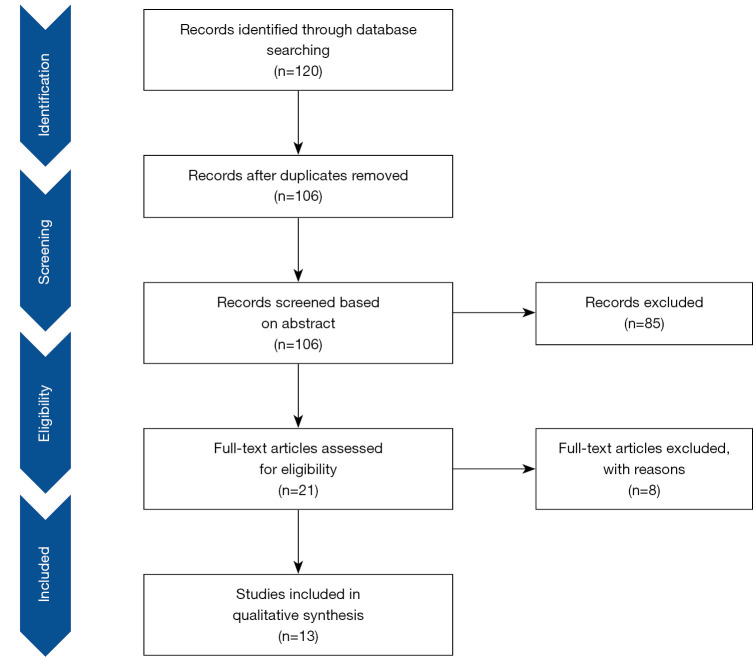
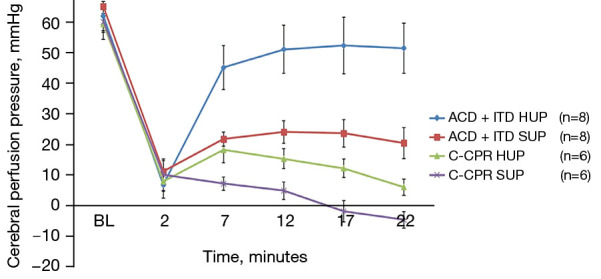
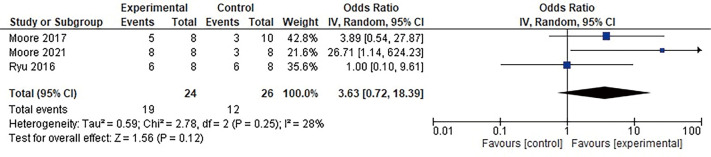
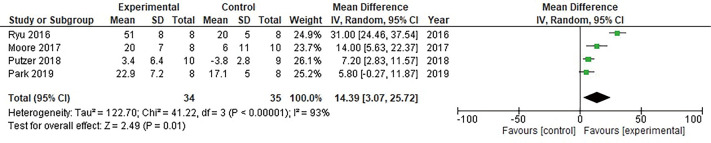
Thirteen articles met the criteria for inclusion (11 animal-only studies, one before-and-after human-only study, one study that utilized human- and animal-cadavers). Among animal studies, the most common implementation of HU-CPR was a 30-degree upward tilt of the head and thorax (n=7), while four studies investigated controlled sequential elevation (CSE). Two animal studies reported improved cerebral performance category (CPC) scores at 24-hour. The pooled effect on 24-hour survival was not statistically significant (P=0.37). The lone human study reported doubled return of spontaneous circulation (ROSC) (17.9% versus 34.2%, P<0.0001). The pooled effect on ROSC in three porcine studies was OR =3.63 (95% CI: 0.72-18.39). Pooled effects for surrogate physiological outcomes of intracranial cranial pressure (MD -14.08, 95% CI: -23.21 to -4.95, P=0.003), CerPP (MD 14.39, 95% CI: 3.07-25.72, P=0.01) and BBF (MD 0.14, 95% CI: 0.02-0.27, P=0.03), showed statistically significant benefit.
Overall, HU-CPR improved neurologically-intact survival at 24-hour, ROSC and physiological surrogate outcomes in animal models. Despite promising preclinical data, and one human observational study, clinical equipoise remains surrounding the role of HU-CPR in SCA, necessitating clarification with future randomized human trials.
头高位心肺复苏(HU-CPR)是一种针对心脏骤停(SCA)的实验性治疗方法,即在斜坡位进行心肺复苏(CPR)。我们评估了与标准心肺复苏(S-CPR)相比,HU-CPR是否能提高生存率和替代结局。
在PubMed、Embase和Cochrane图书馆中检索自数据库建立至2021年5月1日期间报告HU-CPR用于SCA的研究。结局包括神经功能完好的生存、24小时生存、颅内压(ICP)、脑灌注压(CerPP)和脑血流量(BBF)。使用GRADE评估工具和纽卡斯尔渥太华量表评估偏倚风险。采用固定效应模型和随机效应模型估计30度时HU-CPR的合并效应。
13篇文章符合纳入标准(11篇仅为动物研究,1篇仅为前后对照的人体研究,1篇使用人体和动物尸体的研究)。在动物研究中,HU-CPR最常见的实施方式是头部和胸部向上倾斜30度(n = 7),而4项研究调查了控制性顺序抬高(CSE)。两项动物研究报告24小时时脑功能分类(CPC)评分有所改善。对24小时生存的合并效应无统计学意义(P = 0.37)。唯一的人体研究报告自主循环恢复(ROSC)增加了一倍(17.9%对34.2%,P < 0.0001)。三项猪研究中对ROSC的合并效应为OR = 3.63(95%CI:0.72 - 18.39)。颅内压(MD -14.08,95%CI:-23.21至-4.95,P = 0.003)、CerPP(MD 14.39,95%CI:3.07 - 25.72,P = 0.01)和BBF(MD 0.14,95%CI:0.02 - 0.27,P = 0.03)等替代生理结局的合并效应显示出统计学显著益处。
总体而言,HU-CPR在动物模型中改善了24小时神经功能完好的生存、ROSC和生理替代结局。尽管有前景良好的临床前数据和一项人体观察性研究,但围绕HU-CPR在SCA中的作用仍存在临床 equipoise,需要未来的随机人体试验予以澄清。