Maleitzke Tazio, Zocholl Dario, Topp Tobias, Dimitrov-Discher Annika, Daus Elly, Reaux Gabriel, Zocholl Malin, Conze Rolf Nicolas, Kolster Moritz, Weber Philipp, Fleckenstein Florian Nima, Scheutz Henriksen Louise, Stöckle Ulrich, Fuchs Thomas, Gümbel Denis, Spranger Nikolai, Ringk Alexander, Märdian Sven
Charité - Universitätsmedizin Berlin, corporate member of Freie Universität Berlin and Humboldt-Universität zu Berlin, Center for Musculoskeletal Surgery, Berlin, Germany.
Berlin Institute of Health at Charité - Universitätsmedizin Berlin, Julius Wolff Institute, Berlin, Germany.
Front Psychiatry. 2022 Jul 19;13:927696. doi: 10.3389/fpsyt.2022.927696. eCollection 2022.
While repeated shutdown and lockdown measures helped contain the spread of SARS-CoV-2 during the COVID-19 pandemic, social distancing and self-isolation negatively impacted global mental health in 2020 and 2021. Although suicide rates did reportedly not increase during the first months of the pandemic, long-term data, and data on the quality of serious violent suicide attempts (SVSAs) are not available to date.
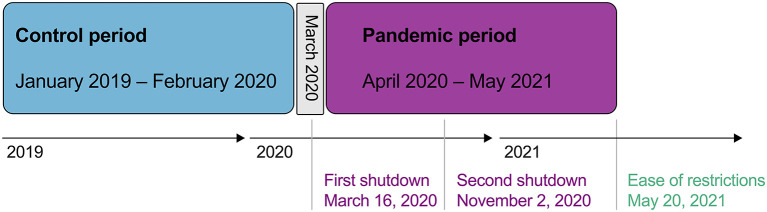
Orthopaedic trauma patient visits to the emergency department (ED), ED trauma team activations, and SVSAs were retrospectively evaluated from January 2019 until May 2021 in four Level-I Trauma Centers in Berlin, Germany. SVSAs were assessed for suicide method, injury pattern and severity, type of treatment, and length of hospital stay.
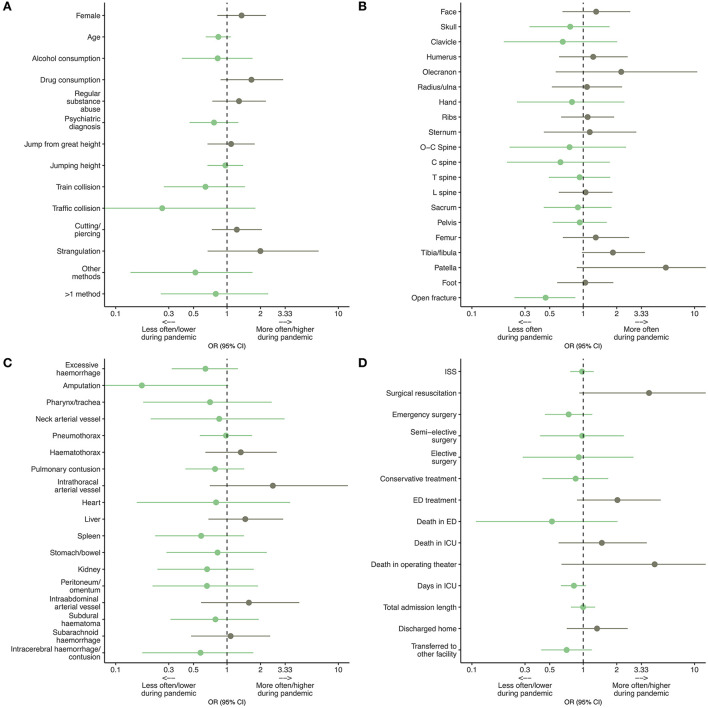
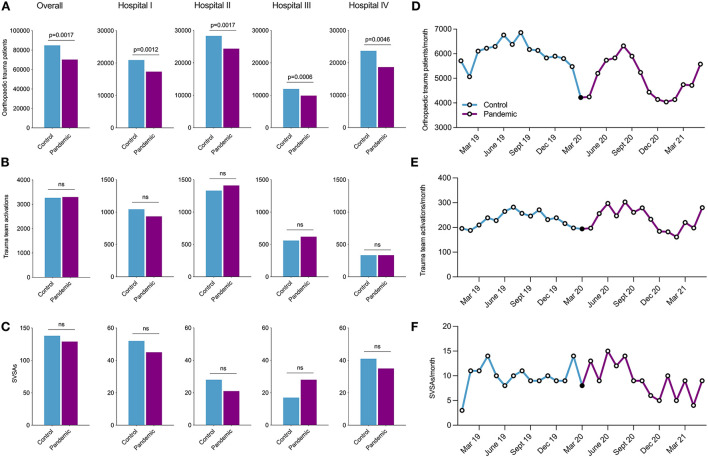
Significantly fewer orthopaedic trauma patients presented to EDs during the pandemic ( = 70,271) compared to the control ( = 84,864) period ( = 0.0017). ED trauma team activation numbers remained unchanged. SVSAs (corrected for seasonality) also remained unchanged during control ( = 138) and pandemic ( = 129) periods, and no differences were observed for suicide methods, injury patterns, or length of hospital stay.
Our data emphasize that a previously reported rise in psychological stress during the COVID-19 pandemic does not coincide with increased SVSA rates or changes in quality of SVSAs.
在新冠疫情期间,反复的停工和封锁措施有助于遏制严重急性呼吸综合征冠状病毒2(SARS-CoV-2)的传播,但社交距离和自我隔离在2020年和2021年对全球心理健康产生了负面影响。尽管据报道在疫情的最初几个月自杀率并未上升,但目前尚无长期数据以及关于严重暴力自杀未遂(SVSA)质量的数据。
对2019年1月至2021年5月期间德国柏林的四个一级创伤中心的骨科创伤患者到急诊科就诊情况、急诊科创伤团队启动情况以及严重暴力自杀未遂情况进行回顾性评估。对严重暴力自杀未遂情况评估自杀方法、损伤模式和严重程度、治疗类型以及住院时间。
与对照期(n = 84,864)相比,疫情期间(n = 70,271)到急诊科就诊的骨科创伤患者显著减少(P = 0.0017)。急诊科创伤团队启动次数保持不变。在对照期(n = 138)和疫情期(n = 129),经季节性校正后的严重暴力自杀未遂情况也保持不变,且在自杀方法、损伤模式或住院时间方面未观察到差异。
我们的数据强调,此前报道的新冠疫情期间心理压力增加与严重暴力自杀未遂率上升或严重暴力自杀未遂质量变化并不一致。