Eden Claire M, Zhu Roger, Khedr Shahenda, Khariton Konstantin
Department of Surgery, New York-Presbyterian/Queens, Queens, New York, USA.
Department of Surgery, Weill Cornell Medicine, New York-Presbyterian, New York, USA.
J Emerg Trauma Shock. 2022 Apr-Jun;15(2):88-92. doi: 10.4103/jets.jets_142_21. Epub 2022 Jun 27.
In March 2020, the first coronavirus disease 2019 (COVID-19) cases were reported in New York and a stay-at-home order was enacted soon after. Social isolation combined with pandemic-related stressors profoundly affected mental health. We hypothesize that there was an increase in violent suicide attempt during the COVID-19 pandemic lockdown compared to previous years.
We queried our institutional trauma registry for total number of trauma activations and identified adult patients with International Classification of Diseases-10 diagnosis of intentional self-harm. We compared incidence during the lockdown to corresponding time periods from previous years. Demographic and injury characteristics were compared, as were outcomes such as mortality.
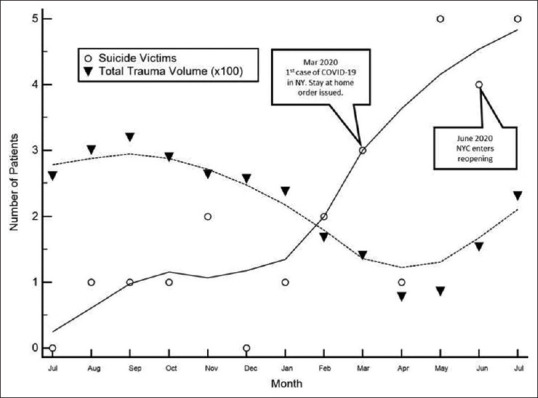
We observe a significant uptrend in patients requiring trauma intervention after suicide attempts from July 2019 through July 2020 ( = 0.8, < 0.001) despite a significant downtrend in trauma volume at our institution during the same period ( = ‒0.7, = 0.003). Although not statistically significant, patients attempting violent suicide during lockdown were more likely to have preexisting psychiatric diagnoses, to live alone, to have injury severity score >9, and to require surgical intervention. Three COVID-period patients died in the emergency room compared to zero in the comparison group.
Our data show a rise in violent suicide attempts during the pandemic lockdown despite an overall decrease in trauma volume. The ramifications of a stay-at-home order seem to have the most profound impact on individuals with preexisting mental health disease. Early establishment of mental health outreach programs may mitigate the reverberating psychosocial consequences of a pandemic.
2020年3月,纽约报告了首例2019冠状病毒病(COVID-19)病例,随后不久便颁布了居家令。社交隔离与大流行相关的压力源对心理健康产生了深远影响。我们推测,与前几年相比,在COVID-19大流行封锁期间暴力自杀未遂事件有所增加。
我们查询了机构创伤登记处的创伤激活总数,并确定了患有国际疾病分类第十版故意自伤诊断的成年患者。我们将封锁期间的发病率与前几年的相应时间段进行了比较。比较了人口统计学和损伤特征,以及死亡率等结果。
我们观察到,尽管在同一时期我们机构的创伤量呈显著下降趋势( = -0.7, = 0.003),但从2019年7月到2020年7月,自杀未遂后需要创伤干预的患者数量呈显著上升趋势( = 0.8, < 0.001)。尽管无统计学意义,但在封锁期间企图暴力自杀的患者更有可能有既往精神疾病诊断、独居、损伤严重程度评分>9,并且需要手术干预。与对照组的零死亡相比,三名COVID期间的患者在急诊室死亡。
我们的数据显示,尽管创伤量总体下降,但在大流行封锁期间暴力自杀未遂事件有所增加。居家令的影响似乎对已有心理健康疾病的个体产生了最深远的影响。尽早建立心理健康外展项目可能会减轻大流行产生的社会心理后果。