Department of Orthopaedic Surgery, The First Affiliated Hospital of Chongqing Medical University, Chongqing, China.
Orthop Surg. 2022 Sep;14(9):2119-2131. doi: 10.1111/os.13400. Epub 2022 Aug 5.
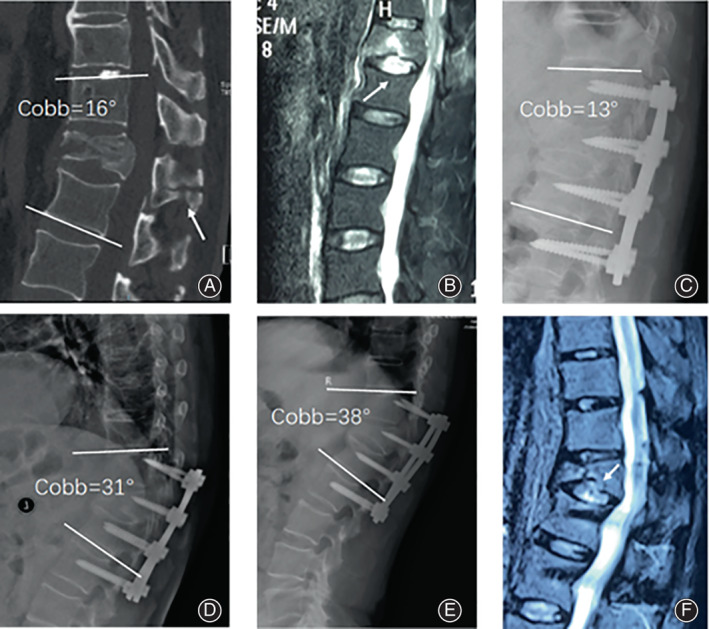
The type AO B2 thoracolumbar fracture is a kind of flexion-distraction injury and the effect of disc injury on treatment results of patients with B2 fracture remains unclear. The objective of the current study was to compare and analyze the outcomes in AO Type B2 thoracolumbar fracture patients with and without disc injuries in terms of the Cobb angle of kyphosis, the incidence of complication, and the rate of implant failure.
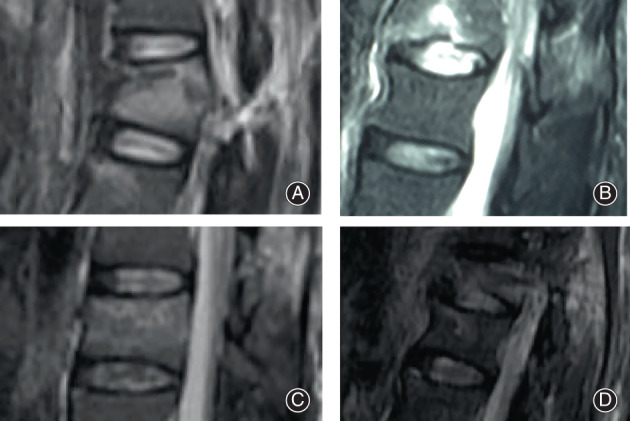
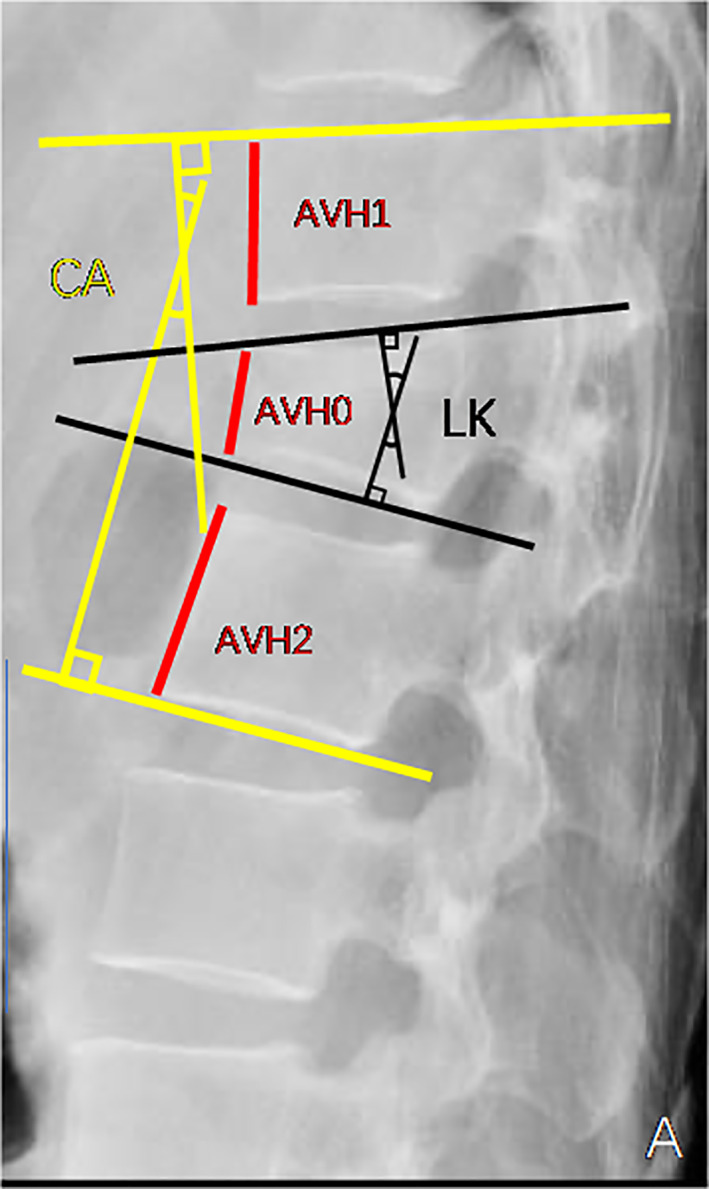
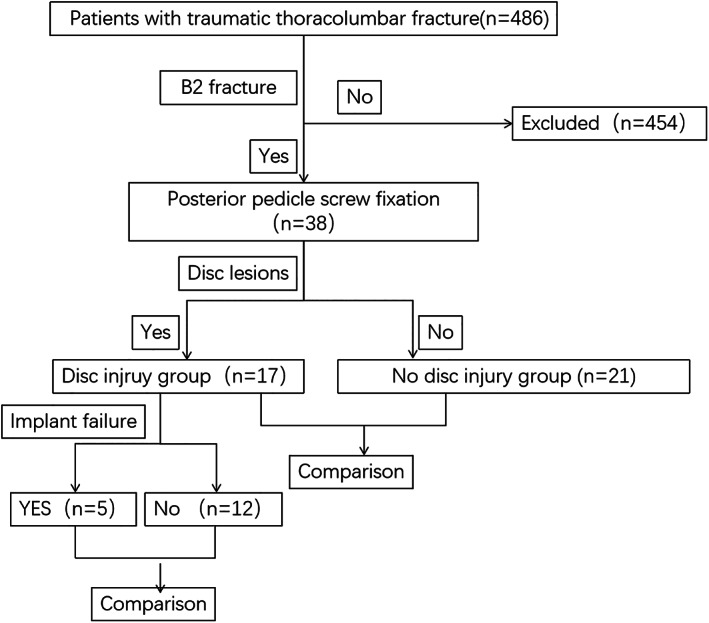
This is a retrospective study. Of the 486 patients with thoracolumbar fractures who underwent posterior fixation, 38 patients with AO type B2 injuries were included. All the patients were divided into two groups according to changes in the adjoining discs. Disc injury group A included 17 patients and no disc injury group included 21 patients. Clinical and radiologic parameters were evaluated before surgery, after surgery, and at follow-up. Clinical outcomes included visual analogue scale (VAS) scores, incidence of complications, and incidence of implant failure. Radiologic assessment was accomplished with the Cobb angle (CA), local kyphosis (LK), percentage of anterior vertebral height (AVBH%), intervertebral disc height, and intervertebral disc angle. Fisher's precision probability tests were employed and chi square test were used to compare categorical variables. Paired sample t tests and independent-sample t tests were used to compare continuous data.
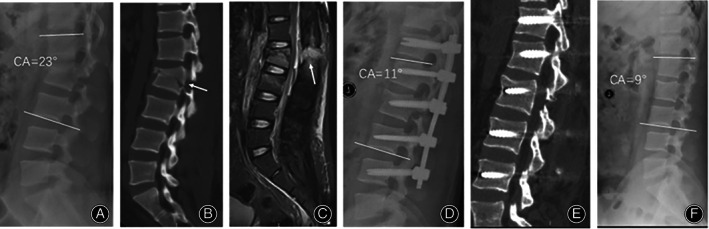
Disc injury mainly involved the cranial disc (15/19, 78.9%). The mean follow-up period for the patients was 30.2 ± 20.1 months. No neurologic deterioration was reported in the patients at the last follow-up. Radiological outcomes at the last follow-up showed significant differences in the CA (18.59° ± 13.74° vs 8.16° ± 9.99°, P = 0.008), LK (12.74° ± 8.00° vs 6.55° ± 4.89°, P = 0.006), and %AVBH (77.16% vs 90.83%, P = 0.01) between the two groups.Implant failure occurred after posterior fixation in five patients with disc injury who did not undergo interbody fusion during the initial surgery. Additionally, in the subgroup analysis, interbody fusion in the implant failure group were significantly different than in the no implant failure group (0% vs 75%, P = 0.009).
AO B2 fracture patients with disc injury have higher risk of complications, especially implant failure after posterior surgery. Interbody fusion should be considered in AO type B2 fracture patients with disc injury.
AO B2 胸腰椎骨折是一种屈曲分离损伤,椎间盘损伤对 B2 骨折患者治疗效果的影响尚不清楚。本研究旨在比较和分析伴有和不伴有椎间盘损伤的 AO 型 B2 胸腰椎骨折患者在后凸 Cobb 角、并发症发生率和内固定失败率方面的结果。
这是一项回顾性研究。在接受后路固定的 486 例胸腰椎骨折患者中,纳入 38 例 AO 型 B2 损伤患者。所有患者均根据相邻椎间盘的变化分为两组。椎间盘损伤组 A 包括 17 例,无椎间盘损伤组包括 21 例。术前、术后和随访时评估临床和影像学参数。临床结果包括视觉模拟评分(VAS)评分、并发症发生率和内固定失败率。影像学评估采用 Cobb 角(CA)、局部后凸(LK)、椎体前缘高度百分比(AVBH%)、椎间盘高度和椎间盘角度。采用 Fisher 精确概率检验和卡方检验比较分类变量。采用配对样本 t 检验和独立样本 t 检验比较连续数据。
椎间盘损伤主要累及颅侧椎间盘(15/19,78.9%)。患者的平均随访时间为 30.2±20.1 个月。末次随访时,患者无神经功能恶化。末次随访时影像学结果显示,CA(18.59°±13.74°比 8.16°±9.99°,P=0.008)、LK(12.74°±8.00°比 6.55°±4.89°,P=0.006)和%AVBH(77.16%比 90.83%,P=0.01)差异有统计学意义。在未行椎间融合的 5 例椎间盘损伤患者中,后路固定后发生内固定失败。此外,在亚组分析中,内固定失败组与无内固定失败组的椎间融合率差异有统计学意义(0%比 75%,P=0.009)。
伴有椎间盘损伤的 AO B2 骨折患者并发症风险较高,尤其是后路手术后内固定失败的风险较高。对于伴有椎间盘损伤的 AO 型 B2 骨折患者,应考虑行椎间融合。