Department of Family Medicine, College of Human Medicine, Michigan State University, Grand Rapids, Michigan, United States of America.
Trinity Health Saint Mary's, Grand Rapids, Michigan, United States of America.
PLoS One. 2022 Aug 5;17(8):e0272609. doi: 10.1371/journal.pone.0272609. eCollection 2022.
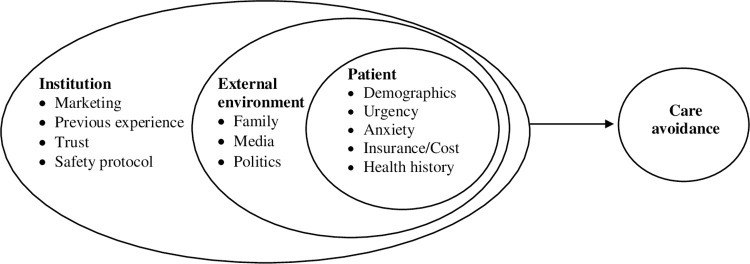
There has been a substantial decline in in-person care in inpatient and outpatient settings during the ongoing COVID-19 pandemic. Avoidance of needed in-person care may contribute to an avoidable decline in patient health and an increase in mortality. While several systems and behavioral theories have been put forward to explain the decline, there is a lack of studies informed by patients' own experiences. The current study applied a socio-ecological model encompassing patient, environmental, and institutional-related variables to examine patient-reported factors associated with avoidance of in-person care.
Between October and December 2020, a total of 3840 persons responded to a nationwide online questionnaire that was administered using ResearchMatch and Facebook. Self-reported avoidance of in-person care among those who needed it was the main outcome. Multivariable logistic regression analysis was used to identify factors associated with avoidance of needed care.
Out of a total of 3372 respondents who reported that they needed in-person care during the early phase of the pandemic, 257 (7.6%) avoided it. Patient-related variables associated with avoiding needed care included younger age (odds ratio (OR), 1.46, 95% CI 1.11 to 1.94, p<0.01; <45 y/o vs 45+), inability to afford care (OR = 1.65, 95% CI 1.17 to 2.34, p<0.01), and greater COVID-related stress (OR = 1.36, CI 1.01 to 1.83, p<0.05). More frequent discussions about COVID with family and friends was the only significant environment-related avoidance of care variable (OR = 1.39, 95% CI 1.01-1.91, p < .05). Institution-related care avoidance variables included a negative patient healthcare experience rating (OR 1.83, 95% CI 1.38 to 2.42, p<0.001), poor awareness of the institution's safety protocol (OR = 1.79, 95% CI 1.28 to 2.51, p<0.01), and low ratings of the institution's effectiveness in communicating their safety protocol (OR = 3.45, 95% CI 1.94 to 6.12, p<0.001). The final model predicted 11.9% of the variance in care avoidance.
These results suggest that care avoidance of in-person care during the initial phase of the pandemic was influenced by a patient's demographics as well as environmental and healthcare institutional factors. Patients' previous experiences and their awareness of healthcare systems' safety protocols are important factors in care avoidance.
在持续的 COVID-19 大流行期间,住院和门诊环境中的面对面护理大幅减少。避免所需的面对面护理可能会导致患者健康状况的不可避免下降和死亡率的增加。虽然已经提出了几个系统和行为理论来解释这种下降,但缺乏基于患者自身经验的研究。本研究应用包含患者、环境和机构相关变量的社会生态学模型,检查与避免面对面护理相关的患者报告因素。
2020 年 10 月至 12 月期间,共有 3840 人对使用 ResearchMatch 和 Facebook 管理的全国性在线问卷做出回应。那些需要它的人报告的自我报告避免面对面护理是主要结果。使用多变量逻辑回归分析来确定与避免护理相关的因素。
在总共 3372 名报告在大流行早期需要面对面护理的受访者中,有 257 人(7.6%)回避了这种护理。与避免所需护理相关的患者相关变量包括年龄较小(优势比(OR),1.46,95%CI 1.11 至 1.94,p<0.01;<45 岁与 45 岁以上)、无力负担护理费用(OR=1.65,95%CI 1.17 至 2.34,p<0.01)和更大的 COVID 相关压力(OR=1.36,CI 1.01 至 1.83,p<0.05)。与家人和朋友更频繁地讨论 COVID 是唯一与环境相关的显著避免护理的变量(OR=1.39,95%CI 1.01-1.91,p<.05)。机构相关的护理回避变量包括患者对医疗保健体验的负面评价(OR 1.83,95%CI 1.38 至 2.42,p<0.001)、对机构安全协议的认知度差(OR=1.79,95%CI 1.28 至 2.51,p<0.01)和对机构传达其安全协议的效果的评价低(OR=3.45,95%CI 1.94 至 6.12,p<0.001)。最终模型预测了 11.9%的护理回避方差。
这些结果表明,在大流行的初始阶段,对面对面护理的回避受到患者人口统计学以及环境和医疗保健机构因素的影响。患者以前的经历以及他们对医疗保健系统安全协议的认识是回避护理的重要因素。