Department of Health Sciences and Technology, GAIHST, Gachon University, Incheon, 21999, Republic of Korea.
Department of Molecular Medicine, School of Medicine, Gachon University, Incheon, 406-840, Republic of Korea.
Stem Cell Res Ther. 2022 Aug 5;13(1):404. doi: 10.1186/s13287-022-03061-1.
Smokers directly inhale mainstream cigarette smoke, which contains numerous known and potential toxic substances, and thus, smoking is expected to have broad harmful effects that cause tissue injury and dysfunction. Interestingly, many studies have suggested that the recent decline in female fertility and increased rate of spontaneous abortion could be associated with increased smoking rates. Indeed, women that smoked for 10 years or more were reported to have a ~ 20% higher infertility rate than women that had never smoked. However, the reasons for the underlying harmful aspects of smoking on female fertility remain a matter of debate. Importantly, a previous study revealed that resident endometrial stem cell deficiency significantly limits the cyclic regeneration potential of endometrium, which, in turn, decreases successful pregnancy outcomes. In this context, we postulated that exposure to mainstream cigarette smoke extracts might decrease female fertility by inhibiting the functions of resident endometrial stem cells.
We investigated whether cigarette mainstream smoke exposure directly inhibits various tissue regeneration-associated functions of endometrial stem cells, such as self-renewal, migration, pluripotency, and differentiation capacity in vitro. Next, we determined whether SERPINB2 mediates cigarette smoke-induced suppressive effects on various tissue regeneration-associated functions by depleting SERPINB2 expression with specific shRNA targeting SERPINB2. Mice were injected intraperitoneally with low (0.5 mg/kg) or high (1 mg/kg) doses of cigarette smoke extract (10 times for two weeks), and endometrial stem cells were then isolated from mice uterine tissues.
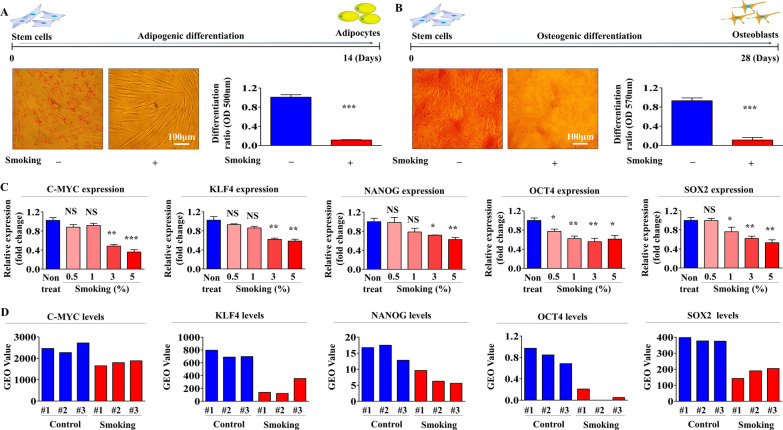
We found that exposure to cigarette smoke extracts remarkably suppressed various tissue regeneration-associated functions of endometrial stem cells, such as self-renewal, migration, multilineage differentiation ability, and pluripotency in vitro and in vivo by activating the SERPINB2 gene. Indeed, cigarette smoke-induced inhibitory effects on various endometrial stem cell functions were significantly abolished by SERPINB2 knockdown.
These findings provide valuable information on the harmful effects of cigarette smoking on resident endometrial stem cells and hopefully will facilitate the developments of promising therapeutic strategies for subfertile or infertile women that smoke cigarettes.
吸烟者直接吸入主流香烟烟雾,其中含有许多已知和潜在的有毒物质,因此吸烟预计会产生广泛的有害影响,导致组织损伤和功能障碍。有趣的是,许多研究表明,女性生育力下降和自然流产率增加可能与吸烟率增加有关。事实上,报告称,吸烟 10 年或以上的女性不孕率比从未吸烟的女性高约 20%。然而,吸烟对女性生育力的潜在有害方面的原因仍存在争议。重要的是,先前的一项研究表明,常驻子宫内膜干细胞缺陷显着限制了子宫内膜的周期性再生潜力,从而降低了成功怀孕的结果。在这种情况下,我们假设暴露于主流香烟烟雾提取物可能通过抑制常驻子宫内膜干细胞的功能来降低女性生育力。
我们研究了香烟主流烟雾暴露是否直接抑制子宫内膜干细胞的各种组织再生相关功能,例如体外的自我更新、迁移、多能性和分化能力。接下来,我们通过用针对 SERPINB2 的特定 shRNA 耗尽 SERPINB2 表达来确定 SERPINB2 是否介导香烟烟雾引起的对各种组织再生相关功能的抑制作用。用低(0.5mg/kg)或高(1mg/kg)剂量的香烟烟雾提取物(两周内 10 次)对小鼠进行腹腔内注射,然后从小鼠子宫组织中分离子宫内膜干细胞。
我们发现,暴露于香烟烟雾提取物显着抑制子宫内膜干细胞的各种组织再生相关功能,例如自我更新、迁移、多谱系分化能力和体内外的多能性,这是通过激活 SERPINB2 基因实现的。事实上,香烟烟雾对各种子宫内膜干细胞功能的抑制作用通过 SERPINB2 敲低显着消除。
这些发现为香烟烟雾对常驻子宫内膜干细胞的有害影响提供了有价值的信息,并有望为吸烟的不孕或不育妇女开发有前途的治疗策略提供帮助。