Department of Surgery, Transplant Division, Indiana University School of Medicine, Indianapolis, IN, USA.
Department of Pathology, Indiana University, Indianapolis, IN, USA.
Am J Case Rep. 2022 Aug 6;23:e936564. doi: 10.12659/AJCR.936564.
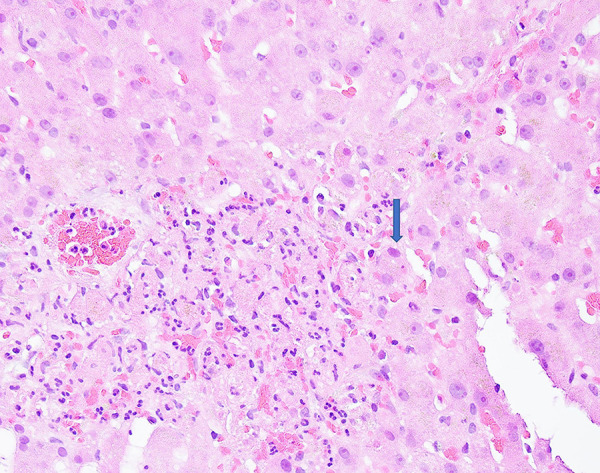
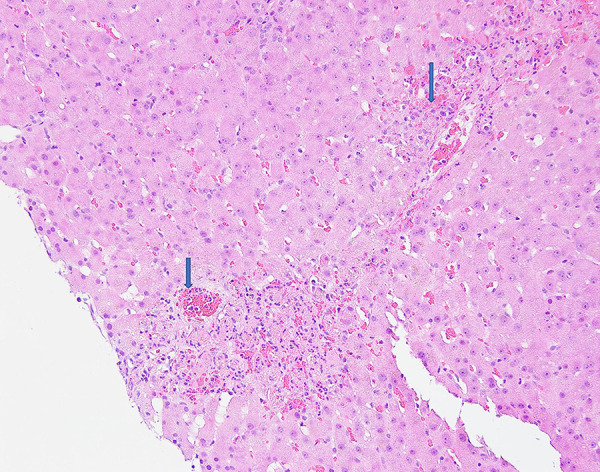
BACKGROUND Human adenovirus is a well-known pathogen that can potentially lead to severe infection in immunocompromised patients. Adenovirus infections in solid-organ transplant recipients can range from asymptomatic to severe, prolonged, disseminated disease, and have a significant impact on morbidity, mortality, and graft survival. The clinical manifestations vary from asymptomatic and flu-like illness to severe life-threatening viremia with multi-organ failure. Post-transplant adenovirus infection is well described in kidney recipients, but in adult liver transplant recipients the impact of the virus is not well described. In this report, a case of disseminated adenovirus infection with subsequent fatal acute liver failure in a post-kidney transplant patient is presented. CASE REPORT A 51-year-old man underwent a deceased kidney transplantation for focal segmental glomerulosclerosis. Shortly after the kidney transplantation, he received multiple plasmapheresis with additional steroid treatments for cellular rejection and reoccurrence of his primary kidney disease. Three weeks after the kidney transplant, he developed a disseminated adenovirus infection with subsequent acute liver failure. Despite the early diagnosis and aggressive treatment, the patient died. CONCLUSIONS Patients with organ transplantation with autoimmune background etiology are usually over-immunosuppressed to avoid early rejection. In this population, opportunistic infections are not rare. Fever, general malaise, and transplant organ dysfunction are the first signs of bacterial or viral infection. Early infectious diseases work-up, including tissue biopsy, is fundamental to establish a diagnosis. Broad antibiotic and possible antiviral aggressive treatment are mandatory.
人腺病毒是一种众所周知的病原体,可导致免疫功能低下的患者发生严重感染。实体器官移植受者中的腺病毒感染可从无症状到严重、持续、播散性疾病不等,对发病率、死亡率和移植物存活率有重大影响。临床表现从无症状和流感样疾病到严重的威胁生命的病毒血症伴多器官衰竭不等。肾移植受者中腺病毒感染的临床表现已有详细描述,但在成人肝移植受者中,该病毒的影响尚未得到很好描述。在本报告中,介绍了一例肾移植后发生播散性腺病毒感染继而导致致命性急性肝衰竭的病例。
一名 51 岁男性因局灶节段肾小球硬化症接受了已故供肾的移植。肾移植后不久,他因细胞排斥反应和原发性肾病复发接受了多次血浆置换和额外的类固醇治疗。肾移植后 3 周,他发生了播散性腺病毒感染,继而发生急性肝衰竭。尽管早期诊断和积极治疗,患者仍死亡。
自身免疫病因的器官移植受者通常接受过度免疫抑制以避免早期排斥。在这一人群中,机会性感染并不罕见。发热、全身不适和移植器官功能障碍是细菌或病毒感染的最初迹象。早期进行传染病检查,包括组织活检,对建立诊断至关重要。广泛使用抗生素和可能的抗病毒积极治疗是强制性的。