Centeno-Schultz Clinic, Broomfield, CO, USA.
Regenexx, Research and Development, Broomfield, CO, USA.
Int Orthop. 2022 Oct;46(10):2219-2228. doi: 10.1007/s00264-022-05524-9. Epub 2022 Aug 6.
Knee osteoarthritis (OA) is a common, progressively debilitating joint disease, and the intra-articular injection of autologous bone marrow concentrate (BMC) may offer a minimally invasive method of harnessing the body's own connective tissue progenitor cells to counteract accompanying degenerative effects of the disease. However, the extent to which the progenitor cell content of BMC influences treatment outcomes is unclear. We sought to determine whether patient-reported outcome measures associated with BMC treatment for knee OA are related to the concentration of progenitor cells provided.
In the present study, 65 patients (72 knees) underwent treatment for knee OA with autologous BMC and self-reported their outcomes for up to one year using follow-up questionnaires tracking function, pain, and percent improvement. A small fraction of each patient's BMC sample was reserved for quantification with a haematological analyzer and cryopreserved for subsequent analysis of potential connective tissue progenitor cells using a colony-forming unit fibroblast (CFU-F) assay.
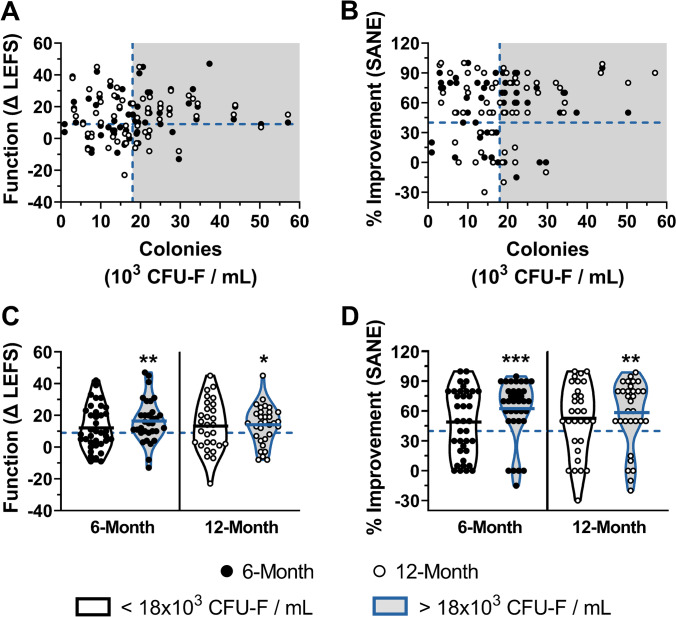
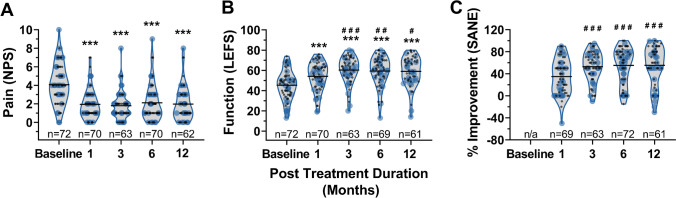
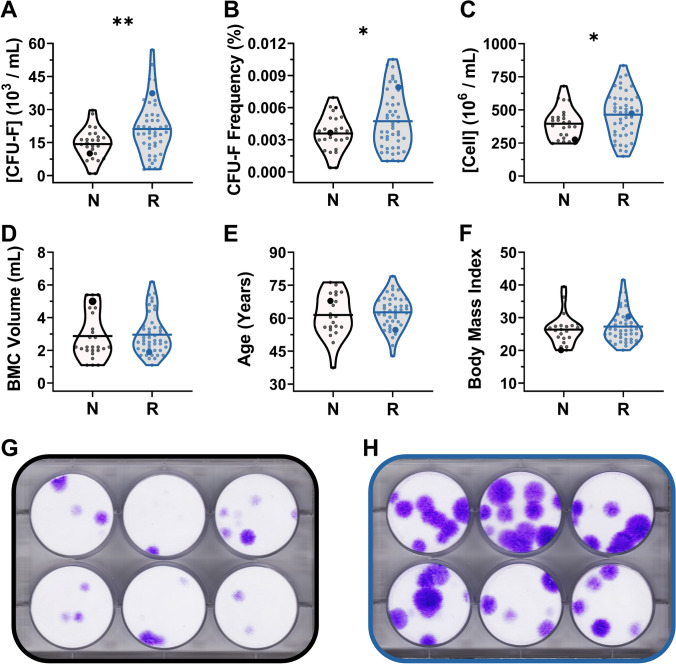
Patients reported significant increases in function and overall percent improvement in addition to decreases in pain relative to baseline levels following treatment with autologous BMC that persisted through 12 months. Patients reporting improved outcomes (46 of 72 knees) received BMC injections having higher CFU-F concentrations than non-responding patients (21.1×10 ± 12.4×10 vs 14.3×10 ± 7.0 x10 CFU-F per mL). A progenitor cell concentration of 18×10 CFU-F per mL of BMC was found to best differentiate responders from non-responders.
This study provides supportive evidence for using autologous BMC in the minimally invasive treatment of knee OA and suggests that increased progenitor cell content leads to improved treatment outcomes.
ClinicalTrials.gov Identifier: NCT03011398, 1/7/17.
膝关节骨关节炎(OA)是一种常见的、进行性致残的关节疾病,关节内注射自体骨髓浓缩物(BMC)可能提供一种微创方法,利用机体自身的结缔组织祖细胞来对抗疾病伴随的退行性影响。然而,BMC 中祖细胞含量对治疗效果的影响程度尚不清楚。我们旨在确定与 BMC 治疗膝关节 OA 相关的患者报告结局测量指标是否与提供的祖细胞浓度有关。
在本研究中,65 名患者(72 膝)接受自体 BMC 治疗膝关节 OA,并使用随访问卷在长达一年的时间内自我报告其结果,这些问卷跟踪功能、疼痛和改善百分比。从每位患者的 BMC 样本中取出一小部分,用血液学分析仪进行定量,并冷冻保存,以备随后使用集落形成单位成纤维细胞(CFU-F)测定法分析潜在的结缔组织祖细胞。
患者报告说,与基线相比,在接受自体 BMC 治疗后,功能显著提高,整体改善百分比增加,疼痛减轻,这种改善在 12 个月内持续存在。报告改善结果的患者(72 膝中的 46 膝)接受的 BMC 注射具有比无反应患者更高的 CFU-F 浓度(21.1×10±12.4×10 与 14.3×10±7.0 x10 CFU-F/mL)。发现 BMC 中祖细胞浓度为 18×10 CFU-F/mL 可最好地区分反应者与无反应者。
本研究为使用自体 BMC 微创治疗膝关节 OA 提供了支持性证据,并表明祖细胞含量增加可导致治疗效果改善。
ClinicalTrials.gov 标识符:NCT03011398,1/7/17。