McDonald J R, Gröschel-Stewart U, Walsh M P
Biochem J. 1987 Mar 15;242(3):695-705. doi: 10.1042/bj2420695.
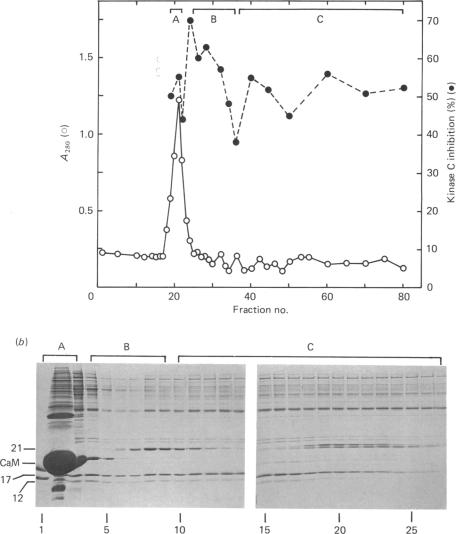
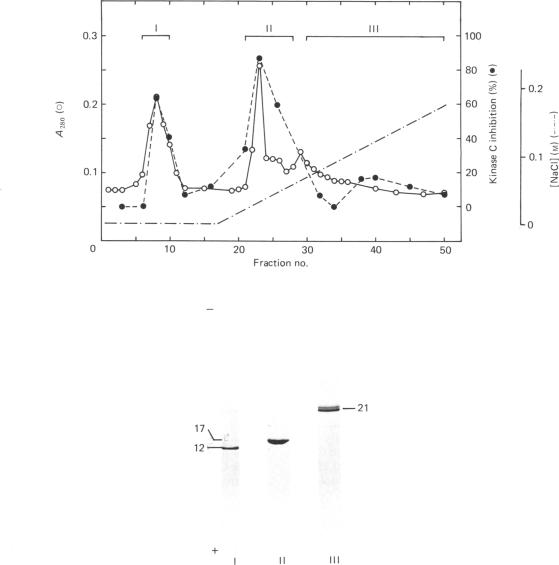
Ca2+-dependent hydrophobic-interaction chromatography is a powerful tool for the identification and isolation of a variety of Ca2+-binding proteins which expose a hydrophobic site(s) in the presence of Ca2+ [Gopalakrishna & Anderson (1982) Biochem. Biophys. Res. Commun. 104, 830-836; Walsh, Valentine, Ngai, Carruthers & Hollenberg (1984) Biochem. J. 224, 117-127; McDonald & Walsh (1985) Biochem. J. 232, 559-567]. Using this approach, we isolated two potent and specific protein inhibitors of protein kinase C, of 17 kDa [McDonald & Walsh (1985) Biochem. J. 232, 559-567] and 12 kDa [McDonald & Walsh (1986) Biochem. Soc. Trans. 14, 585-586]. Although these inhibitors were purified by Ca2+-dependent hydrophobic-interaction chromatography and exhibit properties similar to those of calmodulin and related Ca2+-binding proteins, we were unable to demonstrate high-affinity Ca2+ binding to these inhibitors, using equilibrium dialysis. Protein kinase C exhibited half-maximal activity at 0.6 microM-Ca2+ in the presence of phospholipid and diacylglycerol, and complete inhibition by both inhibitors was observed over the range of Ca2+ concentrations examined (10 nM-10 microM). These observations suggest that the inhibitory action of these proteins does not require Ca2+. The inclusion of proteinase inhibitors during isolation of the kinase C inhibitors, as well as two-dimensional peptide mapping and amino acid analysis of the isolated proteins, suggested that the 12 kDa inhibitor is a proteolytic fragment of the 17 kDa protein which is generated during purification. Antibodies raised in rabbits against the bovine brain 17 kDa inhibitor were shown to be specific by Western immunoblotting and the competitive enzyme-linked immunosorbent assay method and were used to study the tissue and species distribution of this protein. The inhibitor was found to be present in several bovine, murine, avian and human tissues, consistent with a role in the regulation of a variety of physiological functions involving the widely distributed protein kinase C.
钙离子依赖的疏水作用色谱法是一种强大的工具,可用于鉴定和分离多种在钙离子存在下暴露疏水位点的钙离子结合蛋白[戈帕拉克里希纳和安德森(1982年),《生物化学与生物物理学研究通讯》104卷,830 - 836页;沃尔什、瓦伦丁、恩盖、卡拉瑟斯和霍伦伯格(1984年),《生物化学杂志》224卷,117 - 127页;麦克唐纳和沃尔什(1985年),《生物化学杂志》232卷,559 - 567页]。采用这种方法,我们分离出了两种对蛋白激酶C有强效且特异性抑制作用的蛋白,分子量分别为17 kDa[麦克唐纳和沃尔什(1985年),《生物化学杂志》232卷,559 - 567页]和12 kDa[麦克唐纳和沃尔什(1986年),《生物化学学会会报》14卷,585 - 586页]。尽管这些抑制剂是通过钙离子依赖的疏水作用色谱法纯化的,并且表现出与钙调蛋白及相关钙离子结合蛋白相似的性质,但我们通过平衡透析法未能证明这些抑制剂与钙离子有高亲和力结合。在磷脂和二酰甘油存在的情况下,蛋白激酶C在0.6微摩尔/升钙离子浓度时表现出半数最大活性,在所检测的钙离子浓度范围(10纳摩尔 - 10微摩尔)内,两种抑制剂均能完全抑制其活性。这些观察结果表明,这些蛋白的抑制作用并不需要钙离子。在分离激酶C抑制剂的过程中加入蛋白酶抑制剂,以及对分离出的蛋白进行二维肽图分析和氨基酸分析,结果表明12 kDa的抑制剂是17 kDa蛋白在纯化过程中产生的蛋白水解片段。通过蛋白质免疫印迹法和竞争性酶联免疫吸附测定法表明,用兔抗牛脑17 kDa抑制剂产生的抗体具有特异性,并用其研究了该蛋白的组织和物种分布。发现该抑制剂存在于多种牛、鼠、禽和人类组织中,这与它在调节涉及广泛分布的蛋白激酶C的多种生理功能中所起的作用相一致。