Clinical Epidemiology Division, Department of Medicine Solna, Karolinska Institute, Stockholm, Sweden.
Faculty of Medicine, School of Health Sciences, University of Iceland, Reykjavik, Iceland.
Arthritis Res Ther. 2022 Aug 6;24(1):185. doi: 10.1186/s13075-022-02873-z.
To assess whether persistence to treatment with methotrexate (MTX) in early rheumatoid arthritis (RA) is shared among first-degree relatives with RA and to estimate any underlying heritability.
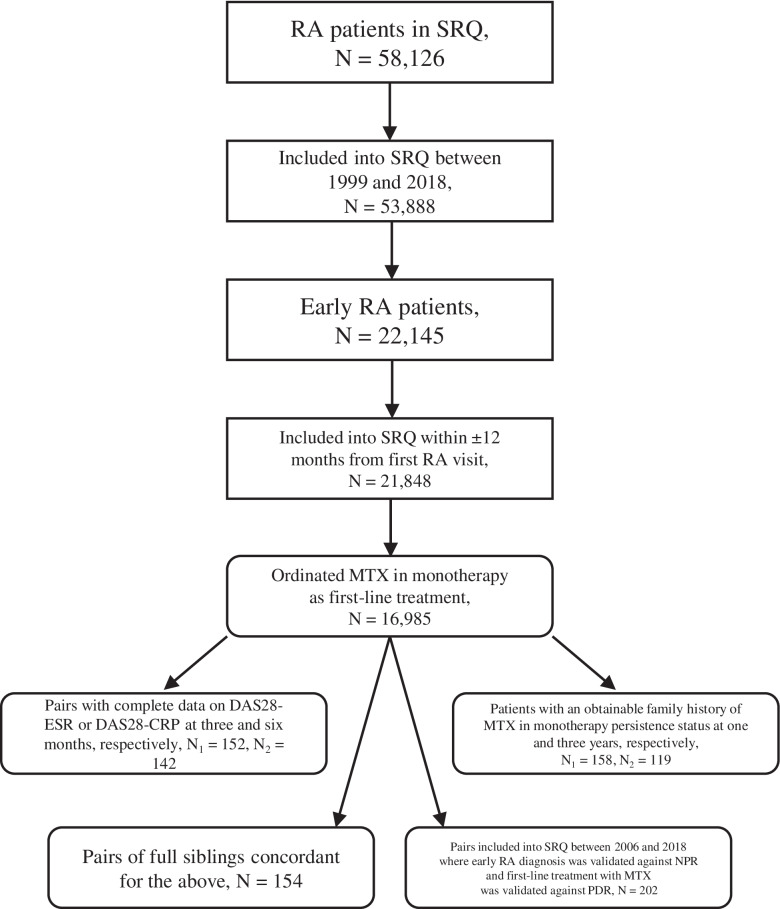
First-degree relative pairs diagnosed with RA 1999-2018 and starting MTX (in monotherapy) as their first disease-modifying anti-rheumatic drug (DMARD) treatment were identified by linking the Swedish Rheumatology Quality Register to national registers. Short- and long-term persistence to MTX was defined as remaining on treatment at 1 and 3 years, respectively, with no additional DMARDs added. We assessed familial aggregation through relative risks (RR) using log-binomial regression with robust standard errors and estimated heritability using tetrachoric correlations. We also explored the familial aggregation of EULAR treatment response after 3 and 6 months. To mimic the clinical setting, we also tested the association between having a family history of MTX persistence and persistence within the index patient.
Familial persistence was not associated with persistence at 1 (RR=1.02, 95% CI 0.87-1.20), only at 3 (RR=1.41, 95% CI 1.14-1.74) years. Heritability at 1 and 3 years was estimated to be 0.08 (95% CI 0-0.43) and 0.58 (95% CI 0.27-0.89), respectively. No significant associations were found between family history and EULAR response at 3 and 6 months, neither overall nor in the clinical setting analysis.
Our findings imply a familial component, including a possible genetic element, within the long-term persistence to MTX following RA diagnosis. Whether this component is reflective of characteristics of the underlying RA disease or determinants for sustained response to MTX in itself will require further investigation.
评估在早期类风湿关节炎(RA)中,甲氨蝶呤(MTX)治疗的持续存在是否在 RA 的一级亲属中共享,并估计任何潜在的遗传率。
通过将瑞典风湿病质量登记处与国家登记处相联系,确定了 1999-2018 年诊断为 RA 并开始使用 MTX(单药治疗)作为其第一种疾病修饰抗风湿药物(DMARD)治疗的一级亲属对。将 MTX 的短期和长期持续治疗定义为分别在 1 年和 3 年内仍在接受治疗,且未添加其他 DMARD。我们使用对数二项式回归和稳健标准误差评估了相对风险(RR)的家族聚集性,并使用 tetrachoric 相关性估计了遗传率。我们还探索了 3 个月和 6 个月后 EULAR 治疗反应的家族聚集性。为了模拟临床情况,我们还测试了家族史与指数患者内的持续性之间的关联。
家族持续性与 1 年(RR=1.02,95%CI 0.87-1.20)的持续性无关,仅与 3 年(RR=1.41,95%CI 1.14-1.74)的持续性相关。1 年和 3 年的遗传率估计分别为 0.08(95%CI 0-0.43)和 0.58(95%CI 0.27-0.89)。在整体和临床情况分析中,均未发现家族史与 3 个月和 6 个月时的 EULAR 反应之间存在显著关联。
我们的研究结果表明,在 RA 诊断后,MTX 的长期持续存在存在家族成分,包括可能的遗传因素。这种成分是否反映了潜在 RA 疾病的特征,或者是否反映了对 MTX 持续反应的决定因素,还需要进一步研究。