William Harvey Research Institute, Barts and The London School of Medicine and Dentistry, Queen Mary University of London, London, UK.
Critical Care and Perioperative Medicine Research Group, Adult Critical Care Unit, Royal London Hospital, London, E1 1BB, UK.
Crit Care. 2022 Aug 6;26(1):240. doi: 10.1186/s13054-022-04113-x.
Clinical research on nutritional and metabolic interventions in critically ill patients is heterogenous regarding time points, outcomes and measurement instruments used, impeding intervention development and data syntheses, and ultimately worsening clinical outcomes. We aimed to identify and develop a set of core outcome domains and associated measurement instruments to include in all research in critically ill patients.
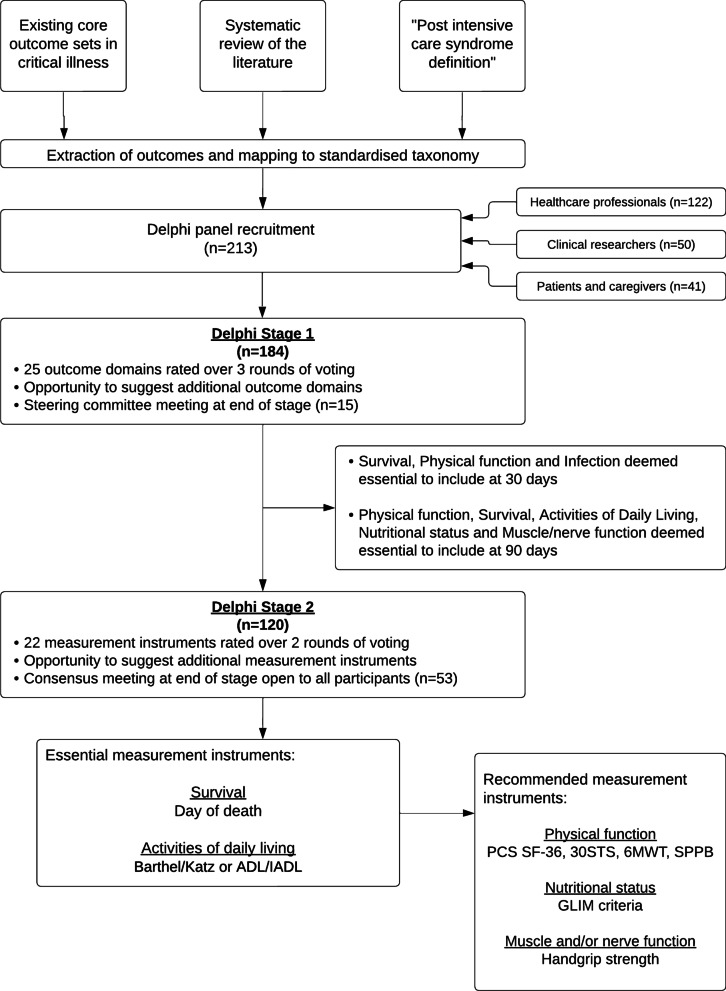
An updated systematic review informed a two-stage modified Delphi consensus process (domains followed by instruments). Measurement instruments for domains considered 'essential' were taken through the second stage of the Delphi and a subsequent consensus meeting.
In total, 213 participants (41 patients/caregivers, 50 clinical researchers and 122 healthcare professionals) from 24 countries contributed. Consensus was reached on time points (30 and 90 days post-randomisation). Three domains were considered 'essential' at 30 days (survival, physical function and Infection) and five at 90 days (survival, physical function, activities of daily living, nutritional status and muscle/nerve function). Core 'essential' measurement instruments reached consensus for survival and activities of daily living, and 'recommended' measurement instruments for physical function, nutritional status and muscle/nerve function. No consensus was reached for a measurement instrument for Infection. Four further domains met criteria for 'recommended,' but not 'essential,' to measure at 30 days post-randomisation (organ dysfunction, muscle/nerve function, nutritional status and wound healing) and three at 90 days (frailty, body composition and organ dysfunction).
The CONCISE core outcome set is an internationally agreed minimum set of outcomes for use at 30 and 90 days post-randomisation, in nutritional and metabolic clinical research in critically ill adults.
危重症患者营养代谢干预的临床研究在时间点、结局和使用的测量工具方面存在异质性,这阻碍了干预措施的发展和数据综合,最终导致临床结局恶化。我们旨在确定并制定一组核心结局领域及其相关测量工具,以便纳入所有危重症患者的研究。
一项更新的系统评价为两阶段改良 Delphi 共识过程(领域和工具)提供了信息。被认为“必不可少”的领域的测量工具经过 Delphi 的第二阶段和随后的共识会议。
共有来自 24 个国家的 213 名参与者(41 名患者/护理人员、50 名临床研究人员和 122 名医疗保健专业人员)参与。在随机分组后 30 天和 90 天达成了共识。在 30 天时有三个领域被认为是“必不可少”的(生存、身体功能和感染),而在 90 天时有五个领域(生存、身体功能、日常生活活动、营养状况和肌肉/神经功能)。核心“必不可少”的测量工具在生存和日常生活活动方面达成了共识,而在身体功能、营养状况和肌肉/神经功能方面达成了“推荐”的测量工具。对于感染的测量仪器没有达成共识。另外四个领域在 30 天随机分组后也符合“推荐”但不是“必不可少”的测量标准(器官功能障碍、肌肉/神经功能、营养状况和伤口愈合),而在 90 天随机分组后有三个领域(虚弱、身体成分和器官功能障碍)符合“推荐”但不是“必不可少”的测量标准。
CONCISE 核心结局集是一个国际公认的在随机分组后 30 天和 90 天使用的最低限度的结局集,用于危重症成年人营养和代谢的临床研究。