Volkov Pavel A, Chandra Premala, Coleman Piers
Center for Materials Theory, Department of Physics and Astronomy, Rutgers University, Piscataway, NJ, 08854, USA.
Department of Physics, Royal Holloway, University of London, Egham, Surrey, TW20 0EX, UK.
Nat Commun. 2022 Aug 6;13(1):4599. doi: 10.1038/s41467-022-32303-2.
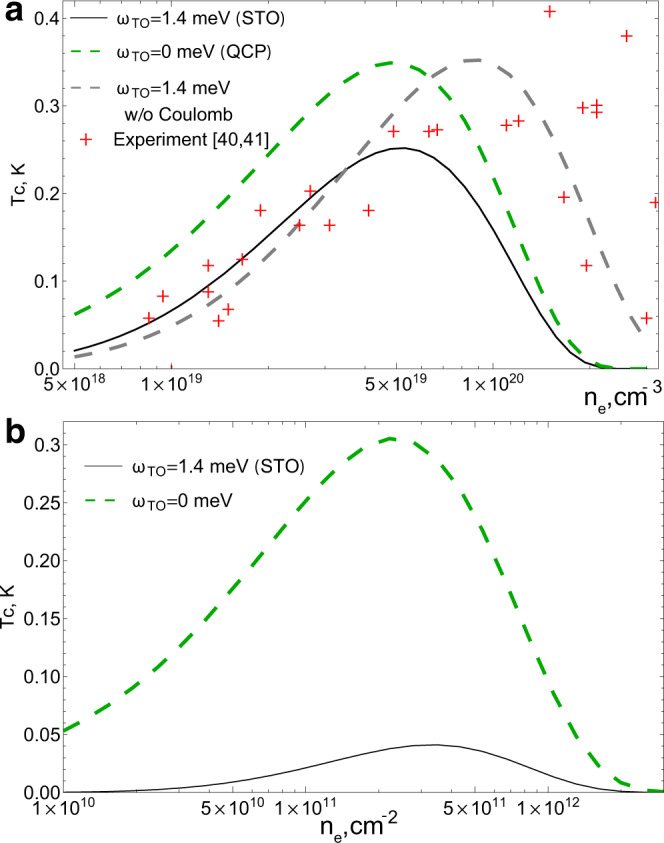
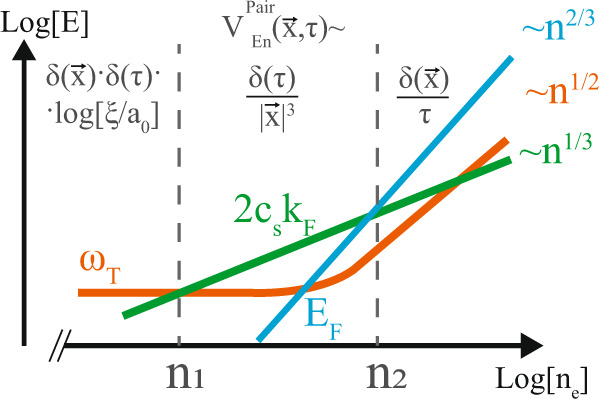
Superconductivity in low carrier density metals challenges the conventional electron-phonon theory due to the absence of retardation required to overcome Coulomb repulsion. Here we demonstrate that pairing mediated by energy fluctuations, ubiquitously present close to continuous phase transitions, occurs in dilute quantum critical polar metals and results in a dome-like dependence of the superconducting T on carrier density, characteristic of non-BCS superconductors. In quantum critical polar metals, the Coulomb repulsion is heavily screened, while the critical transverse optical phonons decouple from the electron charge. In the resulting vacuum, long-range attractive interactions emerge from the energy fluctuations of the critical phonons, resembling the gravitational interactions of a chargeless dark matter universe. Our estimates show that this mechanism may explain the critical temperatures observed in doped SrTiO. We provide predictions for the enhancement of superconductivity near polar quantum criticality in two- and three-dimensional materials that can be used to test our theory.
低载流子密度金属中的超导现象对传统的电子 - 声子理论提出了挑战,因为缺乏克服库仑排斥所需的延迟。在此,我们证明由能量涨落介导的配对(这种能量涨落在接近连续相变处普遍存在)发生在稀量量子临界极性金属中,并导致超导转变温度($T_c$)对载流子密度呈现类似穹顶状的依赖关系,这是非BCS超导体的特征。在量子临界极性金属中,库仑排斥被高度屏蔽,而临界横向光学声子与电子电荷解耦。在由此产生的真空中,临界声子的能量涨落产生了长程吸引相互作用,类似于无电荷暗物质宇宙的引力相互作用。我们的估计表明,这种机制可能解释了在掺杂SrTiO₃中观测到的临界温度。我们对二维和三维材料中极性量子临界附近超导增强给出了预测,可用于检验我们的理论。