Institute for Biocomputation and Physics of Complex Systems (BIFI), University of Zaragoza, 50018, Zaragoza, Spain.
Department of Biochemistry and Molecular and Cell Biology, University of Zaragoza, 50009, Zaragoza, Spain.
Nat Commun. 2022 Aug 6;13(1):4586. doi: 10.1038/s41467-022-32350-9.
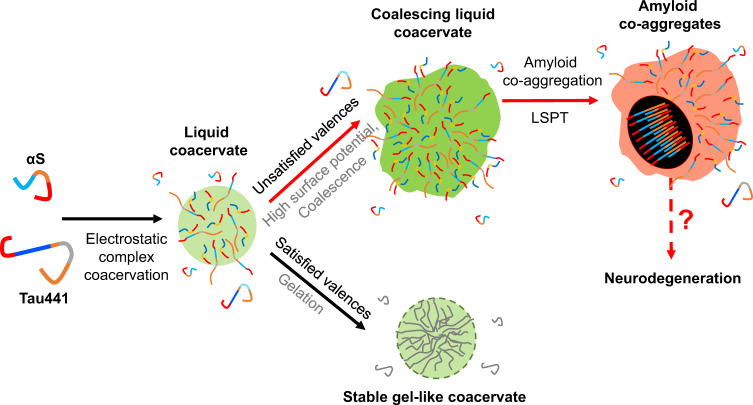
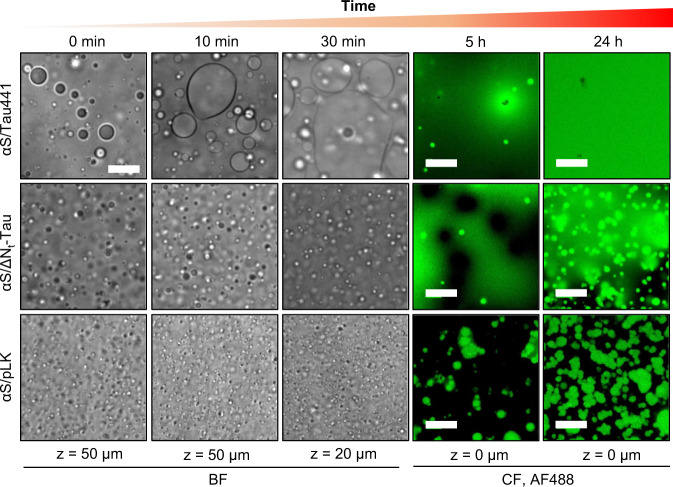
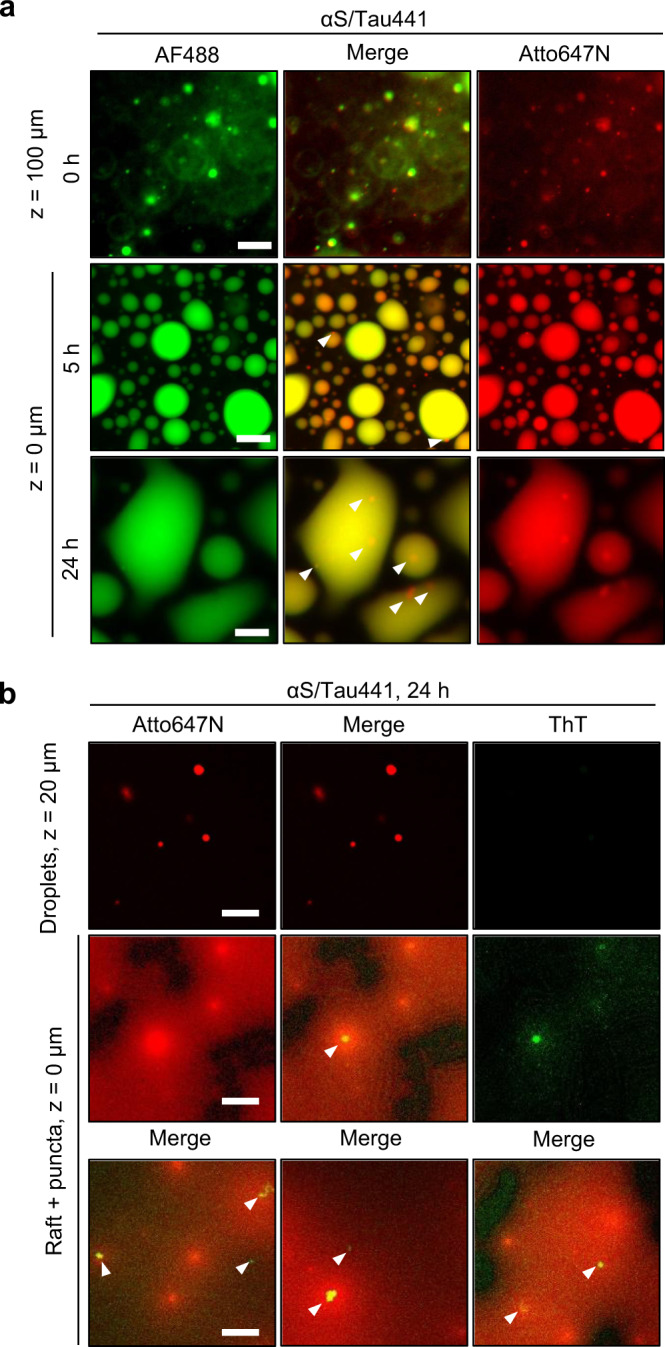
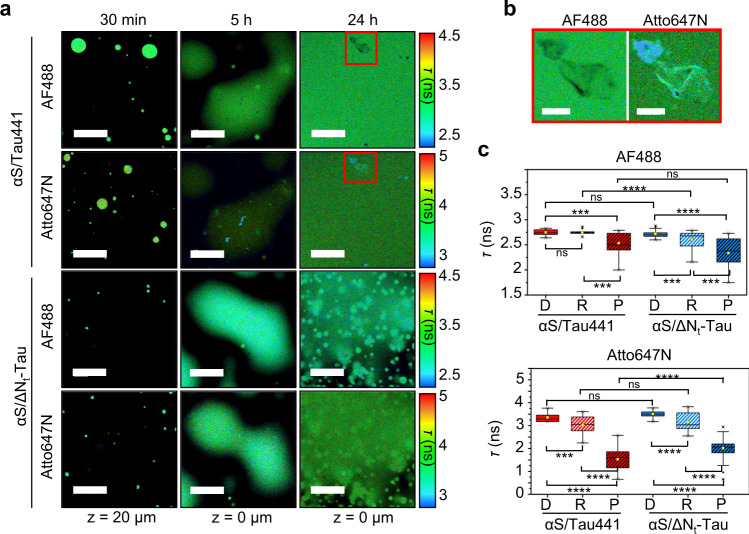
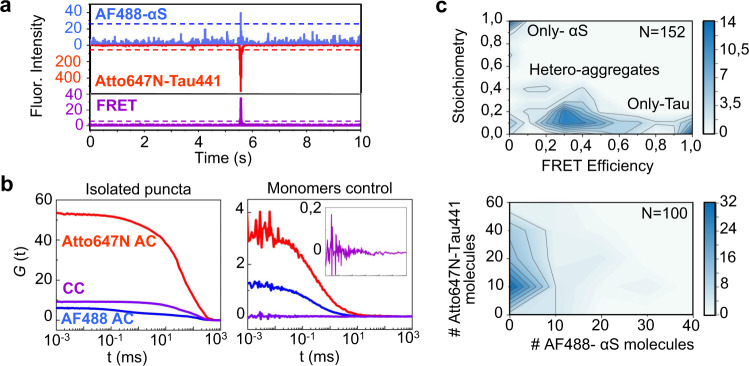
Amyloid aggregation of α-synuclein (αS) is the hallmark of Parkinson's disease and other synucleinopathies. Recently, Tau protein, generally associated with Alzheimer's disease, has been linked to αS pathology and observed to co-localize in αS-rich disease inclusions, although the molecular mechanisms for the co-aggregation of both proteins remain elusive. We report here that αS phase-separates into liquid condensates by electrostatic complex coacervation with positively charged polypeptides such as Tau. Condensates undergo either fast gelation or coalescence followed by slow amyloid aggregation depending on the affinity of αS for the poly-cation and the rate of valence exhaustion of the condensate network. By combining a set of advanced biophysical techniques, we have been able to characterize αS/Tau liquid-liquid phase separation and identified key factors that lead to the formation of hetero-aggregates containing both proteins in the interior of the liquid protein condensates.
α-突触核蛋白(αS)的淀粉样聚集是帕金森病和其他突触核蛋白病的标志。最近,通常与阿尔茨海默病相关的 Tau 蛋白与 αS 病理学有关,并观察到在富含 αS 的疾病包涵体中共同定位,尽管两种蛋白质的共聚集的分子机制仍不清楚。我们在这里报告说,αS 通过与正电荷多肽(如 Tau)的静电复合凝聚相分离成液体凝聚物。凝聚物根据 αS 与聚阳离子的亲和力以及凝聚物网络的价态耗尽速率,要么快速凝胶化或聚结,然后缓慢进行淀粉样聚集。通过结合一系列先进的生物物理技术,我们能够对 αS/Tau 液-液相分离进行表征,并确定了导致含有两种蛋白质的异质聚集体形成的关键因素,这些聚集体存在于液体蛋白凝聚物的内部。