Musculoskeletal Biomechanics Research Lab, Department of Mechanical Engineering, McGill University, Montreal, H3A 0C4, Canada.
Orthopedic Research Laboratory, Montreal General Hospital, Montreal, QC, H3H 1V8, Canada.
Sci Rep. 2022 Aug 6;12(1):13517. doi: 10.1038/s41598-022-17512-5.
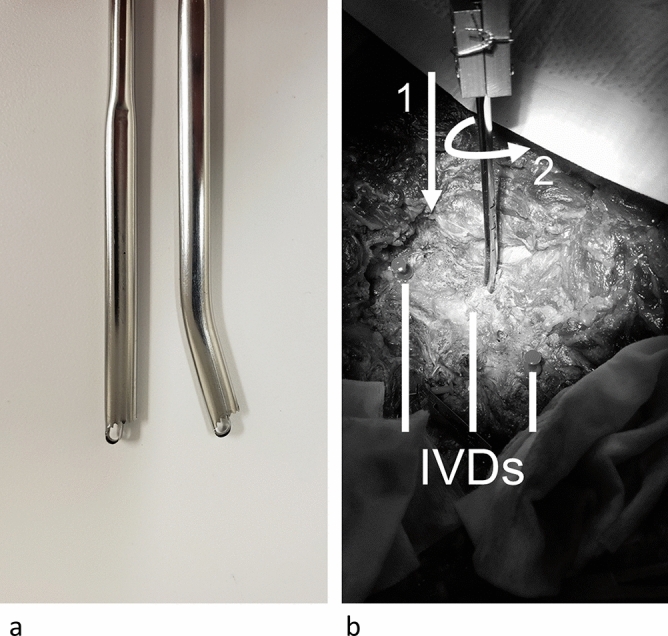
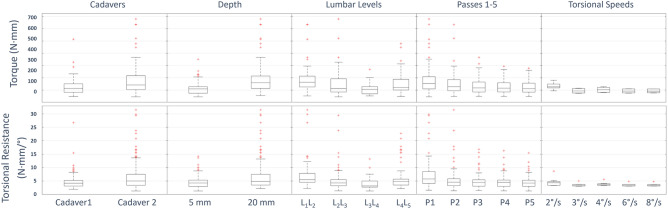
Simulation in surgical training is a growing field and this study aims to understand the force and torque experienced during lumbar spine surgery to design simulator haptic feedback. It was hypothesized that force and torque would differ among lumbar spine levels and the amount of tissue removed by ≥ 7%, which would be detectable to a user. Force and torque profiles were measured during vacuum curette insertion and torsion, respectively, in multiple spinal levels on two cadavers. Multiple tests per level were performed. Linear and torsional resistances of 2.1 ± 1.6 N/mm and 5.6 ± 4.3 N mm/°, respectively, were quantified. Statistically significant differences were found in linear and torsional resistances between all passes through disc tissue (both p = 0.001). Tool depth (p < 0.001) and lumbar level (p < 0.001) impacted torsional resistance while tool speed affected linear resistance (p = 0.022). Average differences in these statistically significant comparisons were ≥ 7% and therefore detectable to a surgeon. The aforementioned factors should be considered when developing haptic force and torque feedback, as they will add to the simulated lumbar discectomy realism. These data can additionally be used inform next generation tool design. Advances in training and tools may help improve future surgeon training.
在外科手术培训中,模拟技术是一个不断发展的领域,本研究旨在了解腰椎手术过程中的力和扭矩,以设计模拟器触觉反馈。研究假设力和扭矩在腰椎水平之间会有所不同,并且组织切除量超过 7%,这将被使用者察觉。在两个尸体的多个脊柱水平上,分别通过真空刮匙插入和扭转来测量力和扭矩曲线。每个水平进行多次测试。线性和扭转阻力分别为 2.1±1.6 N/mm 和 5.6±4.3 N mm/°。通过所有穿过椎间盘组织的测试,均发现线性和扭转阻力存在统计学显著差异(均 p=0.001)。工具深度(p<0.001)和腰椎水平(p<0.001)影响扭转阻力,而工具速度影响线性阻力(p=0.022)。在这些具有统计学意义的比较中,平均差异超过 7%,因此可被外科医生察觉。在开发触觉力和扭矩反馈时应考虑上述因素,因为它们将增加模拟腰椎切除术的真实感。这些数据还可以用于下一代工具设计。培训和工具的进步可能有助于提高未来外科医生的培训水平。