School of Food Science and Pharmaceutical Engineering, Nanjing Normal University, Nanjing, 210023, PR China; Zhejiang Laboratory, Hangzhou, 311100, PR China.
Shenzhen Branch, Guangdong Laboratory of Lingnan Modern Agriculture, Genome Analysis Laboratory of the Ministry of Agriculture and Rural Affairs, Agricultural Genomics Institute at Shenzhen, Chinese Academy of Agricultural Sciences, Shenzhen, 518120, PR China.
Anal Chim Acta. 2022 Aug 15;1221:340120. doi: 10.1016/j.aca.2022.340120. Epub 2022 Jul 2.
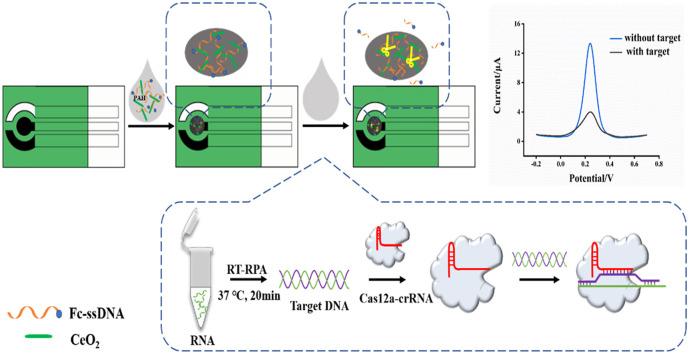
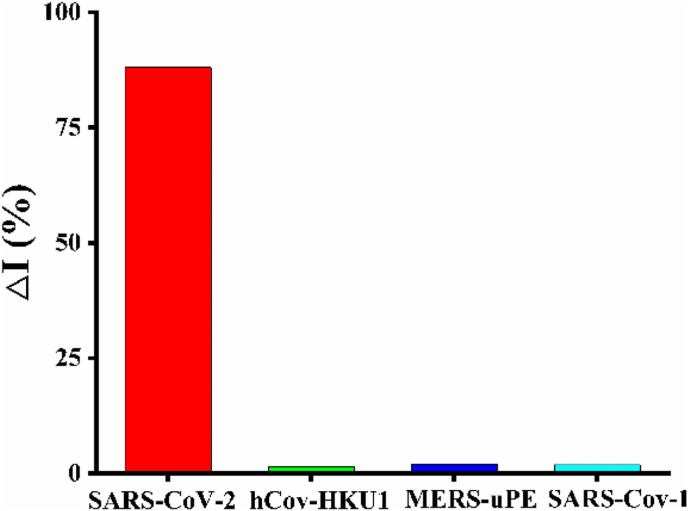
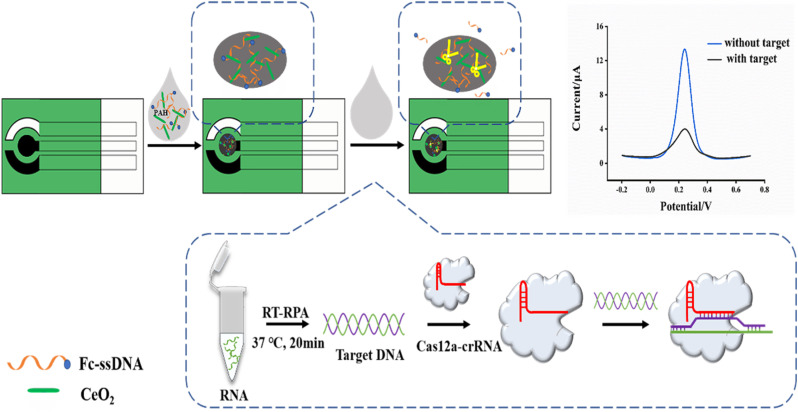
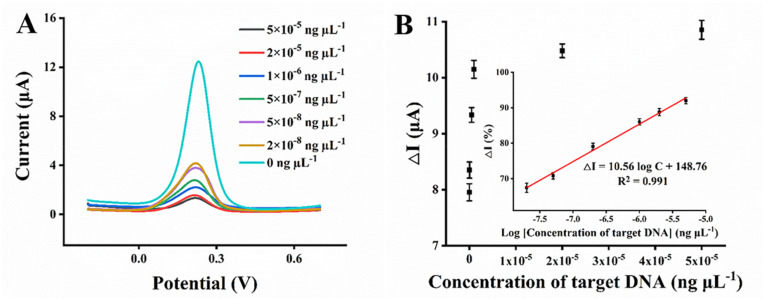
Early and accurate diagnosis of SARS-CoV-2 was crucial for COVID-19 control and urgently required ultra-sensitive and rapid detection methods. CRISPR-based detection systems have great potential for rapid SARS-CoV-2 detection, but detecting ultra-low viral loads remains technically challenging. Here, we report an ultrasensitive CRISPR/Cas12a-based electrochemical detection system with an electrochemical biosensor, dubbed CRISPR-SPCE, in which the CRISPR ssDNA reporter was immobilized onto a screen-printed carbon electrode. Electrochemical signals are detected due to CRISPR cleavage, giving enhanced detection sensitivity. CRISPR-SPCE enables ultrasensitive SARS-CoV-2 detection, reaching as few as 0.27 copies μL. Moreover, CRISPR-SPCE is also highly specific and inexpensive, providing a fast and simple SARS-CoV-2 assay.
早期、准确地诊断 SARS-CoV-2 对于 COVID-19 的防控至关重要,因此急需超灵敏、快速的检测方法。基于 CRISPR 的检测系统在快速检测 SARS-CoV-2 方面具有巨大的潜力,但检测超低病毒载量在技术上仍然具有挑战性。在这里,我们报告了一种超灵敏的基于 CRISPR/Cas12a 的电化学检测系统,该系统配备了电化学生物传感器,被称为 CRISPR-SPCE,其中 CRISPR ssDNA 报告分子被固定在丝网印刷碳电极上。由于 CRISPR 切割,电化学信号被检测到,从而提高了检测灵敏度。CRISPR-SPCE 能够超灵敏地检测 SARS-CoV-2,低至 0.27 拷贝 μL。此外,CRISPR-SPCE 还具有高度特异性和低成本,为 SARS-CoV-2 提供了一种快速、简单的检测方法。