DEFACTUM, Central Denmark Region, Olof Palmes Allé 15, 8200, Aarhus N, Denmark.
Danish Center for Healthcare Improvements (DCHI), Aalborg University, 9220, Aalborg, Denmark.
Appl Health Econ Health Policy. 2022 Nov;20(6):867-880. doi: 10.1007/s40258-022-00741-0. Epub 2022 Aug 8.
This study evaluated the cost effectiveness of using Stockholm 3 (STHLM3) testing compared to the prostate-specific antigen (PSA) test in the diagnostic pathway for prostate cancer.
We created a decision tree model for PSA (current standard) and STHLM3 (new alternative). Cost effectiveness was evaluated in a hypothetical cohort of male individuals aged 50-69 years. The study applied a Danish hospital perspective with a time frame restricted to the prostate cancer diagnostic pathway, beginning with the initial PSA/STHLM3 test, and ending with biopsy and histopathological diagnosis. Estimated values from the decision-analytical model were used to calculate the incremental cost-effectiveness ratio. Deterministic and probabilistic sensitivity analyses were conducted to test the robustness of the base-case analysis.
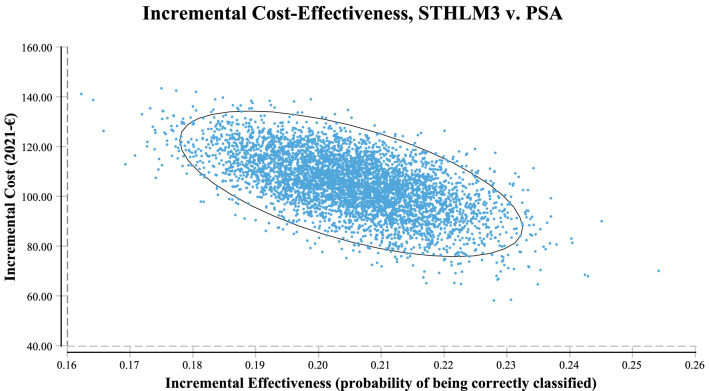
The model-based analysis revealed that STHLM3 testing was more effective than the PSA, but also more costly, with an incremental cost-effectiveness ratio of €511.7 (95% credible interval, 359.9-674.3) for each additional correctly classified individual. In the deterministic sensitivity analysis, variations in the cost of STHLM3 had the greatest influence on the incremental cost-effectiveness ratio. In the probabilistic sensitivity analysis, all iterations were positioned in the north-east quadrant of the incremental cost-effectiveness scatterplot. At a willingness to pay of €700 for an additional correctly classified individual, STHLM3 had a 100% probability of being cost effective.
Compared to the PSA test as the initial testing modality in the prostate cancer diagnostic workup, STHLM3 testing showed improved incremental effectiveness, however, at additional costs. The results were sensitive to the cost of the STHLM3 test; therefore, a lower cost of the STHLM3 test would improve its cost effectiveness compared with PSA tests.
本研究评估了与前列腺特异性抗原(PSA)检测相比,在前列腺癌诊断途径中使用斯德哥尔摩 3 号(STHLM3)检测的成本效益。
我们为 PSA(当前标准)和 STHLM3(新替代方案)创建了决策树模型。在一个假设的 50-69 岁男性个体队列中评估了成本效益。该研究采用了丹麦医院的视角,时间框架仅限于前列腺癌诊断途径,从初始 PSA/STHLM3 检测开始,到活检和组织病理学诊断结束。从决策分析模型中估计的值用于计算增量成本效益比。进行了确定性和概率敏感性分析,以测试基本分析的稳健性。
基于模型的分析表明,与 PSA 相比,STHLM3 检测更有效,但也更昂贵,每增加一个正确分类的个体,增量成本效益比为 511.7 欧元(95%可信区间为 359.9-674.3)。在确定性敏感性分析中,STHLM3 成本的变化对增量成本效益比的影响最大。在概率敏感性分析中,所有迭代都位于增量成本效益散点图的东北象限。在愿意为每增加一个正确分类的个体支付 700 欧元的情况下,STHLM3 具有 100%的成本效益概率。
与 PSA 检测作为前列腺癌诊断工作的初始检测方法相比,STHLM3 检测显示出了更好的增量有效性,但成本也有所增加。结果对 STHLM3 检测的成本敏感;因此,STHLM3 检测的成本降低将提高其与 PSA 检测相比的成本效益。