Vandghanooni Somayeh, Farajzadeh Vahid Zahra, Nakhlband Ailar, Bahadori Mir Babak, Eskandani Morteza
Hematology and Oncology Research Center, Tabriz University of Medical Sciences, Tabriz, Iran.
Faculty of Natural Sciences, Department of Biology, University of Tabriz, Tabriz, Iran.
Adv Pharm Bull. 2022 May;12(3):593-602. doi: 10.34172/apb.2022.062. Epub 2021 Jul 4.
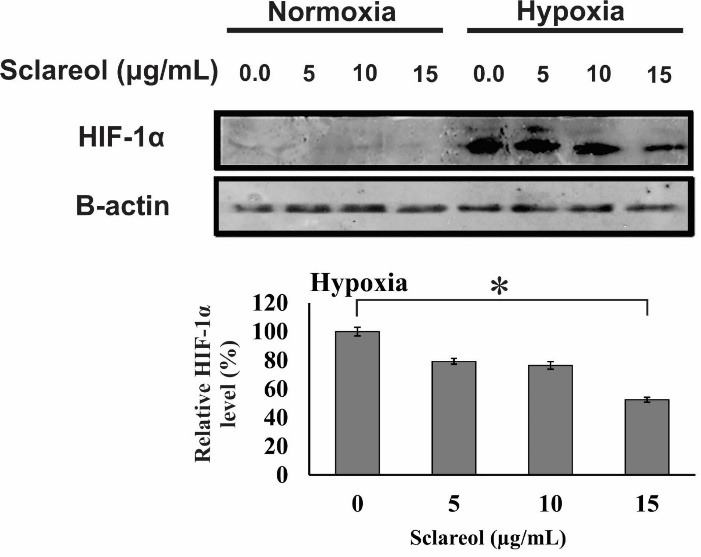
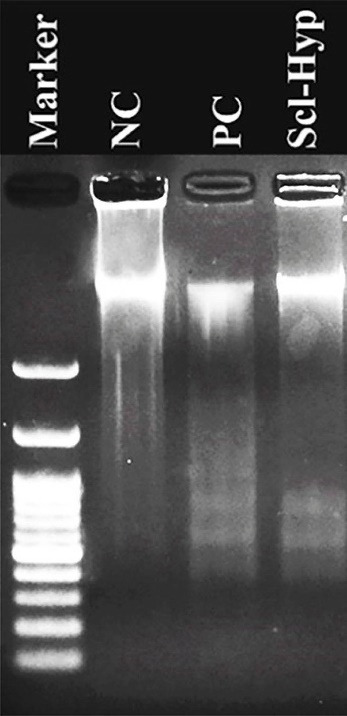
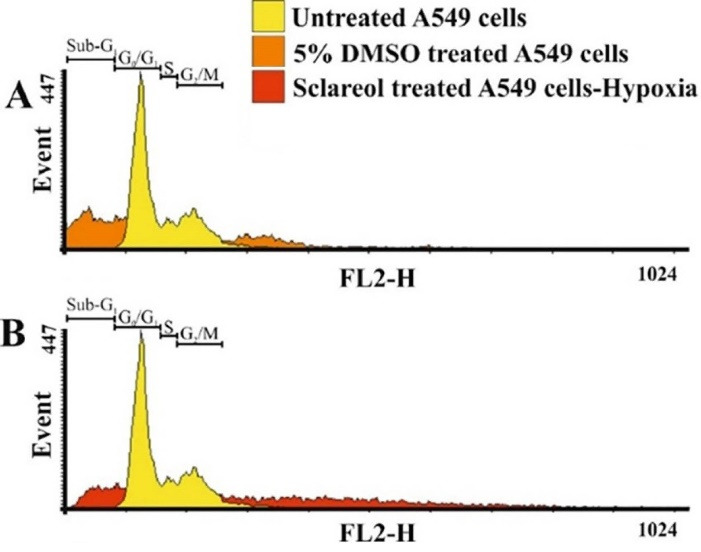
The hypoxia in solid tumors is associated with the resistance to chemo/radiotherapy. Hypoxia-inducible factor-1 (HIF-1) plays a key role in cell remodeling to hypoxia. Therefore, the inhibition of HIF-1 accumulation is considered a hopeful strategy for the treatment of cancer. Here, we aimed to evaluate the geno- and cytotoxicity properties of sclareol, a natural bicyclic diterpene alcohol, on A549 cells in CoCl-induced hypoxia. The cytotoxicity and apoptosis-inducing properties of sclareol on the A549 cell were evaluated using MTT assay and Annexin V/PI staining, respectively in hypoxia. DAPI staining, DNA ladder, and comet assay were used to evaluate the genotoxicity. Further, the qPCR technique was employed to assess the expression of and downstream target genes ( and ). Finally, the level of HIF-1α protein was evaluated through Western blotting in sclareol-treated cells in hypoxia. The inhibitory concentration (IC) of sclareol against A549 cells was 8 μg/mL at 48 hours in hypoxia. The genotoxicity of sclareol was confirmed in the cells treated with sclareol in hypoxia. Sclareol induced ~46% apoptosis and also necrosis in the hypoxic condition. The qPCR analyses showed an enhanced suppression of HIF-1α, HIF-1β, and due to the sclareol treatment in the hypoxia. Moreover, protein quantification analysis showed dose-dependently degradation of HIF-1α in hypoxia upon treatment with sclareol. The results obtained here indicate that sclareol possesses dose-dependent cytotoxicity effects against A549 cells in hypoxia through inhibition of HIF-1α protein accumulation, increasing cell sensitivity to intracellular oxygen levels, and disruption of cell adaptation to hypoxia.
实体瘤中的缺氧与化疗/放疗耐药相关。缺氧诱导因子-1(HIF-1)在细胞对缺氧的重塑过程中起关键作用。因此,抑制HIF-1的积累被认为是一种有前景的癌症治疗策略。在此,我们旨在评估天然双环二萜醇香紫苏醇在氯化钴诱导的缺氧条件下对A549细胞的基因毒性和细胞毒性特性。分别使用MTT法和膜联蛋白V/碘化丙啶染色在缺氧条件下评估香紫苏醇对A549细胞的细胞毒性和诱导凋亡特性。使用DAPI染色、DNA梯状条带分析和彗星试验评估基因毒性。此外,采用qPCR技术评估HIF-1α、HIF-1β及下游靶基因(BNIP3和NIX)的表达。最后,通过蛋白质免疫印迹法评估缺氧条件下经香紫苏醇处理的细胞中HIF-1α蛋白的水平。在缺氧条件下,香紫苏醇作用48小时对A549细胞的半数抑制浓度(IC)为8μg/mL。在缺氧条件下经香紫苏醇处理的细胞中证实了香紫苏醇的基因毒性。香紫苏醇在缺氧条件下诱导约46%的细胞凋亡以及坏死。qPCR分析表明,由于缺氧条件下香紫苏醇的处理,HIF-1α、HIF-1β、BNIP3和NIX的抑制作用增强。此外,蛋白质定量分析表明,在缺氧条件下用香紫苏醇处理后,HIF-1α呈剂量依赖性降解。此处获得的结果表明,香紫苏醇在缺氧条件下通过抑制HIF-1α蛋白积累、增加细胞对细胞内氧水平的敏感性以及破坏细胞对缺氧的适应性,对A549细胞具有剂量依赖性细胞毒性作用。