Shanghai University of Traditional Chinese Medicine, 1200 Cailun Road, Pudong New Area, Shanghai 201203, China.
The Seventh People's Hospital Affiliated to Shanghai University of Traditional Chinese Medicine, 358 Daotong Road, Pudong New Area, Shanghai 200137, China.
Contrast Media Mol Imaging. 2022 Jul 13;2022:6866000. doi: 10.1155/2022/6866000. eCollection 2022.
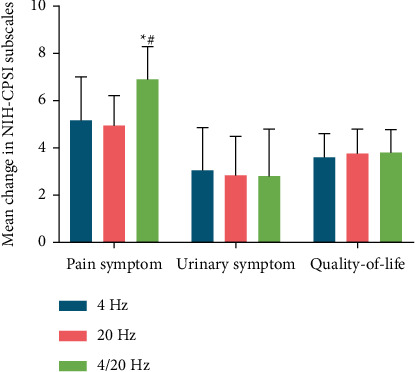
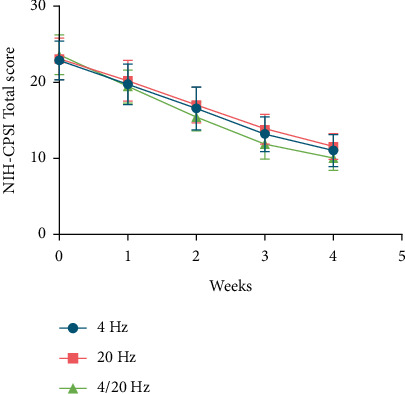
Chronic prostatitis/chronic pelvic pain syndrome (CP/CPPS) is a common disorder in adult men. Evidence has demonstrated that acupuncture is effective for treating CP/CPPS. Electroacupuncture (EA) is a combination of traditional acupuncture and electrical stimulation, and the waveform is one of the key factors influencing EA effects. Different waveforms contain different stimulating parameters, thus generating different effects. However, the effects of different waveforms of EA on CP/CPPS remain unclear and there is no recommended standard for the application of EA waveforms. At the same time, the waveform prescription of CP/CPPS is also different, so exploring the influence of different waveforms on CP/CPPS patients will also provide a certain treatment basis for clinical treatment. A total of 108 eligible patients were recruited from the Seventh People's Hospital affiliated to the Shanghai University of Traditional Chinese Medicine from March 18, 2021, to January 31, 2022, according to inclusion and exclusion criteria. All subjects were randomly divided into three groups (continuous wave 4 Hz, continuous wave 20 Hz, and extended wave 4/20 Hz) in a ratio of 1 : 1 : 1. Patients in all three groups were treated for the same duration of 20 minutes, with intervention twice a week for 4 weeks. The changes in chronic prostatitis index (NIH-CPSI), erectile function index 5 (IIEF-5), Hospital Anxiety and Depression Scale (HADS), and NIH-CPSI response rate in three groups were compared after the intervention, and the occurrence of adverse events in patients during treatment was observed. After 4 weeks of treatment, the CP/CPPS response rates were 66.7%, 62.5%, and 88.2% in the 4 Hz, 20 Hz, and 4/20 Hz groups, respectively. The reaction rate of CP / CPPS in 4 / 20 Hz group was higher than that in 4 Hz group and 20 Hz group. ( < 0.05). During treatment, the difference between NIH-CPSI scores between 4 Hz and 4/20 Hz was insignificant ( > 0.05). NIH-CPSI scores were lower in the 4/20 Hz group than in the 4 Hz and 20 Hz groups ( < 0.05). After treatment, there was no significant difference in the pain and discomfort subscales ( > 0.05) between the 4 Hz and 20 Hz groups and there were significantly lower pain and discomfort scores in the 4/20 Hz group ( < 0.05) compared to the 4 Hz and 20 Hz groups. There was no significant difference in the reduction of urination symptoms and quality of life among the three groups ( > 0.05). Compared with before treatment, IIEF-5 scores of the three groups were improved ( < 0.05). After treatment, there was no significant difference between the IIEF-5 scores in 4 Hz and 20 Hz ( > 0.05), while the IIEF-5 score in 4/20 Hz was significantly higher than that in 4 Hz and 20 Hz, and the change was significant ( < 0.05). The HADS scores decreased in all the three groups ( < 0.05), but there was no significant difference in HADS scores between the three groups ( > 0.05). Adverse events were mild and transient, and no serious adverse events occurred in each group. Both the expansive and continuous waveforms of EA can effectively alleviate symptoms such as prostatitis, erectile dysfunction, anxiety, and depression in patients with CP/CPPS. Expansion waves are superior to continuous waves in improving erectile function and pain symptoms in chronic prostatitis and can be used as a preferred waveform for the treatment of CP/CPPS. This trial is registered with Chinese Clinical Trial Registry, ChiCTR2100044418.
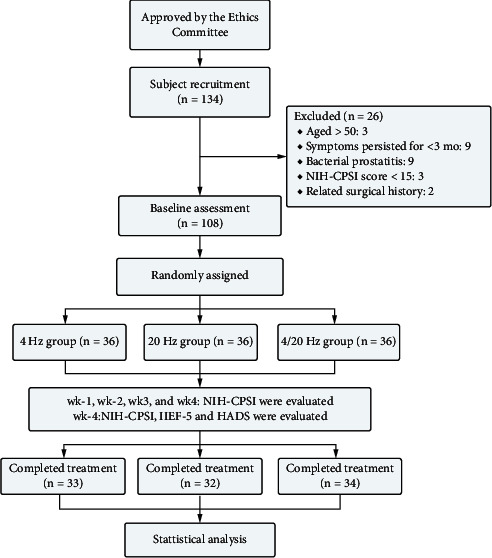
慢性前列腺炎/慢性盆腔疼痛综合征(CP/CPPS)是成年男性的一种常见疾病。有证据表明,针刺对于 CP/CPPS 是有效的。电针(EA)是传统针灸和电刺激的结合,波形是影响 EA 效果的关键因素之一。不同的波形包含不同的刺激参数,从而产生不同的效果。然而,不同波形的 EA 对 CP/CPPS 的影响尚不清楚,也没有推荐的 EA 波形应用标准。同时,CP/CPPS 的波形处方也不同,因此探索不同波形对 CP/CPPS 患者的影响也将为临床治疗提供一定的治疗依据。2021 年 3 月 18 日至 2022 年 1 月 31 日,根据纳入和排除标准,从上海中医药大学第七人民医院招募了 108 名符合条件的患者。所有受试者按 1:1:1 的比例随机分为三组(连续波 4 Hz、连续波 20 Hz 和扩展波 4/20 Hz)。所有三组患者均接受相同的 20 分钟干预,每周两次,共 4 周。比较三组患者慢性前列腺炎指数(NIH-CPSI)、勃起功能指数 5(IIEF-5)、医院焦虑抑郁量表(HADS)和 NIH-CPSI 反应率的变化,并观察患者在治疗过程中的不良反应发生情况。经过 4 周的治疗,4 Hz、20 Hz 和 4/20 Hz 组 CP/CPPS 的反应率分别为 66.7%、62.5%和 88.2%。4/20 Hz 组 CP / CPPS 的反应率高于 4 Hz 组和 20 Hz 组( < 0.05)。治疗过程中,4 Hz 和 4/20 Hz 组 NIH-CPSI 评分差异无统计学意义( > 0.05)。4/20 Hz 组 NIH-CPSI 评分低于 4 Hz 和 20 Hz 组( < 0.05)。治疗后,4 Hz 和 20 Hz 组疼痛和不适亚量表差异无统计学意义( > 0.05),4/20 Hz 组疼痛和不适评分明显低于 4 Hz 和 20 Hz 组( < 0.05)。三组排尿症状和生活质量的改善无显著差异( > 0.05)。与治疗前相比,三组 IIEF-5 评分均有所改善( < 0.05)。治疗后,4 Hz 和 20 Hz 组 IIEF-5 评分无显著差异( > 0.05),而 4/20 Hz 组 IIEF-5 评分明显高于 4 Hz 和 20 Hz 组,差异有统计学意义( < 0.05)。三组 HADS 评分均降低( < 0.05),但三组 HADS 评分无显著差异( > 0.05)。不良反应均为轻度且短暂,三组均未发生严重不良事件。EA 的扩展和连续波形均可有效缓解 CP/CPPS 患者前列腺炎、勃起功能障碍、焦虑和抑郁等症状。扩展波在改善慢性前列腺炎患者的勃起功能和疼痛症状方面优于连续波,可作为 CP/CPPS 治疗的首选波形。本试验在中国临床试验注册中心注册,注册号为 ChiCTR2100044418。